



Carve-outs in Workers' Compensation: An Analysis of Experience in the California Construction Industry
Chapter 1: Introduction
Carve-out Program
Carve-out Program Review
Commission’s Role in Evaluating Carve-outs
Carve-out Programs in California
Early Estimates of the Impact of Carve-outs
Areas of Concern about Collective Bargaining
Study Methods
Chapter 2: Background
Section I: Workers' Compensation
Defined
Parties
Injuries and Illnesses Within Workers’ Compensation
Benefits
The Process for a Worker
Medical Treatment
Medical-Legal Evaluations
Dispute Resolution
Section II: The Construction Industry
Introduction
Construction Unionism
Benefit Programs for Construction Workers
California Construction and Workers’ Compensation
Labor Negotiations and Agreements Concerning Workers’ Compensation
Section 3: Alternative Dispute Resolution
Traditional Litigation
The Rise of Alternative Dispute Resolution
Arbitration
Mediation
Ombudsperson
Problems in Alternative Dispute Resolution
Section IV: Safety Programs
Chapter 3: Overview of Carve-outs in California
Introduction
Summaries of Key Elements
Trustee or Safety Committee Selection
Administrator, Ombudspersons, Arbitrators
Plan Funding
Medical Care and Vocational Rehabilitation
Alternative Dispute Resolution
Information to Injured Workers on Their Rights
Resolution of Liens: Medical and Employment Development Department
Safety and Health Programs
Review of Collective Bargaining Agreements
Discussion of Agreements
Chapter 4: Introduction to the Case Studies
Site Selection
Large Project Carve-outs
Multiple-employer Associations
Methods
Employee Interviews
Chapter 5: Eastside Reservoir Project Carve-out
General Background
History of the Eastside Reservoir Project Carve-out
Structure of the Eastside Reservoir Project Carve-out
Project Contractor
Unions
Insurance Broker/Carrier/Administrator
Construction Contractors
Construction Contractor Employees
Joint Labor-management Workers’ Compensation Committee
Safety Committee
Authorized Providers
Ombudsperson
Mediator
Arbitrator
Conduct and Performance of Agents Involved in the Carve-out
Goals
Attorney representation
Ombudsperson
Issues Concerning the Alternative Dispute Resolution Process
Examples of Grievances, Attorney Involvement, and Case Resolution among Interviewed
Workers
History of the NECA-IBEW Carve-out
Employer Association
Employers
Union
NECA-IBEW Workers' Compensation Trust Fund
Board of Trustees of the NECA-IBEW Workers' Compensation Fund
Administrator of the Trust Fund
Labor-management Safety and Health Committee
Preferred List of Medical Service Providers
Vocational Rehabilitation Providers
Workers’ Compensation Insurance Carrier
Alternative Dispute Resolution Process
Ombudsperson
Mediation
Arbitrator
Perspectives of the NECA-IBEW Carve-out
Employer Perspective
Worker Perspective
Ombudsperson Perspective
Chapter 7: Interviews with Ombudspersons
Section I: Descriptive Understanding of Carve-out Alternative Dispute Resolution
Backgrounds of the Carve-out Ombudspersons
Structure of the Employment Relationship
General Functioning of Ombudspersons’ Offices
Nature of Matters Handled by the Ombudspersons
Mediation and Arbitration
Carve-outs and Attorneys
Ombudsperson Perceptions of Larger Issues
Section II: Analysis of the Survey and Interview Data
Overview
Backgrounds of the Carve-out Ombudspersons
Structure of the Employment Relationship
General Functioning of Ombudspersons' Offices
Nature of Matters Handled by the Ombudspersons
Mediation and Arbitration
Carve-outs and Attorneys
Political or Policy Level
Practice Level
Legislative ambiguities
Ombudspersons’ Frustrations and Suggestions for Improvement
Chapter 8: Quantitative Analysis of NECA-IBEW Carve-out
Introduction
Section I: Expectations and Problems with Early Reports on Carve-outs
Incurred
Section II: Hypotheses
Selection of Carve-out Employers
Safety
Premiums
Reported Injury Rates
Medical and Indemnity Costs
Return to Work
Dispute Resolution Costs
Medical-Legal Evaluation Costs
Legal Costs
Dispute Resolution Frequency
Section III: Data
WCIRB
Cost Data
Accident Frequency Data
Bureau Numbers
Adjusting for Change in Occupational Mix
Adjusting for Claims Mix in Individual Case Records
WCAB Data
Litigation Frequency
Section IV: Results
Selection of Carve-out Employers
Safety
Premiums
Reported Injury Rates
Incurred Costs
Paid Data
Return to Work
Dispute resolution costs
Dispute Resolution Frequency
Section V: Discussion
Future Directions for Analyses
Chapter 9: Conclusions
Summary
Structure of Carve-outs
Overview of Preliminary Results
Safety
Medical Treatment and Evaluation
Indemnity Benefits
Identifying High-quality Caregivers
Alternative Dispute Resolution
The Role of Ombudspersons
The Role of Lawyers
The Role of Arbitrators
Dispute Rates
Wrongful Termination, Serious and Willful, and Third-Party Claims
The Role of Unions
General Discussion
Carve-outs cannot fully carve out a new system for injured workers.
Limitations of this Study
Carve-outs are new.
Case studies are few and without controls.
The quantitative study is imperfect.
The Bottom Line
Identify High-quality Caregivers
Develop a Comprehensive Regulation
Create Ombudsperson Standards
Remove Appearance of Ombudsperson Partiality
Improve Confidentiality
Wrongful Terminations, Serious and Willful, Multiple-employer Disputes
Statute of Limitations
Attorney Fees
Liens
Technical Legal Issues
Does the carve-out worker have available the same statutory penalties against an employer
or insurer as an injured worker whose claim is adjudicated under the statutory system?
Are there issues with the timing and availability of medical depositions for mediation and
arbitration?
To what extent do the rules of evidence apply within carve-outs?
Should reconsideration before the WCAB be continued, or should the decision of the
alternative dispute resolution arbitrator be final?
Should there be requirements for the record kept at arbitrations?
Worker Contact and Information
Reduced Reporting Requirements
The Role of Unions
The Role of Lawyers
Attorney Participation in Alternative Dispute Resolution
Referring Lawyers
Employee vs. Employer Representation
Implications of this Study
Experimentation and Learning are Crucial
Evaluating Carve-out Innovations in the Statutory System: the Role of Information and
Assistance Officers
Follow-up on Injured Employee Earnings
Comparing Carve-out and Statutory System Benefit Accuracy
Scenarios
Examining Choice of Medical Providers
Examining the Proportion of Injuries Reported as Occupational
Extending the Findings Using More Claims and More Mature Data
Analyzing a Large Project with Single Owner and Multiple Unions
Employee Reactions
Caution on Generalizing
Appendix 1: Carve-Out Project Advisory Committee 206
Appendix 2: BILL NUMBER: SB 983
Appendix 3: CALIFORNIA CONSTITUTION--ARTICLE 14 LABOR
RELATIONS
Appendix 4: Labor Code 3201 & 3201.5
Appendix 5: Model Standards of Conduct For Mediators
Appendix 6: The Ombudsman Code of Ethics
Appendix 7: Preliminary Evaluation of Party
Negotiating Strength and Carve-out Agreement Balance
Coding Bargaining Strength
Coding Agreement Balance
Appendix 8: OMBUDSMAN SURVEY
Table of FiguresTable 1: Pioneer Valley Impact
Figure 1: Case Flow in Workers' Compensation
Figure 2: Distribution of Claims Types and Costs
Chart 1: Comparison of applicant and defense ratings
on same claim
Figure 3: Dispute Process
Figure 4: Timing of Disputed Issues
Table 2: Reported Claims Reaching Dispute Resolution
Stage Within Five Years of Injury*
Chart 2: Percent Unionization in U.S. Construction
Industry
Chart 3: Real Wages and Total Compensation for
American Workers
Chart 4: Construction Industry: Wage premium and
Unionization
Chart 5: Construction Industry: Union Wage Premium
Chart 6: California Construction Permits
Table 3: Manual Rates—Selected Trades
Chart 7: California Construction Employment and
Percent Unionization
Table 4: Construction Industry Collective Bargaining
and Project Labor Agreements
Table 5: Average Dispute Resolution Times--Statutory
System
Table 6: Collective Bargaining Agreement Addenda
Table 7: Several Contractor Associations and Southern
California District Council of Laborers
Table 8: TIMEC and International Union of Petroleum
and Industrial Workers (IUPIW)
Table 9: District 9, National Electrical Contractors
Association (NECA) and International Brotherhood of Electrical Workers (IBEW), 9th
District
Table 10: Cherne Construction and Several Locals of
the Pipe Trades
Table 11: Signatories to Collective Bargaining
Agreement and U.A. Local 250 and Southern California Pipe Trades #16
Table 12: Signatory Employers and the Southern
California Carpenters
Table 13: Metropolitan Water District and Contra
Costa Water District and All Craft Unions
Table 14: Level of Employer Participation among
Carve-outs
Figure 5: Structure of the NECA-IBEW Carve-out
Table 15: Data* Reported by Division of Workers’
Compensation
Table 16: Claim Development—Private Self Insured
Employers
Table 17: Weighted Average Experience Modification,
Policy Years 1993 to 1995
Table 18: Premium as Percentage of Exposure
Table 19: Number of Claims per $1 Million Exposure
(all reported claims)
Table 20: Number of Disability Claims per $1 Million
Exposure
Table 21: Number of Permanent Disability Claims per
$1 Million Exposure
Table 22: Total Benefit Dollars Incurred per $1
Million Exposure
Table 23: Indemnity Incurred per $1 Million Exposure
Table 24: Medical Incurred per $1 Million Exposure
Table 25: Percentage of Disability Claims Closed
Table 26: Medical Paid on Individually Reported
Claims
Table 27: Average Indemnity Paid per Claim
(disability claims)
Table 28: Average Permanent Partial Disability (PPD)
Paid per PPD Claim
Table 29: Average Weeks of Temporary Total Disability
per Indemnity Claim
Table 30: Average Total Legal Costs per Disability
Claim
Table 31: Average Defense Legal Costs Paid per
Disability Claim
Table 32: Average Applicant Legal Costs Paid per
Disability Claim
Table 33: Percentage of Disability Claims Represented
by an Attorney
Table 34: Total Medical-Legal Costs Paid (applicant,
defense, and independent)
Table 35: Mediations/Mandatory Settlement Conferences
Table 36: Arbitrations/Hearings
Table 37: Overview of Quantitative Results
Figure 6: Evaluating Carve-outs involving Owner
Controlled Insurance Plans
Chart 8: Comparing Balance of Agreements to Strength
of Parties
Table 38: Coding Bargaining Strength
Table 39: Coding Agreement Balance
Carve-out Program
California’s workers’ compensation reform legislation of 1993 for the first time permitted authorized parties to collectively bargain for alternative workers’ compensation procedures. This provision is known informally as the carve-out, because specified employees and employers are carved out from the state workers’ compensation system.
The carve-out program was modeled on a similar experiment in Massachusetts, where Bechtel and the Pioneer Valley Building and Construction Trades Council had a collective bargaining agreement governing a single construction project. The Bechtel experience was important for its apparent success at reducing reported workers’ compensation costs, largely by lowering injury rates (see Table 1).
Table 1: Pioneer Valley Impact
|
No. of Claims Lost-time Claims Litigated Cases Costs Hours Worked Lost-time Incidence Rate*
Costs Per Hour |
8 Months Before 38 11 7 $480,000 217,117
10.12
$2.21 |
8 Months After 22 2 0 $220,000 223,744
1.78
$0.98 |
*The lost-time incidence rate is the number of lost-time injuries per 200,000 hours worked.
Source: Bechtel Construction Co., 1997
California Labor Code Section 3201.5, established by the 1993 Senate Bill 983 authored by Leroy Greene (see Appendix 2), allows unions and employers in the construction industry to agree on, through collective bargaining:
• An exclusive list of medical providers and medical-legal evaluators.
• An exclusive list of vocational rehabilitation providers.
• An alternative dispute resolution process in place of most Division of Workers’ Compensation (DWC) and Workers’ Compensation Appeals Board (WCAB) procedures.
The statute gives the parties considerable leeway to establish the kind of program they want, as long as the agreement does not diminish compensation to injured workers and the final step of the alternative dispute resolution process includes the option of an appeal for reconsideration by the WCAB, and ultimately to the State Courts of Appeal.
At first limited to the construction industry, in 1994 Senate Bill 853 (Greene) (see Appendix 2) expanded the range of eligible employers to include businesses in: rock, sand, gravel, cement and asphalt operations; heavy duty mechanics; surveying; and construction inspection. Subsequent legislative sessions have seen efforts to expand carve-outs even further. These successive efforts have failed, largely due to concerns over protection of workers’ rights and benefits.
Under the original provisions of the construction carve-out statutes, the DWC administrative director reviewed proposed agreements and issued comments, yet the division lacked authority to disallow plans.
The 1994 revision gave the DWC administrative director authority to affirm that parties to a proposed agreement were eligible to participate, and that the union was a legitimate union representing the workers of employers under the agreement. The parties must also submit a copy of the agreement, although they do not need the DWC administrative director’s approval of the agreement itself.
Pursuant to Labor Code Section 3201.5(i), the DWC was required to report to the Legislature by June 30, 1996 and annually thereafter the number of employers and employees covered by carve-out agreements, as well as other data on claims, costs, vocational rehabilitation, and dispute frequency. However, these requirements were very limited in scope and offered a limited view of the impact of carve-outs.
Commission’s Role in Evaluating Carve-outs
The Commission on Health and Safety and Workers’ Compensation (CHSWC) was established by the same reform legislation that created carve-outs. CHSWC is charged with addressing the workplace health and safety and workers’ compensation systems in California, and recommending administrative or legislative modifications to improve their operation.
During its November 1996 meeting, CHSWC voted unanimously to approve a study of carve-out programs in California. The commission contracted with a multi-disciplinary research team at UC Berkeley’s Survey Research Center and Haas School of Business, and with the Stanford Center on Conflict and Negotiation to perform the research. CHSWC requested that the effort:
- Describe the carve-out programs that have been established.
- Determine the acceptability of these programs by unions, employers, program administrators, injured workers, and service providers.
- Describe the socially useful and less useful incentives of carve-outs for each group (e.g. worker, union, management, ombudsperson, lawyers, doctors, insurers).
- Identify the potential costs and benefits of carve-outs regarding the quality of safety programs, medical care and return-to-work services.
- Perform detailed case studies of two carve-outs.
- Identify the methods of alternative dispute resolution in California, and assess their efficiency, effectiveness and compliance with legal requirements.
- Develop a methodology for making valid estimates of the impact of carve-outs on injury rates, costs and outcomes.
- Implement the methodology for a preliminary quantitative study.
Carve-out Programs in California
In its July 1996 report on the activities of calendar year 1995, the Division of Workers’ Compensation reported that seven carve-out agreements were reached:
1) Agreement between the California Building and Construction Trades Council, AFL-CIO, and the Metropolitan Water District of Southern California. This is the Eastside Reservoir Project labor agreement covering all contractors and sub-contractors on a $2 billion, five-year construction project to build the Domenigoni Reservoir.
2) Agreement between the District Council of the International Brotherhood of Electrical Workers and its 23 local unions and the National Electrical Contractors Association, a multi-employer group of about 500 contractors. Individual employers can choose to sign up or remain in the statutory system.
3) Agreement between the Southern California District Council of Carpenters and its 19 affiliated locals and six different multi-employer groups of about 1000 contractors. Each contractor decides whether or not to join the carve-out.
4) Agreement between the Southern California Pipe Trades District Council No. 16 and a multi-employer group, the Plumbing and Piping Industry Council, Inc.
5) Two agreements between the Cherne Contracting Corporation and Steamfitters Local 250, covering two projects at different oil refineries.
6) Agreement between TIMEC Co., Inc. and TIMEC Southern California, Inc., and the International Union of Petroleum and Industrial Workers.
7) Agreement between the Contra Costa Building and Construction Trades Council, AFL-CIO, and the Contra Costa Water District. This is a series of three project labor agreements covering all contractors and sub-contractors on the Los Vaqueros Project, a $200,000,000 dam project of two and a half years.
In 1997 carve-out employers reported 10,372,459 person hours and $242,577,215—which is approximately 5,180 person-years of employment and one percent of construction employment statewide.
Each carve-out established lists of medical, medical-legal and vocational rehabilitation providers who could provide services for injuries and illnesses occurring under the carve-out.
Except for TIMEC Co., each agreement also established an alternative dispute resolution process. Generally the process starts with an ombudsperson, a neutral person available to all parties who attempts to avert or resolve disputes at an early stage. If unsuccessful, the worker may then move the matter to the next step, which typically is formal mediation by an independent, neutral mediator. Two alternative dispute resolution programs used a joint labor-management committee at this point. If mediation is unsuccessful, the parties turn to an outside neutral arbitrator—often a retired workers’ compensation administrative law judge. By statute, the decision of the arbitrator may be appealed to the seven-member Workers’ Compensation Appeals Board [Labor Code Section 3201.5(a)(1)]. Ultimately, a decision of the WCAB can be appealed to the civil courts at the court of appeals level.
Early Estimates of the Impact of Carve-outs
While the Division of Workers’ Compensation reports stated that it was too early to evaluate the impact of carve-out programs on the cost of workers’ compensation, preliminary results looked promising.
DWC reported that claims numbering 519 in 1995, 837 in 1996, and 661 in 1997 were filed by employees covered by carve-out agreements. Of these 2017 claims as reported within the calendar year in which the injury occurred, only eight mediations and two arbitrations were recorded. The DWC report suggested that this reflected a virtual elimination of disputes under the alternative dispute resolution process.
In addition, the DWC reported that costs to employers in carve-outs were approximately half of those experienced by employers outside the carve-out arrangement.
Insurers stated that they were offering employers a workers’ compensation premium discount of approximately five to twenty-five percent for participating in a carve-out program. Because workers’ compensation costs are typically 3-15 percent of wages in the construction industry, such premium reductions were potentially substantial.
At the April 1996 National Conference of the Building and Construction Trades Department, AFL-CIO, a workshop was held for representatives of carve-out programs in California and Florida. The presentations were extremely favorable, although anecdotal, and focused on the following results achieved to date:
- Lower injury/claims rates . It was felt that with labor and management working together toward common results, greater awareness of safety had been achieved on carve-out construction projects. This was, however, the area in which anecdotal evidence seemed weakest and most conflicting. On the one hand, it was reported that on construction projects covered by these programs the number of claims filed had declined. On the other hand, none of the presentations could provide specific descriptions of the safety provisions that had been put in place. It was not clear whether reduced claims frequencies could have arisen from favorable selection of employers for these programs, or from injured workers being accommodated in such a way that they did not file claims.
- More effective medical delivery . It was widely reported that the quality of medical care delivered was better under the collectively bargained programs, although there is no health service research data to back up this claim. Anecdotally, two sources of improvement were noted:
Selection and monitoring of providers:
One example illustrating this point comes from California. The University of California at Los Angeles (UCLA) Spine Center agreed to become a provider to collectively bargained programs. Reputed to be a premiere treatment facility, the Spine Center had avoided the workers’ compensation field because of the legal disputes involved. Another example is the care with which at least one program selects the medical providers accepted into its program.Case management:
Several programs had case managers assigned to see injured workers through treatment and rehabilitation. It was felt that this had achieved much improved continuity of care. No specific examples were given to support this claim, and no evidence suggests that these programs have established procedures that routinely enable injured workers to return to employment at an earlier stage.- Virtually no friction in dispute resolution . There was unanimous agreement among the programs that the dispute resolution process was working very well, and better than expected. At the time, no disputes had proceeded to the arbitration stage.
- Cost savings . Based in part on the experience from Pioneer Valley (see Table 1), these programs hoped that cost savings of as much as 30 percent could be achieved through fewer claims and greater effectiveness. All of the programs currently in operation reported savings significantly above the expected 30 percent. In addition, Florida’s rate setting authority allows a 15 percent discount off the top of the manual rate in recognition of the special program features, including managed care medical networks.
- Great satisfaction expressed by employers, workers, and union leaders . Union leaders claimed they had not heard a single complaint about these programs from other union leaders or employers, and complete support for the programs from union membership.
Areas of Concern about Collective Bargaining
Growing criticism and concern about aspects of the program , centered around five areas:
- Inadequate due process . Alternative dispute resolution might weaken the legal rights to due process by denying workers access to legal representation and the ability to collect information through discovery or deposition.
- Reduced benefits . Using limited medical networks might reduce physician choice by workers and might result in reduced quality of medical care.
- Distribution of savings . Employers might not pass anticipated savings on to workers. The distribution of savings is particularly problematic on projects with defined time frames and little opportunity for multiple, consecutive collective bargaining agreements.
- Continuity of treatment and adjudication . Perhaps the most important and least considered concern regards continued coverage for long-term disabilities. Collective bargaining agreements are time-limited, while partial or total permanent disabilities and certain temporary disabilities might extend well beyond the limits of these agreements. Further, the disabled worker might cease to be a member of the bargaining unit covered by the agreement. Finally, many disabilities result from cumulative exposures over long periods of time, where many employers inside or outside a particular agreement retain partial responsibility for these cases.
- Unnecessary risk to unions and employers.
This study used a number of methods to evaluate carve-outs. We reviewed the collective bargaining agreements for all existing carve-outs. The dimensions of these agreements are summarized in Chapter 3.
For intensive case study we chose two carve-outs that were very different models. The NECA-IBEW carve-out is a multi-employer carve-out with a single union covering electricians throughout the state (see Chapter 4). The Eastside Reservoir Project carve-out involves an owner, Metropolitan Water District, and more than 200 contractors and subcontractors and all crafts unions (see Chapter 4). For these case studies we interviewed a number of participants in the founding and continued operation of the carve-outs, including representatives of labor and management and the ombudspersons most directly involved in the carve-out. We also interviewed a small number of employees who had experienced difficult compensation claims.
We surveyed the ombudspersons on all California carve-outs. The survey covered their background, training and duties, and other issues (see Chapter 6).
Finally, we performed a quantitative analysis of the first two-plus years of experience of one of the study carve-outs. We examined a number of important outcomes, including incurred and paid indemnity and medical costs, paid legal and medical-legal costs, injury rates, and dispute frequency.
We will begin by giving background information on the reasoning behind the development of carve-outs and how the carve-out structure fits within the framework of current institutions. First, we will describe characteristics of the workers’ compensation system. Second, we will describe characteristics of the construction industry, and the unique institutions and needs that explain why carve-outs were first introduced in that arena.
We will present an overview of the current carve-out programs. This includes the participants and key structural elements of dispute resolution as well as medical and medical-legal provision. This is followed by detailed case studies of two carve-outs: Eastside Reservoir in Southern California and the NECA-IBEW agreement that covers the whole state. The early results from the NECA-IBEW carve-out will be evaluated using insurer cost and dispute data from the carve-outs and the statutory system.
In the last section we will present the conclusions of our work regarding carve-outs and recommendations for their operation and future study.
Chapter 2: BackgroundCarve-outs in California involve modifying the workers’ compensation system in the construction industry in ways that affect provider services, use alternative dispute resolution, and may improve safety programs. This chapter gives background information on the workers’ compensation system, the construction industry, workers’ compensation issues in construction, alternative dispute resolution, and safety programs.
Section I: Workers’ Compensation
Workers’ compensation systems are set up to provide compensation to employees for work-related injuries or illnesses—including medical treatment costs, temporary payment for lost wages, and permanent disability payments that compensate the injured worker for residual impairment/disability.
Workers’ compensation in California dates back to the 1911 formation of the Industrial Accident Board. In today’s workers’ compensation system, the employee exchanges the tort process of pursuing awards in civil court for a process that provides prompt delivery of benefits and legal protection against discrimination. The employer provides workers’ compensation benefits regardless of fault in exchange for protection against civil action by the employee.
In summary, this compromise:
- Requires the employer to pay benefits no matter who caused the injury as long as the injury arose out of employment.
- Assures injured workers of fixed benefits, though they might be less than benefits that could be obtained through a civil suit.
- Establishes the workers’ compensation system as the exclusive remedy for workplace injuries and illnesses.
Both parties are provided with an administrative law procedure for dispute resolution that aims to resolve disputes quickly. By constitutional mandate:
"…the administration of such legislation shall accomplish substantial justice in all cases expeditiously, inexpensively, and without encumbrance of any character…"
Faced in 1993 with workers’ compensation costs at historic highs—and the perceived success of an experiment in labor-management negotiation that reduced such costs, the Pioneer Valley Project in Massachusetts—the California Legislature enacted Senate Bill 983 (Greene). This legislation allowed collective bargaining agreements between a private employer or groups of employers engaged in construction, construction maintenance, or activities limited to rock, sand, gravel, cement and asphalt operations, heavy-duty mechanics, surveying, and construction inspection, and a union that is the recognized or certified exclusive bargaining representative. Under these agreements, called carve-outs, the parties can negotiate the following:
- An alternative dispute resolution procedure for disputes between employees and employers or their insurers that supplements or replaces all or part of the dispute resolution procedure contained in this division [Labor Code Division 4: Workers’ Compensation and Insurance], including but not limited to mediation and arbitration. Any system of arbitration shall provide that the decision of the arbitrator or board of arbitration is subject to review by the appeals board in the same manner as provided for reconsideration of a final order, decision or award made and filed by a workers’ compensation judge pursuant to the procedures set forth in Article 1 [commencing with Section 5900, Chapter 7 of Part 4, Division 4], and the court of appeal pursuant to the procedures set forth in Article 2 [commencing with Section 5950, Chapter 7 of Part 4, Division 4] governing orders, decisions or awards of the appeals board. The findings of fact, awards, order or decision of the arbitrator shall have the same force and effect as awards, order or decision of a workers’ compensation judge. Any provision for arbitration established pursuant to these sections shall not be subject to Sections 5270, 5270.5, 5271, 5272, 5273, 5275, 5277.
- The use of an agreed list of providers of medical treatment that may be the exclusive source of all medical treatment provided under this division.
- The use of an agreed, limited list of qualified medical evaluators and agreed medical evaluators that may be the exclusive source of qualified medical evaluators and agreed medical evaluators under this division.
- Joint labor-management safety committees.
- A light-duty, modified job or return-to-work program.
- A vocational rehabilitation or retraining program using an agreed list of providers of rehabilitation services that may be the exclusive source of providers of rehabilitation services under this division.
However, the parties were not allowed to collectively bargain an "agreement that diminishes the entitlement of an employee to compensation payments for total or partial disability, temporary disability, vocational rehabilitation, or medical treatment fully paid by the employer as otherwise provided in this division."
PartiesWithin carve-outs the dispute resolution process is controlled by parties to the agreement. Employers and/or unions employ and compensate the ombudspersons, mediators and arbitrators. In some cases, employers and/or union members act as ombudspersons and mediators. Consequently, unlike the state administrative law system, the decision maker in dispute process is not necessarily neutral about the outcome. In addition, that outcome may affect third parties such as the insurer, employers outside the carve-out, and the state. Collective bargaining may also leave one side with greater control over alternative dispute resolution. We will carefully define the parties and the workers’ compensation roles they play.
Workers:
Nearly all workers in California are covered by the workers’ compensation system. Exceptions are independent contractors—although the definition is very narrowly drawn for the purposes of workers’ compensation, federal employees, railroad workers, and longshore and harbor workers. Foreigners, including illegal aliens, are entitled to benefits if they are injured on the job. If the worker is unable to recover from the employer because the employer was illegally uninsured and unable to pay, the state steps in and pays compensation from the Uninsured Employers Fund.Employers:
While the terms employer and insurer are often used interchangeably when the system is discussed, these terms need more careful definition. The employer component of the workers’ compensation system has these qualities:1) The employer of the injured worker.
2) The party financially responsible for costs arising from an injury, i.e., the insurer.
3) The party administering the claim, i.e., the claims administrator.
All of these qualities can reside in a single party, the self insured/self administered employer, or exist in different combinations. The incentives of these parties are not always coincidental, nor is the communication among these parties and with the worker always similar across different arrangements. This has important consequences for how alternative arrangements affect outcomes.
Insurers:
Insurance for workers’ compensation takes several forms, each of which can have important implications for safety oversight and incentives to control some or all of the costs. In addition, the adjudication process can determine awards that fall outside the coverage supplied by the insurer, either directly on the employer or on another insurer.Private insurance:
Most employers, 99-plus percent of the private sector representing 80-85 percent of the private sector payroll, purchase insurance from private insurance companies or the State Compensation Insurance Fund. The policies usually cover all direct indemnity, medical and legal costs of a workplace injury. A deductible policy is unusual among small employers, more common among large employers. The economic incentive for safety—independent of the uninsured, indirect costs to employers such as training replacements—is maintained for employers by recording all insured costs for an employer at the Workers’ Compensation Insurance Rating Bureau (WCIRB) and adjusting insurance premiums based on an employer’s experience modification (Ex-Mod). An experience modification adjusts an employer’s premium to reflect the firm’s performance relative to other employers with workers in a similar industry or occupation.Self insurance:
Large private companies and county and local government agencies can choose to self insure. They are required to establish the financial resources to cover any expected liability. Less than one percent of private sector employers self insure, representing approximately 15-20 percent of the private sector payroll. Nearly all public agencies, other than state agencies, are self insured.Safety Groups:
In 1969 legislation was passed allowing employers to form safety groups, which are employer associations involved in a common trade or business. The association negotiates rates for members. Usually the agreement involves cost-plus contracting. Excess premiums are returned to the group and divided among employers, based on each employer’s portion of the overall premium paid and not on individual safety records. However, the incentive of experience rating is maintained, in that "each member of an organization insured under a group policy shall be treated as a single and separate entity as respects rates, classifications, and rating plans." Data on an individual employer’s experience is reported to and maintained separately by the WCIRB. In addition, the safety group is required "to…seek to reduce the incidence and severity of accidents." Employers with less than $250,000 in annual premium who join a carve-out arrangement are required to be members of a safety group.Owner Controlled Insurance Plan (OCIP):
Also referred to as wrap-up projects, owner controlled insurance plans are used for large construction projects where the owner assumes responsibility for workers’ compensation and liability insurance on the part of all general contractors, contractors and subcontractors. These policies are generally written as large deductible policies. For example, the owner might be responsible for the first $100,000 of losses on any claim and $500,000-$1,000,000 of losses overall, with the insurer liable for the remainder. In addition, claims administration costs are billed separately at either a flat rate per claim type or a percentage of claim costs. Under this arrangement, a separate policy is written on each contractor and subcontractor, and the experience of each policyholder is reported to the WCIRB. However, the owner pays the insurance premiums. Construction carve-outs negotiated as part of a project labor agreement are insured under this type of arrangement. Safety incentives are maintained for the individual contractor, as the employer’s experience under the owner controlled insurance plan is combined with any experience on work outside the owner controlled insurance plan to set the experience modification for that employer.Legally Uninsured State Agencies:
State government agencies are not required to carry insurance. They are "legally uninsured." Despite efforts by the California Department of Corrections to promote legislation allowing a carve-out to be formed that covers the California Correctional Peace Officers Association, no state agencies are eligible to participate in carve-outs.
Injuries and Illnesses Within Workers’ Compensation
Approximately eight percent of California’s workers suffer a workplace injury or illness in a year. Fortunately, most are minor injures, about two-thirds of them requiring only medical treatment and, at most, one or two days off work. Though these injuries/illnesses result in opening a claim and filing a report with the Department of Industrial Relations, most are quickly resolved with all medical care paid for by the employer or the employer’s insurer.
The remaining third of claims involve indemnity payments and are more complex to resolve. While events in a case often overlap and timing varies, the basic events follow a pattern similar to Figure 1. When a worker is injured, or in the instance of a cumulative injury becomes aware that an injury or illness is work-related, that worker is required to notify the employer. Notifying the employer in turn requires notifying the insurer or claims administrator, who as noted above can also be the employer. Notifying the insurer in turn starts the clock on numerous statutory and regulatory requirements for delivery of benefits and legal decisions.
Figure 1: Case Flow in Workers' Compensation
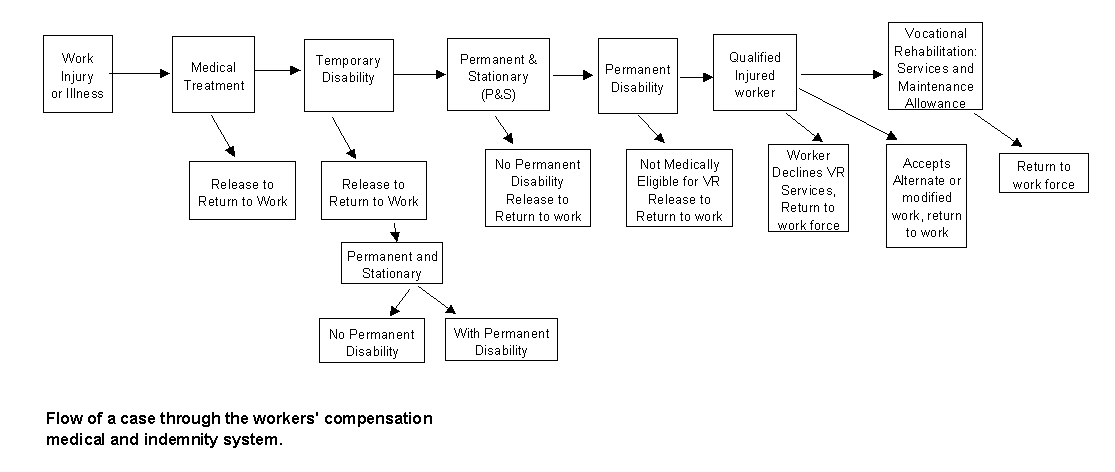
Most workers receive medical treatment and return to work with no lost time or within a few days. If the worker misses more than three days work, temporary disability payments are made. These payments continue until the injured worker is released to return to work or is declared permanent and stationary, which means that the worker has reached maximum medical improvement. This may be complete recovery, which occurs 80-85 percent of the time, or residual impairment as in 15-20 percent of the claims.
About one-third of the claims result in temporary disability with the worker missing three or more days work. For this lost work time the injured worker receives temporary total disability payments equal to approximately two-thirds of the worker’s wage at injury, up to the current maximum of $490 per week.
While most temporarily disabled workers, 50-60 percent, return to work after a short time on temporary total disability and without residual impairment, a substantial number suffer injuries that result in permanent partial disability. Such workers have suffered a permanent impairment resulting from their injury even after their condition has reached maximum improvement, and they receive payments meant to compensate them for their "lost ability to compete in the open labor market."
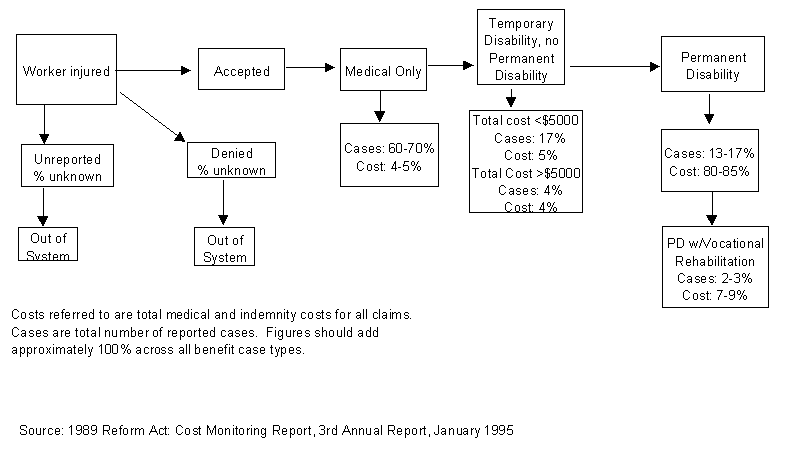
Figure 2: Distribution of Claims Types and Costs
If a worker’s permanent disability makes return to the former job impossible and the worker’s employer is unable to offer an alternate or modified job meeting certain requirements, then the worker is eligible for vocational rehabilitation benefits. These benefits include resources for temporary support, vocational rehabilitation maintenance allowance, training, and job search assistance.
Minimum indemnity benefit levels are set by statute. Nothing precludes an employer or insurer from increasing the level of benefits. However, even in unionized workplaces where wage replacement rates for more highly paid workers may be low, negotiation over the level of disability benefits as part of the compensation package is uncommon.
Medical Treatment
Medical treatment in the workers’ compensation system is paid for by the employer/insurer. Medical treatment costs are approximately 40 percent of the benefits paid out to injured workers, $2.0 billion for insured employers in 1997. Statutes establish several conditions governing medical treatment that bear directly on the motivation for carve-out arrangements:
- Coverage is "first dollar coverage," no deductibles or co-payments by the employee.
- The employer is required to pay for all treatment that is reasonably required to cure or relieve the effects of the injury, and remains liable for any medical treatment necessary for the particular work-related injury for the life of the worker.
- The employer under nearly all circumstances can determine the choice of medical provider only during the first 30 days of treatment.
- The employee has the option after the first 30 days to select any doctor, chiropractor, psychiatrist, acupuncturist, and the like. If the employee notifies the employer prior to an injury, the employee can predesignate a treating physician for all treatment, including the first 30 days.
Medical treatment costs are governed by the state Official Medical Fee Schedule, which establishes "reasonable maximum fees paid for medical services" with workers’ compensation.
Disputes between medical providers and insurers concerning medical treatment are common. The disputes involve the length, intensity or appropriateness of treatment and the charge for treatment. Medical treatment disputes between the provider and payer frequently result in medical liens being filed against a case. The liens require the intervention of the Workers’ Compensation Appeals Board (WCAB). Currently, lien resolution accounts for 25 percent of conferences and hearings scheduled by the WCAB.
Medical Treatment—Discussion
Cost containment is a major issue because co-pay or deductible requirements are forbidden by statute and medical costs run 40-45 percent of all benefit costs. Group health models that have successfully controlled health benefits paid by employers are not easily transferable to workers’ compensation. That is because the models involve contracting between payer and provider, shifting cost control responsibility and sometimes risk to the provider. However, the employer controls medical care for only the first 30 days. While a large number of claims involve no treatment after 30 days, the majority of medical costs accrue on treatment delivered after the first 30 days.
The issue of controlling the primary treating physician became even more important when the WCAB issued a decision in Minniear v. Mt. San Antonio Community College District extending the presumption in favor of the treating physician to treatment as well as evaluation. Medical treatment costs show very skewed distributions. For example, low back injuries are the most common injury category in the compensation system, between 20 and 30 percent of claims depending on the definition of low back. For 90 percent of these claims medical treatment ends in less than 30 days, which is within the period of employer medical control. However, the majority of costs are incurred on claims lasting more than 30 days. Similarly, physical therapy accounts for 30 percent of the cost of low back treatment. Seventy-five percent of low back claims have fewer than four physical therapy treatments, but ninety percent of the physical therapy dollars are spent on claims with more than four visits.
In a decade that saw virtually flat costs on the health benefit side due to managed care, employers still faced a 5-10 percent annual increase in average medical costs per workers’ compensation claim.
Under carve-out arrangements, labor and management can negotiate the length of medical control. Most often, collective bargaining agreements have set this at the life of the claim. However, the employer does not choose the doctor, as can be done in the statutory system, and only restricts the doctor to a jointly negotiated list. While this list is often extensive, applicant attorneys have voiced frustration at not being able to choose doctors they feel will treat or evaluate injured workers most favorably.
Complaints about abuse of control of the treating physician are often leveled at the employer. In fact, statutory maintenance of the 30-day limit on employer control in the face of rising costs has been justified as a way to encourage employers to maintain the proper balance between treatment and cost. The reasoning is that if the employee receives good medical treatment during the initial period, there will be little incentive to change physicians after 30 days.
For California’s carve-outs the tension between employers and unions over the restrictions of medical provider lists has been one of the most serious problems. The balance between cost control and freedom of choice is one of the main challenges to the success of their internal responsibility systems.
Many critical issues in workers’ compensation are legal questions determined by medical findings. This is referred to as the medical-legal process and is distinct from treatment Medical-legal evaluations generally begin at the time the injured worker reaches maximum medical improvement, referred to as permanent and stationary in the California system. At this time, the primary treating physician makes a report concerning several issues, the most important of which are listed below. As with decisions about treatment, the findings are presumed to be correct and are difficult for an objecting party to overcome. Issues include:
Permanent disability:
The most important and most often disputed issue concerns the level of residual impairment present when the worker is permanent and stationary. The evaluating doctor records both objective and subjective findings that measure impairment according to California’s rating schedule. The impairment measures are translated into disability ratings, from 0 to 100 percent, by raters who modify the standard rating for impairment by age and occupation. Workers receive permanent disability payments based on these findings.Apportionment:
When permanent disability results from the aggravation of an existing disabling condition or underlying disease process, then the permanent disability benefits are apportioned between the current injury and the pre-existing condition. For example, if a worker sustained a previous back injury resulting in a work restriction to no heavy lifting, a 20 percent Standard Rating, and the current injury results in a further restriction to semi-sedentary work, 60 percent Standard Rating, the worker’s employer will be liable only for the additional disability. This has important implications for both the worker, whose award may be reduced, and the employer, whose cost can be reduced.Future medical care:
The evaluating physician determines whether the worker will require medical care subsequent to settlement of the indemnity portion of the claim. Since the employer/insurer is responsible for all medical care connected with an injury, even 20 or more years into the future, this issue is often financially important and subject to dispute. Most often this issue is resolved as part of a lump sum payment covered by a compromise and release agreement at the close of a claim. A substantial number of claims are resolved through a stipulated settlement that settles all issues and reserves the worker’s right to future medical treatment paid for by the insurer.Qualification for vocational rehabilitation:
If a worker’s permanent impairment prevents return to the former occupation, then the worker is medically eligible for vocational rehabilitation benefits. The treating physician makes this determination. A finding that a worker is a qualified injured worker can increase the indemnity on a claim by 20 percent on average.Worker restrictions:
The physician also determines what work restrictions the worker and employer should follow. These are important to a worker’s early return to work and eligibility for vocational rehabilitation.Medical-legal—Discussion
The workers’ compensation system has been successful at establishing effective cost controls over medical-legal exams. One mechanism established during the same legislative reforms that created carve-outs was the granting of presumption to the findings of the primary treating physician. This high threshold has doubled from 15 percent to 30 percent the number of claims resolved based solely on the primary treating physician’s evaluation.
However, medical-legal costs are only two to three percent of insurers’ direct costs. The major impact of the medical-legal process on employer costs and employee benefits is indirect, though the effect that the opinion of the medical-legal evaluator has on indemnity payments to injured workers. The California medical-legal process and opinions on permanent disability have been criticized as overly subjective. Given the subjectivity, many argue that parties abuse the process by manipulating the choice of evaluating physician.
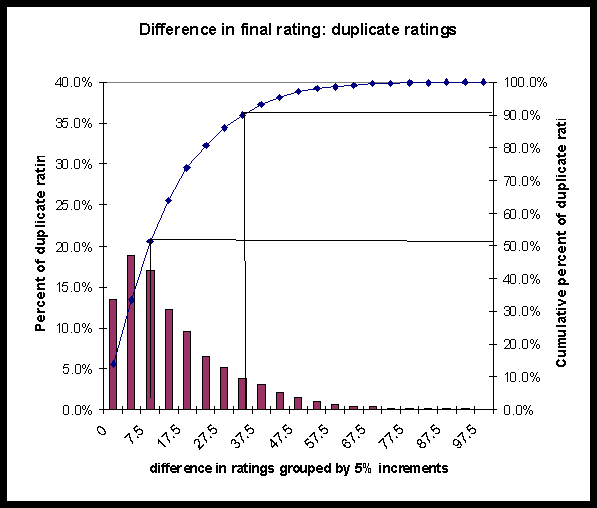
As an example, two doctors evaluating the same patient may differ in their permanent disability evaluation by a substantial amount. This is especially true if the doctors are chosen by the applicant or defense side for their liberal or conservative judgment. This is especially true if a particularly extreme evaluator is also the primary treating physician. Chart 1 compares the distribution of ratings performed by the DWC Disability Evaluation Unit on claims for which reports by more than one doctor were submitted for ratings on the same injury. On 50 percent of these claims the ratings differed by more than 7.5 rating points, a difference of between $3000 and $15,000 depending on rating and average weekly wage. On 10 percent of these claims the two ratings differed by more than 35 rating points, a difference of between $20,000 and $100,000 depending on rating and average weekly wage. Such differences are extraordinary, in light of the fact that the vast majority of ratings are below 25 percent. Examination of the most extreme conservative and liberal ratings suggests that they are highly concentrated among a subset of the evaluating physicians.
Chart 1: Comparison of applicant and defense ratings on same claim
Carve-outs offer an opportunity to management and labor to agree on establishing limited lists of medical-legal evaluators. Ideally, the lists would eliminate the most extreme doctors while including the majority of evaluators, thus maintaining choice. This requires substantial effort by management and labor to identify and agree upon an applicable list, and this is one of the areas in which carve-outs have been least successful.
The major role of the Division of Workers’ Compensation (DWC) is to resolve disputes over entitlement to medical and indemnity benefits. Figure 3 describes this process. Claimants can file applications for adjudication at any stage in the process where a dispute arises. The basic steps, which may occur more than once or not at all, are 1) application for adjudication, 2) declaration of readiness to proceed, 3) mandatory settlement conference, 4) hearing, and 5) decision by judge/referee. Most cases settle before a trial or decision. The settlement document in most cases is a compromise and release agreement in which the claimant releases the insurer of liability in the case for a payment, usually a lump-sum. Other types of resolutions are stipulated settlements—voluntary settlements of all issues not stipulated, findings and awards, and take-nothings. The last two are decisions by a judge/referee.
Following a decision by a judge/referee, parties can appeal the decision to the Workers’ Compensation Appeals Board (WCAB). This is also the level at which a dispute that is unresolved in the carve-out alternative dispute resolution process would enter the conventional compensation dispute resolution process. WCAB decisions can be, but rarely are, appealed to the State Courts of Appeals.
The terms dispute and litigation are often used in discussions of the workers’ compensation system, and their meanings can be confusing. Here we use the term dispute to generally refer to any disagreement between parties over an issue that falls within the jurisdiction of the WCAB. The term litigation refers to disputes that involve one or more formal dispute resolution process.
The majority of claims are medical only, involve no dispute and are resolved quickly. A small percentage of claims have disputes over one or more issues that result in a mandatory settlement conference or hearing. Figure 3 shows the issues and approximate timing of them.
Figure 4: Timing of Disputed Issues
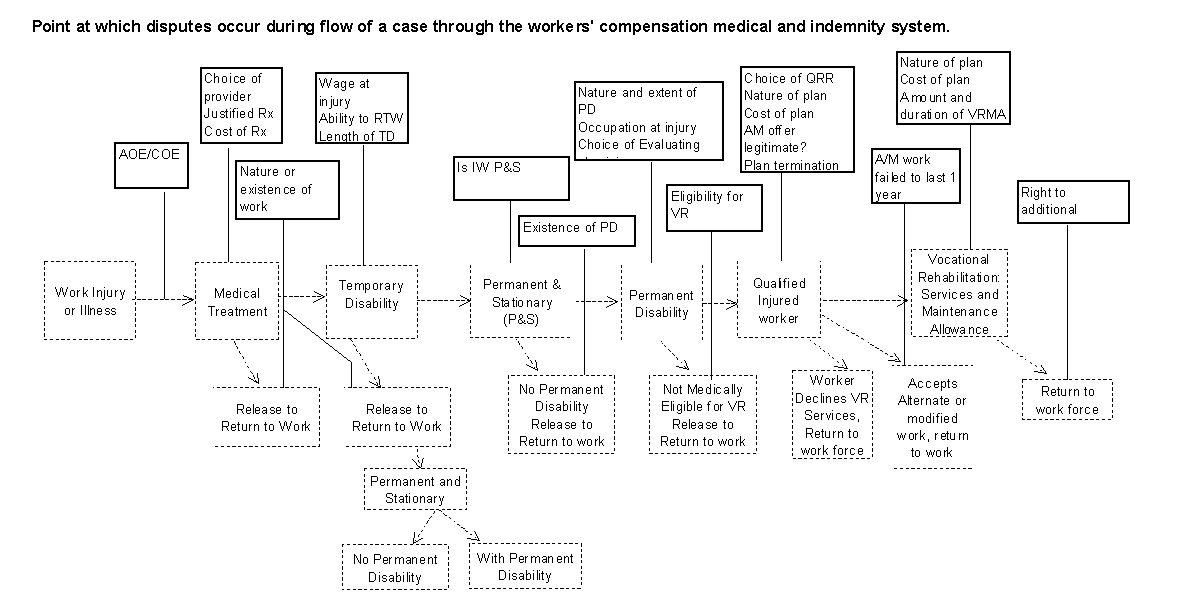
Since agreements involving permanent disability claims are required to be reviewed by a workers’ compensation judge for adequacy, nearly all claims involving permanent disability file an application for adjudication or a declaration of readiness. Most applications are filed simultaneously with a settlement document, either compromise and release or stipulated settlement. Only a small number of claims are actually adjudicated. The following table gives the approximate percentage of claims at each stage of the claims adjudication process.
Table 2: Reported Claims Reaching Dispute Resolution Stage Within Five Years of Injury*
| Stage | |
| Reported | 100% |
| Application for Adjudication/Declaration of Readiness (including opening document that is a settlement) | 15% |
| Mandatory Settlement Conference | 7% |
| Hearing | 6% |
| Decision | 1% |
*Data from WCAB On-line System, analyzed by authors, injury years 1991-1993
While two-thirds of claims are medical only, of the remaining third where the worker spends some time on disability, 40 percent involve some level of permanent disability. Of the permanent disability claimants, 80 percent are represented by attorneys.
Legal fees for attorney representation of injured workers before the Division of Workers’ Compensation, Workers’ Compensation Appeals Board, or Appellate Court are determined by the WCAB. No attorney may demand or accept a fee for such purpose until the amount of the fee has been approved or set by the WCAB. According to the Labor Code, when establishing these fees consideration is given to the responsibility assumed by the attorney, care exercised in representing the applicant, time involved and results obtained. In practice, local custom at the particular WCAB office is usually followed in applying a percentage to the benefits obtained by the worker. The law is silent on negotiation of fees for services other than representation before the division, board, or appellate courts.
The WCAB customarily determines fees as a percentage of the final settlement of benefits. The fee structure has evolved as a contingency fee dependent on the settlement of the claim and the decision of the WCAB judge concerning a reasonable percentage. The average fee is 12-18 percent of the award for permanent disability, future medical, and vocational rehabilitation maintenance amounts. In nearly all instances the attorney’s fee is paid out of the award to the worker, reducing the worker’s compensation by the size of the fee.
Though defense attorneys representing the employers/insurers are involved in fewer claims than applicant attorneys, defense attorney costs in any year are about 150 percent of the total applicant attorney costs. Data supplied by the WCIRB show that defense attorney expenses paid in 1997 were equal to 4.4 percent of premiums paid by insured employers. Applicant attorney expenses equaled 12.5 percent of all permanent disability and vocational rehabilitation maintenance allowance indemnity payments to injured workers in 1997.
The direct financial impact or liability of a workplace injury can fall on parties other than the insurer responsible for securing the liability for workers’ compensation coverage. Disputes over the liabilities are sometimes adjudicated within the administrative law system, and sometimes they involve additional legal issues that are resolved in the tort system. For example:
Third party
claims arise when an injury occurred in the course of employment but responsibility, through negligence of action, can be attributed to a party other than the worker and employer. Under these circumstances, the worker can pursue compensation through the tort system and the insurer can also seek recovery through subrogation.Serious and willful
and wrongful termination violations related to workplace injuries subject employers to substantial penalties that can not, by law, be indemnified by the insurer. Consequently, as will be discussed later, these violations pose particular problems for adjudication under a system where the employer is involved in selection or payment of the adjudicator.Cumulative injuries
subject each employer at which exposure occurred, during the 12 months prior to the injury date, to responsibility for indemnity and medical benefits. Apportionment of responsibility among these employers or their insurers for the judgment brought in the case against any one employer is the responsibility of the WCAB. Within carve-outs the responsibility falls on the arbitrator. Consequently, in a carve-out, the adjudication could be made by a party interested in shifting costs to outside parties.Each of the above issues involves specialized legal knowledge and injured workers without legal representation rarely pursue them.
Workers' Compensation Overlaps
Numerous other social insurance benefits are delivered that overlap the workers’
compensation system, making it difficult to isolate workers’ compensation from its
impact on delivery of other benefits. Even "carved-out" alternative arrangements
exist within a complex web of interrelated systems. Some important examples follow:
State Disability Insurance (SDI)
Social Security Disability Insurance/Supplemental Security Income (SSDI/SSI) are federal benefits paid to workers who are permanently totally disabled. Payment of these benefits is affected by payment of other social insurance benefits, including workers’ compensation. Consequently, the structuring of compensation settlements has important effects on eligibility for federal benefits.
Health Benefit:
Workers’ compensation pays all medical costs for work-related injuries and illnesses. Yet many people believe there is a good deal of cost shifting between workers’ compensation and private health insurance, in both directions. Occupational injuries may not be reported as occupational and treated under the regular health benefit. This has important implications for the health benefit insurer who may face some costs that should be borne by the compensation insurer.Americans With Disabilities Act (ADA)
established protections for disabled workers in the workplace, requiring that employers make reasonable accommodation for seriously disabled workers.
Dispute Resolution—Discussion
In theory, workers’ compensation benefits are provided to the injured workers quickly and easily or in the words of the California Constitution, "…shall accomplish substantial justice in all cases expeditiously, inexpensively, and without encumbrance…." Evidence in recent years indicates that many injured workers in California have not been able to get through the system quickly or easily. These workers’ problems appear to be caused in part by tremendous difficulties in learning about their rights and obligations in the workers’ compensation system and in getting sufficient help to process their claims. When faced with denials of their claims, long delays, or threats to their employment, these workers either forego their rights to medical treatment and benefits altogether or end up in protracted disputes and litigation.
Many of the workers report that they felt the system was unfair, they were kept in the dark about what was happening with their claims, shut out and pushed aside. Carve-out arrangements, particularly the ombudsperson innovation, were expected to resolve many of these problems. For example, the statutory system includes a mechanism, the DWC Information and Assistance Unit (I&A) that in theory acts like the ombudsperson in solving problems and informing workers about the process. However, I&A can be difficult to contact and has been ineffective in assisting workers who face problems. Without assistance from the state, workers felt required to seek the expertise and assistance of an attorney. Within carve-outs, ombudspersons were expected to assist the worker and theoretically increase understanding, solve problems, reduce disputes, and eliminate the need for attorneys.
Claim resolution in workers’ compensation is a long process. Half of all permanent disability claims are unresolved thirty months after injury, and ten percent remain unresolved after five years. Many system participants have blamed the dispute process for these delays, in particular the involvement of attorneys. The feeling is that attorney involvement leads to delays in resolution and escalation of disputes. Most carve-outs have instituted some form of restriction on attorney participation in the initial stages of alternative dispute resolution. It was the expectation of proponents that the dispute process would operate more inexpensively and more quickly under carve-outs.
Proponents of attorney involvement argue that the system is complex by nature and an unrepresented worker is unlikely to understand the full range of issues. This can have significant consequences for the workers’ compensation and the opportunity to return to work with the at-injury employer. The ombudsperson was expected to be available to answer questions at different points in the process, enabling workers to better understand the decisions faced at any moment, but ombudspersons were not expected to play the role of worker’s advocate.
The carve-out alternative dispute resolution process differs markedly from the state administrative law system. Control of the alternative dispute resolution process is in the hands of interested parties, while the state is essentially neutral on issues before the WCAB. As we will discuss later, the balance of power between management and labor in the collective bargaining process can influence the design of a carve-out’s alternative dispute resolution arrangement. In addition, many parties with interests in the outcome of a claim adjudicated under alternative dispute resolution are not parties to the collective bargaining process, and this could lead to shifting costs from the bargaining parties to third parties.
For example, the WCAB is a means by which SDI becomes aware of a compensation claim and is able to recover on that lien. On a monthly basis, the California Employment Development Department (EDD) matches SDI claims with claims filed at the WCAB. An EDD representative at each local WCAB office pursues recoveries of SDI liens when claims are resolved. Since SDI is worker supported and workers’ compensation is employer paid, separation of these two benefits has important implications. There is no mechanism within existing carve-outs to allow EDD to become aware of claims against an employer that involve EDD, and hence to facilitate recovery.
Liens by third parties, apportionment of permanent disability between multiple employers, third party liability against subcontractors covered under a wrap-up project, and liability for future medical treatment on the health benefit side are just a few of the issues that may be problematic under alternative dispute resolution.
Section II: The Construction Industry
The construction industry is primarily composed of small employers with less than 100 employees and who employ an itinerant work force. The majority of individual contractors cannot successfully predict their future volume of business and employment because of competitive bidding for projects. Except for a few key personnel, employment is limited from project to project.
Even within a particular project, employment fluctuates widely by craft. On a commercial or industrial building, for instance, operating engineers and teamsters are required to operate earth-moving equipment for site preparation and excavation. The next work is done by carpenters, concrete finishers, ironworkers, plumbers, pipe fitters and electricians, and a smaller number of operating engineers to hoist building materials. On a highway project, dam or other primarily earth-moving projects, the operating engineer employment is more continuous, though the types of equipment fluctuate.
A general contractor is responsible for an entire project and typically employs the five basic trades—carpenters, laborers, cement masons, operating engineers, teamsters—while subcontracting with specialty contractors for the other required skills. The specialty trades move even more frequently among projects, though they may remain for several projects in the employ of a single subcontractor. Whether for basic or specialty trades, any one project may last from a few weeks to a few years. A construction worker may have one or several employers in one construction season, and upwards of one hundred or more employers over a working career.
Since contractors cannot afford to keep workers on their payrolls between projects, a casual labor market is the result. Both the employer and the employee may be permanently attached to the industry while not attached to each other. Weather adds an additional seasonal and sporadic factor to the employment relationship, differing by geographical section of the country. A fully employed construction worker can rarely expect more than 1,500 annual hours of employment, including overtime.
The type of construction is another variable. Housing and commercial construction may be fairly continuous, though fluctuating in volume in any one locality. Highway construction is sporadic in any one locality, yet fairly continuous within a state. Heavy construction projects, such as dams and airports, and major industrial construction, such as power-generating plants, oil refineries and factories, occur rarely in any one locality. Commercial and housing contractors can concentrate geographically, while industrial and heavy and highway contractors must maintain geographical mobility. Craft mobility must be equal to that of the contractors.
The industrial relations of the construction industry are shaped by these forces. Since the employers tend to be relatively small and tenuous, the building and construction trades unions serve as the personnel arm of the industry in order to protect their members. With labor costs usually around 25 percent of total production costs and contracts awarded by competitive bidding, workers have an interest in seeing that wages are not unduly driven down in the process. The primary goal of construction unions is to take wages out of competition.
Though any one contractor might find advantage in breaking ranks and bidding on the basis of lower wages in a particular instance, they all have an interest in knowing that their competitors can not obtain skilled labor any more cheaply. Hence, there is employer support for a uniformly enforced wage rate. Wages negotiated between a craft union and an association of all the employers of that craft is an advantage to all within the industry.
Similarly, the training and recruitment functions are also shaped by the forces mentioned above. Few construction industry employers are large enough and provide sufficient continuity of employment to afford training their own employees. The costs must be imposed on the employees, the public education system, or spread over the entire industry. If a trainee is to have continuity of employment and exposure to all applications of the craft, there must be a mechanism for rotation among employers. Pursuant to regulations of the Taft-Hartley Act, jointly negotiated and administered union-management apprenticeship systems have resulted.
Also, for employers to be free to release any unnecessary employees, yet be assured of access to competent skills when they were again needed, there has to be a multi-employer referral system. Since the priority interest is that of the employees, the union is the driving force in hiring hall operations, but employer cooperation is essential.
If all of that is so, why has the construction industry, which was 70 percent union a generation ago, become 70 percent non-union? First, the driving force in the open shop movement has been not the contractor-employers, but the large-scale purchasers of construction services. While contractors were concerned more about relative costs than absolute costs, the purchaser of construction was paying the tab for all. Second, there has been considerable excess capacity and high unemployment in the industry for the past quarter century. Skilled workers were available and they had to accept employment where they could find it. If purchasers insisted upon non-union conditions and workers had no alternatives, open shop contractors had no difficulty finding the needed skills.
The construction industry has seen greater declines in unionization and wages than the U.S. labor market as a whole. Chart 2 shows the weakening of the union movement nationwide. Union membership has been declining since the mid-1950s, although it increased in absolute numbers until the early 1980s. The civilian labor force increased 22 percent from 1970 to 1980, whereas union membership increased only 8 percent in that decade.
Declining in absolute numbers thereafter, the percentage organized became half what it had been three decades earlier. Chart 3 shows that average real wages have fallen persistently since the early 1970s while benefits have stagnated, sustained from decline by rising health care costs.
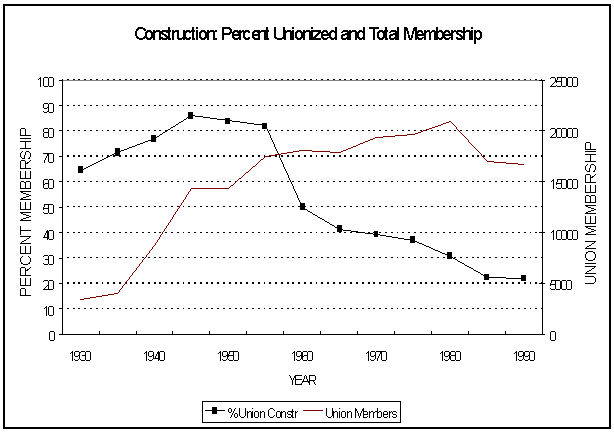
Chart 2: Percent Unionization in U.S. Construction Industry
Chart 3: Real Wages and Total Compensation for American Workers
These economy-wide trends in unionization and compensation have been realized in the construction industry to a larger extent. As Chart 4 shows, the construction industry has historically been one of the most unionized sectors of the U.S. economy. However, construction union membership, after starting higher, has fallen faster, farther, sooner, and almost as low as union membership in the general economy. In 1947 construction workers were 87 percent organized and by 1960, half of all construction workers were unionized. In 1991 construction worker unionization stood at 22 percent. During this precipitous decline, construction employment has maintained a constant five percent share of the U.S. labor force. Despite the dramatic decline in the rate of unionization, union workers have sustained a substantial wage premium over their nonunion counterparts. Figure 3 shows that the union wages have historically been 20 percent higher than nonunion wages. Real wages fell for both union and nonunion construction workers from 1970 to 1991 (see Figure 4). Union workers experienced a 26 percent decline while nonunion wages fell 27 percent.
Chart 4: Construction Industry: Wage premium and Unionization
Chart 5: Construction Industry: Union Wage Premium
Benefit Programs for Construction Workers
The jointly-trusteed workers’ compensation funds, which administer and finance the carve-outs in California, are part of a long tradition of unions and union employers sponsoring benefit programs for their members and employees. Beginning around the 1850s, American labor unions sought to add benefits beyond wages to improve the well-being of their members. The movement did not gain much strength until the 1890s. Establishment of benefit funds was a dramatic break with the old ideology that insurance programs were more of a burden to unions than an advantage.
By the end of the century the ideology had changed. Unions recognized that benefit funds strengthened a union by bolstering its treasuries. The funds were not subject to a great deal of government regulation, and the union could invest the money as it wished or dip into the treasury in an emergency situation, such as a strike. Also, allegiance to the union was strengthene. Death benefits or pensions could only be obtained if the worker remained with the union. And when the economy took a downturn and employers tried to cut costs by hiring nonunion workers, these benefits were a factor in convincing union members not to scab in order to avoid losing such future income.
The first union-sponsored benefit funds were not collectively bargained for and were administered solely by the unions. In almost all unions, administration of benefit funds was "carried on by the officers who maintained the general affairs of the union."
Following World War II, benefit programs emerged as an integral objective of American unionism. Chronologically, the first factors contributing to the growth of union-negotiated benefit plans were the wage stabilization and taxation policies enacted during wartime and extended into the postwar period. The economic boom fostered a favorable climate at the collective bargaining table for union negotiators. However, their ability to bargain for increased wages was checked by government wage controls. Compensation had to be diverted into areas other than members’ paychecks. Taxation laws favored a shift from wages because employer contributions toward employee insurance were tax deductible. Also, employees did not have their benefit contributions taxed as income. The Internal Revenue Service decided to tax pensions only upon their receipt and not their accumulation. The result was an increase in the number of health insurance and pension programs within unions.
Most important for all unions, the National Labor Relations Board (NLRB) ruled in 1948 that pension and insurance benefits were included in the term wages, which meant that pensions and group insurance were mandatory subjects of collective bargaining. This decision came after a Chicago local of the United Steelworkers took the Inland Steel Company to court on the issue of employee benefits. Inland had refused to bargain on a change in the company’s pension plan. The NLRB ruled against the company, stating that pensions were included in the term wages under the National Labor Relations Act. The Supreme Court upheld the NLRB decision in April 1949. The effort of the Chicago local was a turning point in the history of union struggle for benefit programs. Because employers now had to bargain in good faith over such benefits though they did not have to grant them, health insurance and pensions became an integral part of any compensation package.
In 1947 Congress passed the Taft-Hartley Act of 1947. The act was a response to the National Labor Relations Act (NLRA) of 1935, which bolstered the power of organized labor. Management and conservative members of government sought to level the playing field or tip it in the direction of employers with the passage of Taft-Hartley. Its authors trusted employers, not unions, to unilaterally administer pension funds. In the case of union-negotiated benefit funds, a requirement for management representation was designed to prevent the union from using fund money to foster union goals. While management was given the right to serve on all union pension plans, Taft-Hartley did not mandate union representation on all benefit funds, which covered union members. The condition of union representation extended only to multi-employer plans. Single employer plans, such as the General Motors pension which covers members of the United Auto Workers, can be run exclusively by the employer. Subsection 302(c)(5)(b) of Taft-Hartley mandated that the multi-employer union pension funds be governed by an equal number of employer and union trustees. Generally, the union trustees were to be appointed by the president of the union in the case of a nationwide fund, or appointed by the chief administrative officer of a local union in the case of a local fund.
A jointly-trusteed benefit program in the construction industry has two sources of revenue: contributions from employers and employees and the return on assets held by a benefit fund. The responsibility for allocating this revenue falls in the hands of the board of trustees. The revenue flows to participants or insurance companies for payment of pension, health and welfare benefits and purchase of administrative services. The Employee Retirement Income Security Act of 1974 (ERISA) mandated that boards of trustees make these decisions under the consultation of professionals.
The joint management-labor trusteed benefit plans and the history of negotiating over benefits as well as wages set the stage for carve-outs. Carve-outs allowed management and labor to exchange aspects of rights, protections and regulatory oversight for reduced costs, potentially higher wages, and more union jobs.
California Construction and Workers’ Compensation
In the early 1990s two severe blows hit the California construction industry. First, California was facing the worst recession in 50 years, and it was felt particularly strongly in the construction industry. As measured by the value of permits (see Chart 6), by 1993 construction had fallen to just half of what it had been at the end of the 1980s—the steepest decline in new construction in memory.
Chart 6: California Construction Permits
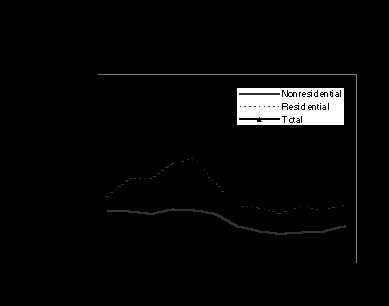 Source: California Labor
Market Information Division, EDD
Source: California Labor
Market Information Division, EDD
Second, workers’ compensation claim incidence and claim costs were at all-time highs. For the construction industry this was particularly serious. Because of the high rate of injuries and the severity of injuries, workers’ compensation costs are a significant cost of business to construction contractors. Table 3 gives the premium costs for most major construction trades per $100 of exposure, approximately equal to payroll without wage premiums for overtime.
Because union contractors paid higher wages than the nonunion sector, workers’ compensation premium costs, which are calculated as a percentage of payroll, were a problem for unions as well as employers. Union and nonunion workers received distinctly different wage rate distributions, employers were imperfectly experience modified, and employers paying higher wages were subsidizing the workers’ compensation costs of employers paying lower wages.
Just prior to this period, unions had been able to persuade the Rating Bureau to establish separate manual rates for union and nonunion workers. The second column of Table 3 gives the nonunion manual rate for trades where it was in effect. While this alleviated some of the competitive disadvantage caused by high workers’ compensation costs, union contractors were still competing for projects against nonunion firms. The level of construction employment in California represented by a union reached an all-time low of just over 20 percent—from nearly 60 percent less than 20 years earlier (see Chart 7).
Selected Trades Rates Effective October 1, 1994 |
Union Scale Class Code $/$100 Exposure |
Non-scale or Apprentice Class Code $/$100 Exposure |
| Carpenters and Joiners | 8.11 |
21.91 |
| Electrical Workers | 3.30 |
7.41 |
| Bridge, Structural and Ornamental Iron Workers | 15.62 23.24(<3 stories) |
same |
| Plasterers | 12.30 |
17.70 |
| Cement Masons | 10.48 |
14.30 |
| Roofers | 27.31 |
31.25 |
| Waterproofers | 6.12 |
14.27 |
| Painters | 7.29 |
16.99 |
| Sheet Metal Workers | 6.20 |
13.20 |
| Plumbers and Pipefitters | 3.61 |
9.21 |
| Elevator Constructors | 3.26 |
same |
| Bricklayers and Allied Craft Workers | 10.48 |
12.01 |
Source: WCIRB--Manual rates effective January 1, 1994
Chart 7: California Construction Employment and Percent Unionization
Source: California Labor Market Information Division, EDD
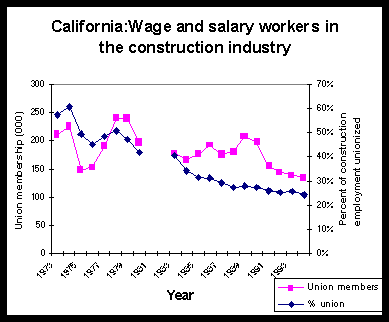
Labor Negotiations and Agreements Concerning Workers’ Compensation
Until recently, management/union collective bargaining agreements almost never involved bargaining over the design of the workers’ compensation system, or the delivery of medical or indemnity benefits. The sole exception was the agreements involving salary continuation benefits for industrially injured workers, common for police and firefighters in California and for some state and government employees. The medical provider, rehabilitation professionals, claims administration, and dispute resolution processes, despite their direct impact on workers and working conditions, were not subject to bargaining.
This report is concerned with two types of agreements common to the construction industry: collective bargaining agreement and project labor agreement. Collective bargaining agreements, the generic form of such agreements, can be used for any agreement between management and labor. In this report we use them in conjunction with agreements negotiated between a single trade and an employer or group of employers. Each construction trade negotiates a collective bargaining agreement covering a set time period and particular geographic area.
Project labor agreements are a special type of collective bargaining agreement covering a single project or group of projects and all trades working on the project. Project labor agreements are fairly common on very large construction projects. The following table highlights the difference between the two types of agreements.
Table 4: Construction Industry Collective Bargaining and Project Labor Agreements
Collective Bargaining Agreements |
Project Labor Agreements |
One union |
Multiple unions (up to 30) |
Many employers |
Single employer/owner |
Geographically restricted |
Site(s) specific |
Standard is three-year duration |
Term of the project |
Project labor agreements generally contain many of the contract provisions of the collective bargaining agreements that are in effect in the local area. In addition, project labor agreements offer several advantages:
1. If a project relies on local collective bargaining agreements and multiple trades are involved, there would be contracts constantly expiring and being negotiated with wage and rule changes.
2. Project labor agreements often contain additional project-specific clauses such as no strike or special transportation arrangements.
3. Project labor agreements allow employers to insert additional safety measures such as drug testing.
While workers’ compensation had not been a negotiated benefit prior to the introduction of carve-outs, a collective bargaining or project labor agreement is required for negotiating a carve-out arrangement. The carve-out agreement is negotiated as an addendum to the collective bargaining agreement.
Carve-outs require an administrative structure to oversee the alternative dispute resolution process. Unions and management have a long history of organizing jointly-trusteed funds for specific purposes such as health and pension. Consequently, the structure for developing a neutral source of payment for the adjudication process was already in place. Without this reliable structure, it is difficult to imagine stable carve-out alternative dispute resolution. Direct payment by employers to the adjudicators would not be perceived as neutral. And workers would be unlikely to participate in paying for the adjudication, if expected benefits of the arrangement inured to employers.
Section 3: Alternative Dispute ResolutionThe legislation authorizing worker’s compensation carve-outs permits unions and contractors to set up an alternative dispute resolution process (California Labor Code Section 3201.5). The provisions essentially privatize the fact-finding or trial phase of disputes arising from workplace injuries, while preserving the injured worker’s ultimate right to appeal to the public system. With minor variations in collective bargaining agreements, they uniformly call for private resolution of disputes by ombudspersons, mediators, and arbitrators before a matter may be heard in the public system at the appellate stage.
To understand how alternative dispute resolution methods operate in carve-outs, it is first helpful to understand how they generally operate and differ as dispute resolution processes. For purposes of contrast we begin with a brief overview of the traditional litigation system and factors leading to the rise of alternative systems of dispute resolution. The principal distinguishing characteristics of alternative dispute resolution derive from the nature of the process and the roles played by third-party neutrals.
In the traditional legal system the resolution of disputes is an adversarial process that generally revolves around the law and the courthouse. Disputes are legalized by the rights of constitutions, statutes, court rules or other sources of law, and parties seeking to vindicate those rights do so in a court of law according to procedures that are generally predictable, well defined and designed to further the goal of fairness and accuracy in the pursuit of justice.
In an adversarial process the parties to the dispute present their versions of the facts and the law to an authority who in turn issues a decision resolving the dispute, and the decision may be appealed to a higher authority. The proceedings are conducted according to strict and intricate rules of evidence and procedure. As such, litigation is highly formalized in both its structural institutions and the agents who engage in the process. Judges decide questions of law. Juries, or sometimes judges, decide questions of fact to which the law will be applied. Attorneys generally represent parties in litigation because of the technical sophistication of the process. While ethical rules provide that final decisions regarding the case generally inure to the client, the lawyer plays a central role in this process. Direct party involvement is often minimal.
Specific rules vary widely by jurisdiction, such as whether a claim is filed in federal or state court or an administrative agency. The essential structure, however, tends to be fairly constant. At a very general level, the litigation process formally begins with filing a complaint by an aggrieved party alleging some violation of law, and the response to such complaint by the opposing party. These preliminary filings or pleadings set out the initial issues of the litigation, which are then clarified during an investigatory or discovery phase. Requests for judicial determination or motions are commonly filed during or upon completion of discovery, including motions on the admissibility of evidence and for summary judgment. The latter typically comes at the close of discovery, and essentially asks the court to rule in favor of the moving party as a matter of law. If that motion is rejected, the matter proceeds to trial, after which a decision is reached by a jury or a judge. That decision is appealable to higher courts to ensure the accuracy and integrity of the decision.
While this describes the basic structure of the litigation system, it is well worth noting that dispute resolution activity can and usually does take place informally before the filing of a complaint. Attorneys for both parties spend considerable time evaluating the legal and factual merits of their cases, interviewing potential witnesses, putting together arguments that ultimately would be used to persuade the judge/jury to rule in their favor. During this period the two sides begin negotiating possible settlements, a process heavily influenced by the parties’ analysis of their respective cases and general negotiation strategies [Robert Mnookin and Tony Kornhauser, "Bargaining in the Shadow of the Law," 88 Yale L.J. 950 (1979)].
While litigation is often thought of in terms of trial, this pre-trial negotiation process ultimately ends in the resolution of the dispute in the overwhelming majority of civil and criminal cases. Most researchers estimate that 95 percent of all disputes are resolved through negotiation and without the need for trial. This phenomenon is also reflected in the California workers’ compensation system (see Table 2, Chapter 1).
The Rise of Alternative Dispute Resolution
The litigation process may be effective as a truth and justice seeking vehicle, yet it certainly carries efficiency costs. While research tends to disavow popular beliefs in a litigation crisis, the civil justice system nonetheless remains heavily burdened and can be expected to become even more so. An already sluggish civil trial process is further slowed by the gamesmanship of litigation, which increases costs to parties and the system itself—costs that are reflected in higher insurance premiums and lower public confidence in the system. Moreover, the complexity of the process, the trauma often associated with trial, and a general dissatisfaction with the traditional legal system have led to a search for new avenues to resolving disputes.
The late 1980s and early 1990s saw an unprecedented rise in alternative dispute resolution in public and private spheres at both state and federal levels. The movement toward more informal methods of dispute resolution is considered one of the most significant modern civil justice developments, and includes dispute resolution methods that have their source of authority in court orders, legislative pronouncements and private contracts. The California workers’ compensation carve-outs are one such technique, legislatively authorized and contractually secured.
The claimed advantages of alternative dispute resolution can be understood in terms of efficiency and process. Efficiency arguments supporting alternative dispute resolution are that it is a faster and therefore less expensive process than traditional litigation—although researchers have not been able to document such advantages. Efficiency rationales are by far the most commonly cited justifications for adoption of alternative dispute resolution in workers’ compensation carve-outs. Process rationales suggest that the alternative dispute resolution processes are more satisfying, produce better outcomes, are more private and contribute to a more civil society through less contentious methods of dispute resolution. [See generally, Warren Burger, "Isn’t there a Better Way?," 68 A.B.A. J. 274 (1982); Robert Raven, "Alternative Dispute Resolution: Expanding Opportunities," 43 Arbitration Journal 44 (1988); William Simon, "Informality and Redistributive Politics," 19 Clearinghouse Review 384 (1985); Frances McGovern, "Beyond Efficiency: A Bevy of ADR Justifications (An un-footnoted Summary)," 3 Dispute Resolution Magazine 12-13 (1997)]
Perhaps not surprisingly, the perceived disadvantages of alternative dispute resolution are a mirror image of its strengths. To the extent that court formalities in part strive to equalize the power imbalances between the parties, the informal structures of alternative dispute resolution can serve to reinforce those imbalances. Similarly, the privatization of dispute resolution through alternative methods infuses a profit motive for the neutral that does not exist in the public system. As such, repeat players, particularly large institutional players like insurers and banks, can have a significant advantage in alternative dispute resolution. Alternative dispute resolution also results in the sacrifice of constitutional and other public rights through its processes—such as the right to an attorney and due process, the accurate application of public laws, and the deterrent value of public decision making. For this reason, one of the most controversial issues in modern alternative dispute resolution is whether one can be coerced into such processes, and the ramifications of such coercion.
Of the many different forms of alternative dispute resolution, three are implicated by carve-outs: arbitration, mediation, and ombudspersons.
Arbitration refers to an adversarial process in which a third-party neutral simply decides or adjudicates the dispute between the parties in an informal proceeding not bound by traditional rules of evidence or procedure. The arbitrator’s decision or award is generally final and not appealable on substantive grounds.
Commercial arbitration arose early in the 19th century because of the importance of industry customs and standards, and the need for speed in resolving disputes. Disputants preferred to have arbitrators with knowledge and experience in the disputed area, as they could bring more technical expertise to the resolution process than could judges in courts of general jurisdiction. Labor arbitration first appeared in the last half of the 19th century in response to labor unrest and as an alternative to strikes, and became more pervasive after World War II. Today virtually all collective bargaining agreements include provisions for arbitrating grievances. Contractual arbitration is also common in the nonunion workplace—virtually all employment disputes in the securities industry, for example, are decided by arbitration rather than trial.
The judiciary initially viewed arbitration with skepticism and distrust, and generally refused to enforce agreements to arbitrate under the so-called ouster doctrine. Beginning in the 1920s, however, federal and state legislatures began passing legislation providing for the specific enforcement of such clauses that preempted application of the doctrine. Such statutes provide the backbone of the modern alternative dispute resolution movement, although their application of alternative dispute resolution in workers’ compensation carve-outs is less direct because of the specific statutory authorization of the carve-outs. To the extent that the carve-out statutes may need to be interpreted by courts, it is certainly possible that judicial decision-making will be guided by and may even rely directly on these statutes and the cases that interpret them.
Decision makers in arbitration settings are called arbitrators, and wield considerably more unchecked power than their public judicial counterparts. They act alone and blend the functions of judge/jury into a single adjudicatory power for resolving disputes that is supported by broad statutory and common law discretion. Moreover, they generally are not bound by the constraints of substantive law in either the procedures by which they conduct their hearings or in the standards they use to resolve the dispute. In fact, arbitrators need not even have legal training.
The many different types of arbitration have some common characteristics. First, they are informal procedures unlike their highly regimented public court counterparts. Both sides have an opportunity to present witnesses and evidence, and to engage in cross-examination—subject to the arbitrator’s discretion, or to the rules agreed upon by the parties themselves (or by the government in court-related programs) prior to the arbitration—although there is much less discovery than in traditional litigation. As a result, the arbitrator’s decision, called an award, generally may be rendered quickly on the basis of the arbitrator’s sense of fairness under the circumstances, rather than on traditional legal norms.
A second unifying feature is the unique character of arbitrators. Unlike judges, arbitrators are selected primarily for their substantive expertise and experience, rather than their general knowledge of the law. The ability to bring substantive expertise into decision making is perhaps arbitration’s greatest strength as a dispute resolution process. For this reason, arbitration is best suited for cases involving technical and related matters. Also unlike public judges, the decisions of arbitrators are generally not subject to substantive review. They may be modified for scrivener’s errors and other such technical imperfections, yet may only be vacated upon proof of bias, fraud, misconduct or abuse of discretion by the arbitrator. An arbitrator’s award may be adopted by public courts and enforced as their own judgments.
For this reason, the selection of the arbitrator is critical to the process, and research supports the intuitive belief that the identity of the individual neutral plays a significant role in the outcome of a given case. [See for example, K.D. Schultz, Florida’s Alternative Dispute Resolution Demonstration Project: An Empirical Assessment, Florida Dispute Resolution Center, 1990; and J.D. Rosenberg and H.J. Folberg, Alternative Dispute Resolution in a Civil Justice Reform Act Demonstration District: Findings, Implications and Recommendations, University of San Francisco School of Law, 1993] The competence, neutrality, and independence of the arbitrator is of paramount concern to a fair process and to the parties’ perception of a fair process.
However, the presence of a profit motive and repeat players combine to create an unusual and potentially dangerous pressure on arbitrator neutrality. The pressure can be eased somewhat by the customary participation of all parties in the selection process. Reputation is the arbitrator’s stock in trade, and a reputation for bias can lead to the parties’ refusal to select an arbitrator. While the marketplace provides this safeguard, serious questions can be raised about equal access to information in establishing the pool of arbitrators from which the selection is drawn—as well as bargaining power disparities between the parties in such negotiations. This problem is particularly poignant in carve-outs, as the ultimate end-user of arbitration, the injured worker, is often not involved in the selection process. Our discussion of California carve-outs includes instances in which the selection of the arbitrator is an issue.
Unlike adjudicatory judicial and arbitration proceedings, mediation is a consensual process in which the parties decide the resolution of the dispute themselves with the help of a third-party neutral. This is typically accomplished by the mediator taking the parties through a series of stages: agreement upon ground rules, issue development by identifying facts and positions, working the conflict by promoting mutual understanding and developing mutually acceptable options, and closure by agreement on options. [C. Moore, The Mediation Process: Practical Strategies for Resolving Conflict 32-33 (1986); Rogers, Nancy and Craig McEwen 1989]
As a method of dispute resolution, mediation’s central strength lies in its communicative power—the ability of the parties with the help of a third-party neutral to get beyond the initial positions that defined the conflict to the real underlying interests of the parties—as well as the powerful potential to reach creative solutions not possible in a court of law, arbitration hearing, or other adjudicatory process. As such, it can be particularly effective in interest-based cases in which the preservation of relationships is particularly important, and which allow for the consideration of options for resolution that exceed those traditionally available in a court of law. While mediation agreements can generally be confirmed by a court for purposes of enforcement, the most fundamental enforcement power of mediation comes from the fact that the parties themselves reached the agreement.
Though mediation techniques have been practiced for centuries, their use in alternative dispute resolution is still in the early stages of formalization. Experts have yet to agree on such fundamental issues as the definition of mediation, the necessary training and qualifications of a mediator, and the proper role if any of lawyers in the process. All these issues are relevant to mediation proceedings in workers’ compensation carve-outs.
On the question of definition, there are two central models of mediation: facilitative and evaluative. In facilitative mediation, the least controversial of the two, mediators may only facilitate the parties’ own consensual dispute resolution process, and should offer neither their opinions nor their substantive expertise to the parties. This view has been adopted by the American Arbitration Association, the Society of Professionals in Dispute Resolution, and divisions of the American Bar Association.
In evaluative mediation, mediators are encouraged to offer opinions, expertise, advice, whatever the parties need to promote resolution of the dispute. Evaluative mediations can resemble the settlement conferences that are a staple of the traditional public litigation system. There is raging debate about whether evaluative mediation is in fact a mediation process or a different form of settlement altogether.
The definition of mediation will in turn affect mediator training and qualification, another subject of continuing debate. Many states, through legislation, court rules or task force recommendations, use a hybrid method of mediator qualification, requiring some combination of two or more of the following: academic degree, apprenticeship or mentoring, training, or practical experience. No consensus has emerged and states have not yet begun to regulate mediator qualifications. [Margaret Shaw, Selection, Training, and Qualifications of Neutrals 157, in National Symposium on Court-Connected Dispute Resolution Research, National Center for State Courts (1994). SPIDR Commission on Qualification Presents Report at Annual Meeting, 2 BNA/ADR Reports 392 (1988). See generally, Nancy Rogers and Craig A. McEwen, Mediation Law, Policy, Practice (1989) Ch. 10]
Regardless of orientation, mediation may not be effective for all disputes. A critical problem in mediation is its capacity to exacerbate power imbalances. In particular, some criticize mediation as tending to favor the economically or emotionally stronger party, or to work against the one who can least tolerate conflict or who most values a harmonious resolution. Some parties may settle for far less than they might obtain before a judge in a traditional adversarial setting. As one writer has put it, "compromise only is an equitable solution between equals; between unequals, it inevitably produces inequality" [Jerold S. Auerbach, Justice Without Law? 136 (1983)]. For example, while mediation can be extremely effective in addressing interest-based issues of child custody and property division in divorce proceedings, some women’s rights organizations have taken positions urging women not to mediate such disputes.
One common remedy for this problem is for parties to be represented by counsel in mediation proceedings. This is controversial in at least two respects: whether attorneys should be involved in the process at all, and what their proper role should be if they are. Some contend that attorneys should not be involved in mediation at all, because mediation is a party-driven process seeking to get beyond legal issues to the underlying causes of the dispute, and the presence of lawyers will only lead to the domination of legal standards. Because of the problem of power imbalances, this is increasingly a minority view. The issue of role, then, becomes more important. Whether lawyers should assume their traditional role of primary spokesperson and advocate for their clients and the standards by which they should assess and provide counsel on the ultimate mediation agreement are the subjects of vigorous debate in the dispute resolution community. [See generally, Leonard L. Riskin, Toward New Standards for the Neutral Lawyer in Mediation, 26 Az. L. Rev. 329 (1984)]
The third type of alternative dispute resolution process called for by the carve-outs is that of the ombudsperson. This is something of a misnomer, as an ombudsperson does not follow a single process. Rather, the ombudsperson method is a vehicle for dispute resolution that encompasses many different processes.
The term ombudsperson is of early 19th century Scandinavian origin, and most generally may be understood as a buffer between large institutions and their constituents. "Most commonly, the ombudsperson in Scandinavia was appointed by the Parliament to ensure that the laws and statutes were properly applied and to guard against abuses, malpractice, or error by officials designated to administer the laws; the person holding the office has been referred to as ‘the watchman of the watchman’."
Though relatively obscure, ombudspersons today may be found throughout American life in university, government agency, newspaper, hospital, prison, social welfare agency, and consumer settings. The two principal types of ombudspersons are classical and organizational.
The classical ombudsperson derives most directly from the Scandinavian model, and is one who serves as a bridge between a government and its citizenry. As described by Walter Gellhorn, one of America’s foremost administrative law scholars and an early student of the ombudsperson, the classical ombudsperson is a "high-level, independent, legally constituted, greatly respected officer" who will "look into citizens’ dissatisfactions with government." The classical ombudsperson has the power to investigate, criticize, publicize, persuade, but not to reverse or dictate official actions. While it is true that the classical ombudsperson handles individual complaints, primary objectives are to use such grievances to identify and correct flaws in the system, and to minimize the likelihood of similar grievances arising in the future. As Gellhorn put it, the "primary purpose of the external critic (ombudsperson) is to build for the future rather than to exhume the past." To the extent that the ombudsperson has a client, it is the system itself and not the parties to the system.
An example illustrates the classic ombudsperson’s role. A police officer arrests a young boy at his school for shoplifting. The parents of the boy sue the police officer for what they claim was an unnecessarily embarrassing incident that stigmatized the child in the eyes of peers. The court dismisses the complaint because the officer had a valid arrest warrant to seize the child. As far as the courts are concerned, the matter is ended. A classical ombudsperson in the police department, however, might have suggested to the chief of police that such arrests in the future be effected outside the classroom and in a more private setting. Rather than being concerned with whether the police officer was right in making the arrest, the ombudsperson would have found the most satisfactory method for implementing that policy, thereby easing inevitable friction between citizens and their government.
The organizational ombudsperson performs a similar function in the private and corporate setting. Unlike the classical ombudsperson, organizational ombudspersons have no authority to engage in formal investigations or fact-finding. Rather, their central powers are the ability to persuade and publicize. Generally operating outside traditional lines of authority and reporting to the highest levels of the organization, the organizational ombudsperson is a designated neutral or impartial dispute resolution practitioner whose major function is to provide confidential information and informal assistance to managers and employees, and/or clients of the employer: patients, students, suppliers, or customers.
The organizational ombudsperson often serves as a confidential first-stop clearinghouse for all types of complaints and seeks not to solve problems, but rather to foster values and behavior such as fairness, equity, justice, equality of opportunity and respect. The scope and limitations of an organizational ombudsperson’s powers have developed with an eye toward the preservation of the office’s core values of independence, neutrality, and confidentiality. For example, they may provide information/communications assistance, look into problems, and provide options to complainants, but as a matter of independence they have no obligation to assist anyone who contacts them. They may use their office to publicize and bring attention to issues, and to persuade parties and institutions, but in furtherance of their neutrality, they do not have the power to change or dictate policies, or to serve as a formal fact-finder, judge, arbitrator or advocate. Bolstering the confidentiality essential to the office, as a general rule organizational ombudspersons will not keep case files, testify as witnesses, or even answer questions from anyone, including senior managers, about those with whom they have had contact.
Problems in Alternative Dispute Resolution
A serious problem with alternative dispute resolution procedures is that employers may establish procedures rigged in their favor. For example, one law firm proposed that employees give up their legal rights in return for the right to use a company-designed dispute resolution program. This program’s highest level of appeal was a partner from another large law firm (Commission on Worker-Management Relations 1994b, 27). It is likely that a young woman working in a law firm who accuses her older male boss of sexual harassment will feel that an older, male partner in a nearby large law firm is not a neutral decision maker. Other alternative dispute resolution procedures that companies have established set maximum penalties far below those permitted by law, and others have taken years to resolve disputes.
A recent high-level commission found that both employers and employees generally agree on standards that alternative dispute resolution procedures must meet if they are to serve as a legitimate form of private enforcement of public employment law (Commission on Worker-Management Relations 1994b). Specifically, the process must provide: a neutral arbitrator who knows the laws in question and understands the concerns of the parties; a fair method by which employees can secure the necessary information to present their claim; a fair method of cost sharing that ensures all employees can afford access to the procedure; the option for employees to have independent representation; a range of remedies equal to those available through litigation; a written opinion by the arbitrator explaining the rationale for the result; and sufficient judicial review to ensure that the result is consistent with governing laws. Some have proposed that the process must also lead to a timely decision.
Some analysts have argued that union/management bargaining can provide decentralized means to achieve the goals of regulations, what John Dunlop has called an "internal responsibility system" (e.g. Bok and Dunlop 1970).
Union approval of the alternative dispute resolution process may address many concerns. The key insight is simple: unions will not approve a procedure that systematically gives employers the ability to act with no regard for the facts. In principle, the union can require protections such as a written record or access by lawyers when the expected value to employees outweighs their cost. In addition, unions can inform their members of their rights as they work their way through the alternative dispute resolution process. In fact, the literature on workers’ compensation is consistent with union members having better information on the system. The repeat play problem is less serious because arbitrators and other neutrals are in repeat play with the union as well as management, and do not face strong incentives to favor the employers. A goal of this study is to determine the extent to which unions can fulfill the oversight functions envisioned by proponents of this form of conditional deregulation.
Improving workplace safety and health requires that managers and employees actively participate in identifying and eliminating hazards. As carve-outs potentially increase union and employee involvement in workers’ compensation, a key advantage of carve-outs would be the increased union involvement in labor-management cooperation leading to improved safety programs and reduced injury rates.
In the writings of safety professionals such as industrial hygienists, ergonomists, union safety representatives and regulators, a consensus is rising on adequate safety programs. Such programs must ensure that both managers and employees have the training to understand safety, incentives to improve safety, and the authority to make safety enhancing changes. To be more specific, the following elements are common to most proposals for an adequate safety and health program:
- Managers and employees receive training and education on identifying and controlling hazards. They or the outside experts they choose perform periodic workplace inspections to identify hazards.
- Managers and employees have incentives to participate fully in the safety and health program. Employees or their representatives have the authority to make recommendations to the employer with assurance that the employer will respond in a timely manner. Employees are protected from retribution due to their contributions to the safety program.
- When accidents occur, an emergency response plan is implemented and first aid services are available. An investigation to eliminate root causes follows each accident.
- The employer provides appropriate medical surveillance for all health hazards.
- Written records include a description of the safety and health program, records of injuries and illnesses, and plans to abate hazards. The abatement plans have timetables and procedures to track progress.
These elements are already required in California construction projects (Construction
Safety Orders Section 1412, Title 8 Article 3, Register 95, n. 22, 6-2-95, p. 533).
Evidence of effectiveness
: Fifteen states currently require employers in some or all sectors to sponsor safety committees. A majority of state workers’ compensation systems are beginning to require workplaces to establish a safety and health program, at least in hazardous sectors (US Dept. of Labor, OSHA 1995). Most required programs contain similar minimum standards.Although no careful evaluation exists, preliminary evidence on the effectiveness of safety committees is favorable. For example, both state and business officials agree that mandated safety and health committees have contributed to the $1.5 billion decrease in injury costs experienced by Oregon employers between 1990 and 1993 (US Dept. of Labor, OSHA 1993).
Cal/OSHA’s Voluntary Protection Program (VPP) is a well-respected program that recognizes companies with excellent safety programs. VPP employers have injury rates about 40 percent lower than the average of their industries, although it is unclear how much of the decrease is due to the actions measured by the VPP program [GAO, 1992:10]. Generally, employers that voluntarily adopt safety and health programs have lower injury and illness rates than do other employers, and their managers often attribute the difference to the existence of the program (GAO, 1992).
Carve-out legislation included specific reference, but not a requirement, to the formation of labor-management safety committees, which are consistent with best work practices. In addition, legislation authorizing safety groups, a requirement for small employers joining carve-outs, includes requirements for the formation of a safety committee, but requires participation only by employers.
Chapter 3: Overview of Carve-outs in California
In 1997 eight addenda to collective bargaining agreements in the California construction industry established jointly-trusteed workers’ compensation funds with alternative dispute resolution procedures. This chapter summarizes and discusses the agreements, and briefly discusses agreements that were disallowed because they appeared to establish sham unions.
In general, legitimate collective bargaining agreements claim that the purpose of workers’ compensation funds is to improve the delivery of benefits to workers who sustain injuries on the job. A jointly-trusteed workers’ compensation fund establishes a labor-management trustee or safety committee of union and employer representatives to oversee implementation and execution of the alternative dispute resolution process, fund administration, and delivery of benefits to injured construction workers.
The funds are regulated by Section 3201.5 of the California Labor Code, which states the Department of Industrial Relations shall recognize as valid any provision in a collective bargaining agreement between a private employer or groups of employers engaged in construction ... and a union that is recognized or certified [as the] exclusive bargaining representative ... Specifically, Section 3201.5 allows the jointly-trusteed workers’ compensation funds to implement (1) an alternative dispute resolution process, (2) an agreed list of exclusive medical providers, (3) an agreed list of medical evaluators, (4) labor-management trustee or safety committees, (5) a modified job or return-to-work program, and (6) an agreed list of vocational rehabilitation providers.
The jointly-trusteed workers’ compensation funds are not permitted to reduce the amount of benefit payments to workers who are injured on the job. Benefits and medical treatment must be provided as required by California workers’ compensation law. However, the jointly-trusteed workers’ compensation funds may design their own plans for the delivery of medical treatment. In general, collective bargaining agreements establish a list of providers from which injured workers may choose. An injured worker dissatisfied with the medical care can usually change once to a new medical provider. Further changes due to dissatisfaction with care or denial of care usually result in initiation of the alternative dispute resolution process.
Tables in Review of Collective Bargaining Agreements following this summary show collective bargaining elements we examined: participants in the agreement; employer contribution and insurance arrangements; choice of administrator, ombudsperson, arbitrator; outline of the alternative dispute resolution process; structure of the delivery of medical care; safety and health programs, and expanded benefits.
Trustee or Safety Committee Selection
The majority of the collective bargaining agreements describe how trustee or safety committees are established. Earlier agreements refer to joint labor-management boards as safety committees, while more recent agreements refer to boards of trustees. The boards of trustees have either an equal number of labor and management representatives or unequal representation. If the representation is unequal, each side—labor and management—usually has one vote for decision making. A few of the collective bargaining agreements describe how each trustee is chosen.
Administrator, Ombudspersons, Arbitrators
Most of the collective bargaining agreements do not mention the appointment of an administrator, and rarely describe an administrator’s duties. The fund appearing to have the most active administrator role is the Laborers agreement. In this fund the administrator appoints the ombudsperson, who is considered an employee of the administrator.
The ombudsperson is usually chosen through the board of trustees negotiations. Most of the collective bargaining agreements do not mention how the ombudsperson is compensated. The collective bargaining agreement covering the Eastside Reservoir project has the owner of the project, the Metropolitan Water District, appoint and compensate the ombudsperson.
Arbitrators and mediators are usually designated by the board of trustees. Most of the collective bargaining agreements specify that these individuals must be former referees and/or retired judges of the workers’ compensation system in California. The collective bargaining agreements that list arbitrators for alternative dispute resolution have three persons from which parties can choose.
The jointly-trusteed workers’ compensation funds are funded by contributions from participating employers. Contributions are determined either as a percentage of the employers’ workers’ compensation premiums or as a set rate per hour worked by an employee. The funds are used to administer alternative dispute resolution, and to defend the alternative dispute resolution if a lawsuit is filed against the jointly-trusteed workers’ compensation fund. It is not clear in the case of the Pipe Trades agreement, which has a supplemental safety benefit, whether that benefit is paid by the fund or the insurance carrier.
Medical Care and Vocational RehabilitationThe board of trustees establishes a preferred provider network from which injured workers choose a provider for their treatment. Injured workers unsatisfied with the care may usually change once to a new provider. If care is denied or a medical evaluation is disputed, the alternative dispute resolution process is usually started. In the case of the Pipe Trades agreement, a panel of IME physicians decides whether the denial of care is justified. The Pipe Trades collective bargaining agreement does not state whether the panel’s decision is binding.
The collective bargaining agreements often lack information on vocational rehabilitation and return to modified or alternate work, which were a specific subject of the legislation and were expected to be an area where carve-outs could deliver. The collective bargaining agreements that mention this subject usually state that a designated list of providers will be established from which an injured worker may choose. The IBEW collective bargaining agreement is the only one with specific information on how injured workers can choose from a list designated by either the California Casualty Insurance Company or Firemen’s Fund Insurance Company.
Alternative Dispute Resolution
Originally two collective bargaining agreements, both Pipe Trades, had an alternative dispute resolution structure in which the ombudsperson tries to resolve the dispute, followed by a meeting with the board of trustees and finally arbitration. Subsequent alternative dispute resolution processes do not involve the boards of trustees. In a similar three-step process the board of trustee consultation is replaced by mediation. An exception is the Laborers agreement, in which the case goes immediately to arbitration if the ombudsperson is unsuccessful in resolving the dispute.
In terms of length of time for conflict resolution, the most rapid alternative dispute resolution process is in the first Pipe Trades agreement. Under this agreement, conflicts should take no longer than 112 days to resolve. The alternative dispute resolution process with the longest time for conflict resolution is the Laborers agreement, in which conflicts can last up to 180 days.
For comparison, Table 5 gives the average resolution time for disputes before the Workers’ Compensation Appeals Board (WCAB). These times are for claims in which the application for adjudication is not a settlement document. Between 1991 and 1993 the application for adjudication was a request for settlement of dispute, approximately equivalent to a request to the ombudsperson for resolution of an issue or issues. For mature claims in the statutory system (five years after injury), the average dispute resolution time was over 8 months. For claims that involved conferences and hearings the time was longer.
Mean number of days from Application for Adjudication to Settlement--Evaluated at months from date of injury |
||||
Months from injury |
||||
| Injury Year | 73 months |
61 months |
49 months |
37 months |
| 1991 | 299 |
268 |
225 |
171 |
| 1992 | 289 |
267 |
229 |
182 |
| 1993 | 275 |
249 |
195 |
Information to Injured Workers on Their Rights
Basically, this subject is not dealt with in the collective bargaining agreements. Though a couple of the collective bargaining agreements state the need for the ombudsperson to explain things in terms understandable to the employee, most collective bargaining agreements do not say that employees may be lacking information and need to be educated on the alternative dispute resolution process. Information services are most often supplied by the ombudsperson. Some ombudspersons take a proactive role, contacting each injured worker as soon as possible after the accident. Others take a reactive approach, waiting for the injured worker or another party to contact them with a question or a dispute.
Resolution of Liens: Medical and Employment Development Department
In general, this subject is not dealt with in the collective bargaining agreements. The second Pipe Trades agreement states that a provider who is not on the designated list and has given emergency medical care to a worker may file a lien claim against the jointly-trusteed workers’ compensation fund. An arbitrator will then resolve the lien. The Laborers agreement also specifically mentions medical liens, stipulating that the Laborers’ Health and Welfare Trust may file a lien against the employers’ insurance company for care related to an injury on the job. Other collective bargaining agreements state that the insurer will not be responsible for any liens from medical providers who are not on the approved list of providers.
Three collective bargaining agreements have safety and health programs. The second Pipe Trades agreement establishes a supplemental safety benefit of 10 percent to workers who did not violate any known safety code when they sustained an on-the-job injury. The Carpenters agreement requires employers to join the Carpenters-Contractors Safety Group, though the specific purpose of this group is not given. The ARB agreement with the Building Trades establishes a safety committee, separate from the board of trustees, to receive reports on safety programs at the job site and recommend further programs for improving safety.
A potential problem for carve-outs is the possible incentive for establishing sham unions. To reduce their workers’ compensation costs, construction contractors and employers could set up sham unions for the exclusive purpose of qualifying for a carve-out. Sham unions would lack any accountability to the work force, and collective bargaining for the rights of workers could be employer-dominated. The employer’s alternative dispute resolution process could appoint ombudspersons, mediators and arbitrators who would favor the company’s interests.
A case in point is an application to the Division of Workers’ Compensation (DWC) in 1993 by the Builders Staff Corporation, a multi-trade construction company that leases construction workers to contractors.
In a posted advertisement titled "Evolve or Die," the Builders Staff Corporation states that they assume workers’ compensation coverage for the workers they provide to construction contractors, and they assume all employee-related risks such as wrongful termination lawsuits and lawsuits alleging discrimination in hiring, promotion, or firing under the Americans with Disabilities Act.
When the Builders Staff Corporation filed for a carve-out in October 1993, they claimed their employees were represented by the United Association of Construction Workers (UACW). As part of the application they submitted a copy of the collective bargaining agreement between them and the UACW. The collective bargaining agreement included an alternative dispute resolution process for workers’ compensation grievances, as well as a list of exclusive medical providers and qualified medical evaluators for medical treatment for workers injured on the job.
The San Diego Public Works Task Force, which is charged with seeing that construction contractors in the San Diego area comply with the California Labor Code, investigated the Builders Staff Corporation and found that they were claiming they had been approved by the DWC for a carve-out. The president of Builders Staff Corporation gave the name of the union president to the task force. When the task force called this person, she claimed she was not the union president but the ombudsperson for the carve-out. This person was also the administrative assistant of the president of Builders Staff Corporation.
Under current law the employee representative must provide evidence to the Division of Workers’ Compensation that the union is legitimate. The Builders Staff Corporation application for a carve-out was denied by the DWC because of insufficient evidence to warrant that the UACW was an official union.
Table 6: Collective Bargaining Agreement Addenda
Establishing Carve-out Programs Before 1997
Employers
Unions Date ofAgreement
Several contractor associations So. Calif. Dist. Council of Laborers Dec. 1994
TIMEC Intl. Union of Petroleum & Ind. Workers Jan. 1995
District 9, NECA IBEW, 9th District Oct. 1994
Cherne Contracting Corporation Local 250 and So. Calif. Pipe Trades #16 July 1994
Piping Industry Council So. Calif. Pipe Trades District #16 July 1994
Signatory employers So. Calif. Carpenters (12 Counties) Dec. 1995
Morrison-Knudsen of Ohio Contra Costa Building Trades May 1995
Metropolitan Water District. Building and Construction Trades (Intl.) May 1996
Review of Collective Bargaining Agreements
Table 7: Several Contractor Associations and Southern California District Council of Laborers |
|
Employer Participation |
|
| Employer penetration | 4 stand-alone employers of > 1000 possible contractors |
| Contribution of employer | Unknown hourly rate |
| Insurance | Stand-alone employers insure separately. A safety group being developed allows multiple insurers to write for group. |
Alternative Dispute Resolution (ADR) |
|
| Steps of ADR | Ombudsperson => Arbitration |
| Timeframes for ADR | Ombudsperson has 90 days to resolve conflict, after which the employee can file for arbitration. Application for arbitration must be submitted within 60 days, and must then be conducted within 20 days with a decision reached 10 days thereafter. |
| Ombudsperson employer | Joint labor-management Trust |
| Ombudsperson involvement | Depends upon the individual employer. Some want ombudsperson involved with every claim, some only when a dispute arises. |
| Mediation | ADR has no mediation stage |
| Arbitration | Trust retains professional arbitration service |
| Attorney participation | No restrictions |
| Wrongful termination Serious and willful |
Covered within ADR Ombudsperson refers worker to an attorney |
Medical, Medical-Legal and Vocational Rehabilitation |
|
| Medical provider list | Up to individual employers |
| Length of medical control | Not firmly established |
| Predesignation of doctor | Allowed |
| Medical-Legal provider list | Established by Trust |
| Voc Rehab provider list | Established by Trust |
Safety and Benefits |
|
| Safety | No mention of specific safety and health programs |
| Expanded benefits | None |
Laborers Locals face the most difficulty among the trades in organizing a carve-out. Laborers are the most general of the trades and rarely comprise a majority of an individual contractor’s work force. Different arrangements for resolution of claims for the Laborers minority of the work force poses a burden on the employer that may be seen as outweighing the benefits of the carve-out arrangement. To improve carve-out penetration among employers:
1. The ombudsperson for the Laborers has led an effort to reduce this barrier by having the DWC agree that a safety group does not have to be insured by a single insurer. Their position is that even if the total premium or exposure represented by the group meets only the minimum requirements, more than one insurer can insure parts of that exposure.
2. The ombudsperson has actively recruited other unions—Cement Masons and Operative Plasters and Pipe Trades working with landscaping—to join a single, multiple-craft carve-out arrangement.
Table 8: TIMEC and International Union of Petroleum and Industrial Workers (IUPIW) |
|
Employer Participation |
|
| Employer penetration | Single employer carve-out |
| Contribution of employer | N/A |
| Insurance | Self insured/self administered employer |
Alternative Dispute Resolution (ADR) |
|
| Steps of ADR | No ADR under carve-out |
| Timeframes for ADR | N/A |
| Ombudsperson employer | N/A |
| Ombudsperson involvement | N/A |
| Mediation | N/A |
| Arbitration | N/A |
| Attorney participation | N/A |
| Wrongful termination Serious and willful |
N/A |
Medical, Medical-Legal and Vocational Rehabilitation |
|
| Medical provider list | Restricted list developed by company workers’ compensation administrator and company nurse with outside assistance. Restriction to list has been litigated at WCAB on several occasions, TIMEC won. |
| Length of medical control | Not firmly established |
| Predesignation of doctor | Not allowed |
| Medical-Legal provider list | Restricted list developed by company workers’ compensation administrator with assistance from defense and applicant attorneys. Restriction to list has been litigated at WCAB on several occasions, TIMEC won. |
| Voc Rehab provider list | Established by company |
Safety and Benefits |
|
| Safety | No mention of specific safety and health programs |
| Expanded benefits | Offers modified work when possible, paying $10.51 + 2/3 of difference between $10.51 and usual wage. |
The TIMEC carve-out is the only current carve-out that does not include provisions for alternative dispute resolution. At the time the agreement was negotiated, the company would have preferred alternative dispute resolution, but the union did not feel well enough informed.
TIMEC is a refinery maintenance company with medium term contracts requiring up to several hundred IUPIW workers for up to six months at a time.
Table 9: District 9, National Electrical Contractors Association (NECA) and International Brotherhood of Electrical Workers (IBEW), 9th District |
|
Employer Participation |
|
| Employer penetration | 95% of NECA West (Safety Group) 50% of NECA |
| Contribution of employer | 2% of workers’ compensation insurance premium, 75% to ombudsperson and 25% to ADR Trust |
| Insurance | Ulico (Safety Group) + several insurers for stand-alone employers |
Alternative Dispute Resolution (ADR) |
|
| Steps of ADR | Ombudsperson => Mediation => Arbitration |
| Timeframes for ADR | Conflict resolution should take a maximum of 120 days. Ombudsperson has 10 days to resolve conflict, then assists the employee in filing for mediation. Application for mediation must be submitted within 60 days, mediation must be conducted within 10 days, and any party not satisfied with the outcome has 30 days to file for arbitration. Arbitration must be conducted within 30 days and a decision made within 10 days of proceedings. |
| Ombudsperson employer | Joint labor-management Trust |
| Ombudsperson involvement | Originally the ombudsperson acted when contacted by the employee, recently has taken the proactive approach, contacting injured workers soon after injury. |
| Mediation | Mediators negotiated as part of collective bargaining agreement. Mediation is by phone, not face to face. |
| Arbitration | Arbitrators negotiated as part of collective bargaining agreement |
| Attorney participation | Active representation at arbitration only, may advise at mediation |
| Wrongful termination Serious and willful |
Handled within the ADR process since the Bacera decision |
Medical, Medical-Legal and Vocational Rehabilitation |
|
| Medical provider list | 18 provider networks + union’s Health and Welfare Trust preferred providers |
| Length of medical control | Life of claim |
| Predesignation of doctor | ? |
| Medical-Legal provider list | IMC QME list |
| Voc Rehab provider list | Designated by California Casualty and Firemen’s Fund insurance companies |
Safety and Benefits |
|
| Safety | Labor-management Safety Committee meets two times per year |
| Expanded benefits | Employer pays attorney fees if worker prevails at arbitration or enters into an agreement after mediation |
The NECA/IBEW carve-out is the most successful at achieving significant penetration among the membership of an employers association. In part this is because prior to the carve-out legislation, there was a long established safety group, NECA West, that negotiated jointly for insurance coverage. This formed the basis for the subsequent carve-out.
The ombudsperson role has changed since the beginning of the carve-out. Originally the ombudsperson operated in a reactive role, responding to requests from injured workers with questions or problems. More recently the ombudsperson has adopted the proactive role of contacting injured workers soon after the injury to supply information and establish communication. The ombudsperson feels that this has improved the carve-out operation from both worker and employer perspectives.
Table 10: Cherne Construction and Several Locals of the Pipe Trades |
|
Employer Participation |
|
| Employer penetration | Single employer |
| Contribution of employer | $0.02 per person-hour |
| Insurance | Usually self insures on each project |
Alternative Dispute Resolution (ADR) |
|
| Steps of ADR | Ombudsperson => Joint Management-labor Committee =>Arbitration |
| Timeframes for ADR | Maximum of 127 days. Either side of a conflict can request an ombudsperson conference and the meeting must take place within 7 days. If conflict cannot be resolved during this meeting, either party can request a meeting with the Safety Committee, which has 30 days to hold the meeting and 15 days thereafter to issue a finding of fact. Any party not satisfied with this report may file for arbitration within 30 days. Arbitrators have 45 days to file a position paper. |
| Ombudsperson employer | Joint labor-management Trust. Ombudsperson is also a member of the Pipe Trades union and performs other duties for the union through position with the Trust. |
| Ombudsperson involvement | Responds to requests from either party |
| Mediation | Second stage is decision by a joint management-labor committee |
| Arbitration | Parties attempt to agree on arbitrator. If not, the ombudsperson selects three and each side can eliminate one. |
| Attorney participation | Full participation only at arbitration. At early stages all communication is directly between parties. |
| Wrongful termination Serious and willful |
Not covered under ADR Ombudsperson refers worker to an attorney |
Medical, Medical-Legal and Vocational Rehabilitation |
|
| Medical provider list | Highly restricted lists, most recent agreement includes option of two doctors |
| Length of medical control | Life of claim |
| Predesignation of doctor | Not allowed |
| Medical-Legal provider list | Highly restricted list, most recent agreement includes less than 20 QMEs |
| Voc Rehab provider list | Highly restricted list |
Safety and Benefits |
|
| Safety | No mention of specific safety and health programs |
| Expanded benefits | 10% increase in indemnity payments (up to $10,000) if Joint Labor-management Committee determines: 1) no safety rules were violated, 2) the injury was a burn, laceration, fracture, or crush injury as a result of a trauma. |
At the time of this review, Cherne was the only employer with experience in negotiating multiple carve-out agreements. At the time of this writing, Cherne was negotiating its fourth such agreement. Their cost experience, as reported by Cherne, has been mixed. The carve-outs have had good experience, and the company has other large projects not covered by carve-outs where the experience was sometimes better and sometimes worse.
Cherne has negotiated very restricted lists of medical providers and medical-legal evaluators. This was an issue with the union when Cherne was involved in the original Pipe Trades carve-out agreement in Southern California that included other employers. That carve-out subsequently changed to a more open list of medical and medical-legal providers. A recent agreement with Pipefitters Local 342 in Northern California included only two doctors and less than twenty medical evaluators. Several reviewers considered the medical-legal list moderate to conservative. These lists are prepared with the assistance of an insurer, Hartford, and a nurse case management firm, Occusystem.
The Cherne agreements included provisions for extra benefits under specific conditions. According to Cherne, these extra benefits have never been awarded.
Table 11: Signatories to Collective Bargaining Agreement and U.A. Local 250 and Southern California Pipe Trades #16 |
|
Employer Participation |
|
| Employer penetration | Approximately 20 of 150 possible members of employer association |
| Contribution of employer | 1.5% of premium |
| Insurance | Ulico |
Alternative Dispute Resolution (ADR) |
|
| Steps of ADR | Ombudsperson => Mediation => Arbitration Originally the second stage was a review by a management-labor committee, which was replaced with mediation during renegotiations. |
| Timeframes for ADR | Ombudsperson has 90 days to resolve conflict, after which the employee can file for arbitration. Application for arbitration must be submitted within 60 days, and must be conducted within 20 days with a decision reached 10 days thereafter. |
| Ombudsperson employer | Joint labor-management Trust. Ombudsperson has additional duties involving union-directed safety and education activities. |
| Ombudsperson involvement | Becomes involved when requested by either party |
| Mediation | Choice mechanism unknown |
| Arbitration | Parties attempt to agree on arbitrator. If not, the ombudsperson selects three and each side can eliminate one. |
| Attorney participation | Full participation only at arbitration. At early stages all communication is directly between parties. |
| Wrongful termination Serious and willful |
Not covered under ADR Ombudsperson refers worker to an attorney |
Medical, Medical-Legal and Vocational Rehabilitation |
|
| Medical provider list | Original list restricted, subsequently expanded |
| Length of medical control | ? |
| Predesignation of doctor | ? |
| Medical-Legal provider list | If a medical evaluation is disputed, the ombudsperson selects a three-member panel of IME physicians and the non-objecting party selects one of the physicians to perform an evaluation. No mention is made of how conflict is ultimately resolved. |
| Voc Rehab provider list | Established by Trust |
Safety and Benefits |
|
| Safety | No mention of specific safety and health programs |
| Expanded benefits | Original agreement said the savings from carve-out would be shared equally between employee benefits and reduction in employer costs. |
The Pipe Trades/Pipefitters carve-out originally had a joint management-labor committee review the disputes at the second stage. At the suggestion of the ombudsperson, this was recently replaced by mediation.
The union has been involved in several carve-outs. The one listed here is with one or more multi-employer associations in Southern California. Others have been with Cherne Corporation. We have reviewed with the union what was learned from repeat negotiations. At a minimum, the medical provider lists were expanded. To the extent these negotiations are conducted by the Local and the particular Local changes, some advantages of repeat negotiations may be lost if the participants of earlier negotiations are not brought in. A case in point is the negotiation between Local 342 in Northern Californian and Cherne Corporation. The Southern California Pipe Trades and ombudsperson were unaware of these negotiations, even though the ombudsperson on the earlier carve-out was listed as ombudsperson in the Northern California carve-out. That carve-out has several very restrictive clauses concerning the list of medical and medical-legal providers, which might have been negotiated differently.
This carve-out does not handle several areas of possible dispute within the alternative dispute resolution process. These areas include wrongful termination and serious and willful claims against employers. In addition, alternative dispute resolution does not cover cumulative trauma injuries involving more than one employer.
Table 12: Signatory Employers and the Southern California Carpenters |
|
Employer Participation |
|
| Employer penetration | Approximately 25 of 800 employers |
| Contribution of employer | $0.032 per hour, low risk employers $0.04 per hour, high risk employers |
| Insurance | Ulico and State Compensation Insurance Fund |
Alternative Dispute Resolution (ADR) |
|
| Steps of ADR | Ombudsperson => Mediation => Arbitration |
| Timeframes for ADR | Ombudsperson must provide the employee with a final response in a reasonable time period. The employee has 10 days to file for an informal conciliation with the ADR director. An arbitration request can be filed within 20 days of the meeting with the ADR director, and arbitration must be conducted in a reasonable time period. The arbitrator has 30 days to render a decision. |
| Ombudsperson employer | Ombudsperson is an applicants attorney law firm with one partner handling most issues. This partner is paid by the Joint Management-labor Trust. |
| Ombudsperson involvement | Ombudsperson becomes involved only when a dispute occurs. If the worker is represented, the dispute bypasses the ombudsperson stage and moves directly to mediation. |
| Mediation | Mediation stage is referred to as informal conciliation. A consultant for the employers association handles the conciliation. |
| Arbitration | A consultant for the employers association selects the arbitrator from a list in the bargaining agreement. |
| Attorney participation | No restrictions |
| Wrongful termination Serious and willful |
No issues at time of review |
Medical, Medical-Legal and Vocational Rehabilitation |
|
| Medical provider list | Originally a very restricted list of providers selected by the insurer. This list has been expanded by the addition of one or more large provider networks. Some complaints from workers. |
| Length of medical control | Life of claim |
| Predesignation of doctor | Not allowed, employee restricted to carve-out list |
| Medical-Legal provider list | All QMEs on IMC list within 12 county Southern California region |
| Voc Rehab provider list | No restriction |
Safety and Benefits |
|
| Safety | Safety handled through the Safety Group formed for carve-out |
| Expanded benefits | None |
The Carpenters carve-out has an unusual arrangement for the alternative dispute resolution process. Unrepresented workers can receive assistance from the ombudsperson, an applicant law firm. Represented workers technically could use the ombudsperson, and in practice none have. Rather, they have moved directly to the mediation stage.
Other differences occur at the mediation and arbitration stages. The mediator is the general counsel for the main employers association. The mediator also selects the arbitrator. In addition, an arbitrator selected by the same general counsel reviews all settlements for adequacy. The arbitrator reviewing settlements is always the same former workers’ compensation judge.
As the carve-out matured, several changes were made to the original agreement:
1. Subsequent negotiations vastly expanded the network of doctors. The original list selected by the insurer was small and restricted. Negotiations were difficult and the union reported that it did not feel it had a lot of leverage. The new list was Preferred Health Network, which was a large workers’ compensation preferred provider network. Kaiser was also added.
2. The costs faced by employers for the support of alternative dispute resolution have been adjusted downward several times. When originally established, the employers paid $0.07 per hour. This has declined to the current levels of $0.032 -$0.04 per hour.
Table 13: Metropolitan Water District and Contra Costa Water District and All Craft Unions |
|
Employer Participation |
|
| Employer penetration | All contractors and subcontractors are required to participate in the carve-out as a condition of the contract. |
| Contribution of employer | Owner pays all costs of ADR as incurred |
| Insurance | Structured as large deductible owner controlled insurance policies. Hartford offered Eastside Reservoir a 25% reduction on the premium because ADR was included. |
Alternative Dispute Resolution (ADR) |
|
| Steps of ADR | Ombudsperson => Mediation => Arbitration |
| Timeframes for ADR | Conflict resolution should take a maximum of 155 days. Employees have 30 days to file for an ombudsperson meeting when they believe their benefits have been unfairly reduced or terminated. There is no stipulated time period for when the ombudsperson should meet with the employee. The ombudsperson has 15 days to resolve the issue, after which the employee may file for mediation within 25 days. Mediation is conducted within 15 days of receipt of the request. If either the employee or the carrier is not satisfied with the mediation, they may file with the ombudsperson for arbitration within 30 days. Arbitration must be conducted within 45 days and a decision rendered 10 days thereafter. |
| Ombudsperson employer | Eastside Reservoir: insurance broker employs ombudsperson Los Vaqueros: owner of the project employs ombudsperson |
| Ombudsperson involvement | On both projects very proactive involvement by ombudspersons, contacting all injured employees |
| Mediation | Negotiated list of mediators assigned on a rotating basis |
| Arbitration | Negotiated list of arbitrators assigned on a rotating basis |
| Attorney participation | Full participation at arbitration. Can be present at mediation but only as advisor. |
| Wrongful termination Serious and willful |
Dealt with in carve-out ADR |
Medical, Medical-Legal and Vocational Rehabilitation |
|
| Medical provider list | Employer selects one or more provider networks, unions add Health and Welfare Trust preferred provider |
| Length of medical control | Length of claim |
| Predesignation of doctor | Allowed |
| Medical-Legal provider list | All QMEs on IMC list |
| Voc Rehab provider list | Selected by insurer and labor representatives |
Safety and Benefits |
|
| Safety | Very active safety programs at each site. Regular safety meetings and reports on incidents. Safety Committees are in addition to joint management-labor committee that oversees carve-out. |
| Expanded benefits | None |
These projects have very similar arrangements. The Eastside Reservoir agreement has been used as a model by all subsequent large construction projects adopting carve-out arrangements.
These carve-outs are responsible for the innovation of including both the lists of employer-designated medical providers and the preferred provider of each union’s Health and Welfare Trust. This has apparently worked very well.
The employers pay for ombudspersons. This may not be ideal, yet the arrangement might be best suited for large fixed-period projects involving multiple crafts. In such a situation, crafts and contractors come and go while administration of alternative dispute resolution and the other carve-out procedures must be maintained—possibly for some time after the end of the project.
This summary of carve-out agreements demonstrates the diversity of arrangements negotiated by the various unions and employers. For example, some agreements have very restricted lists of physicians, who supply all medical treatment for injuries covered by the carve-out. Other agreements allow workers more choice of physicians than most would have experienced in the statutory system. Similarly, some carve-outs place substantial restrictions on the participation of attorneys while others negotiated no restrictions. This diversity represents an opportunity for parties to experiment and learn during the evolution of this innovation in delivery of workers' compensation benefits. This diversity and experimentation should be studied by participants in the traditional statutory system as well as parties negotiating or renegotiating carve-out agreements.
These differences may have consequences for savings that can be achieved under carve-outs. Restricted lists of medical providers may allow carve-outs to achieve greater savings on medical costs. Properly determined, some restriction may also improve medical treatment. However, restrictions can also mean that the cost savings come at the expense of the injured workers satisfaction with treatment, or even at the expense of the quality of that treatment.
The structure of agreements can also determine the distribution, between labor and employers, of benefits that derive from the agreements. Employers certainly considered savings on workers' compensation costs as a major motivation for negotiating agreements. Workers might have expected to expand their benefits, either directly through higher benefit levels (e.g., under the Cherne agreement) or indirectly because the need to pay an attorney to navigate the system is reduced.
However, benefits and the distributions of benefits between parties depends heavily on the characteristics of the agreements. In the final chapter and in Appendix 7, we review how the particular characteristics of an agreement are affected by the negotiating strength of the parties during the collective bargaining process.
Chapter 4: Introduction to the Case Studies
Carve-outs differ in numerous ways. Most notably, some involve a large project, single owner and multiple trades while others are multiple-employer associations with a single union. Because these two structures are quite different, we chose one of each for this study, hoping to select a multiple-employer carve-out that included a large number of employers. However, several such projects had not yet gotten started.
The large project/multi-trade arrangement existed at both Eastside Reservoir in Hemet and Los Vaqueros in Contra Costa County. Each project used very similar agreements, processes and procedures. In fact, Los Vaqueros copied from and coordinated with the Eastside Reservoir project.
The Hemet project was the more mature of the two. It had been running for at least 18 months, had reported approximately 150 injuries in 1995 for 1500 workers. It is approximately three times bigger than the Los Vaqueros project. The Hemet project agreement was in place at the start of construction. Though the Los Vaqueros project was signed in August 1995, the agreement did not go into effect until July 1996, so there are claims both prior to and following implementation of alternative dispute resolution.
Multiple-employer Associations
We contacted four carve-outs with large associations of employers. Only one of these had been successful at achieving employer participation at the time of the case study selection. The following table indicates the approximate number of potential employers and the number joining.
Table 14: Level of Employer Participation among Carve-outs
| Carve-out | Employers eligible | Employers joined |
| IBEW/NECA | 500 | 250 (7,500-10,000 employees) |
| So. Cal. Carpenters | 800 | 17 |
| Pipefitters | 150 + independents | 20 (400-500 employees) |
| Laborers | 300 | 3 |
Because we selected a carve-out partly on the basis of its success in getting started, it may not be representative of all carve-outs.
We followed similar methods for both carve-outs. We began by listing the interested parties at each carve-out: ombudsperson, employers, employees, union, workers’ compensation insurer, arbitrators and mediators, and lawyers. At the Eastside Reservoir project, a single large project, we included the project owner as well as local, state and national representatives of the building trades. At NECA-IBEW, a multi-employer project, we included representatives of NECA, the employers federation.
We read all written materials that we could identify for each carve-out, including the project labor agreement at the Eastside Reservoir project, the collective bargaining agreement, handouts from the ombudspersons to injured workers explaining the carve-out, injury reports and other reports to parties to the agreements.
We performed site visits using pairs of researchers. The Eastside Reservoir project visits took place from May to August 1997, and the NECA visits were from June to September the same year.
All interviews were recorded and transcribed. The entire research team read all interviews. Most interviews involved follow-up phone calls, occasionally faxes or e-mails, to clear up specific points or ask follow-up questions.
For each case study we asked the ombudsperson to identify workers who had disputes that had resulted in their filing for mediation or arbitration. The workers were chosen based upon suggestions by the ombudsperson, who first contacted the workers for their permission to be interviewed. Thus the sample of workers we interviewed was biased toward those who had tested the process. We did not interview workers who did not have a dispute or whose disputes were rapidly and successfully handled by the ombudsperson.
Because the objective of the alternative dispute resolution process is to avoid mediation, our informants are an extremely unrepresentative sample. That is, these employees in some sense represent failure of the alternative dispute resolution process to avoid a formal dispute. Thus they provide one extreme of the problems that alternative dispute resolution might cause—the other extreme is injured employees not knowing of their rights to compensation. The intent of the employee interviews was not to find out about the experience of the representative injured worker, but rather the worst-case experience of employees for whom alternative dispute resolution was not leading to rapid resolution of their dispute.
To protect the confidentiality of the interviewees we subscribed aliases to each person.
Chapter 5: Eastside Reservoir Project Carve-out
The Eastside Reservoir project is a Metropolitan Water District effort to construct a reservoir in the Diamond and Domenigoni Valleys near Hemet, California. It is a two billion dollar project, the largest construction project in the Western U.S., and will take five years to complete. The reservoir will double the fresh water storage capacity in Southern California.
The Eastside Reservoir project labor agreement is a single employer, multiple contractor/subcontractor, multiple union agreement between the project owner and the unions. The agreement contains the alternative dispute resolution process for resolving workers’ compensation issues and extends to all contractors and subcontractors participating in the project. The carve-out is a workers’ compensation wrap-up, also referred to as an owner controlled insurance program. Wrap-ups are large projects for which the insurance is carried by the project owner to cover workers’ compensation and liability for all contractors and subcontractors involved.
History of the Eastside Reservoir Project Carve-out
The Eastside Reservoir project carve-out emerged as a result of the belief shared by the National and State Building Trades and the Metropolitan Water District of Southern California that the Eastside Reservoir project was the ideal situation for a project labor agreement involving alternative dispute resolution. The most compelling reason for the owner to operate under a project labor agreement was to avoid problems of contracting with multiple trades over time. Eastside Reservoir would be under construction for five years and most contracts in the building trades last three years. Each trade has a separate contract with renegotiation dates staggered over project duration. A primary goal was to avoid disruptions in the construction schedule.
Several parties to the negotiation indicated that while setting up a carve-out was not the primary reason, it was nevertheless the deciding factor for Metropolitan Water District in negotiating a project labor agreement. California had recently removed the prohibition on public agencies assuming the risk associated with workers’ compensation under an umbrella policy covering contractors and subcontractors on a public project—that is, arranging insurance as an owner controlled insurance plan. Assuming the workers’ compensation and liability risk on a project allows the owner to avoid inclusion of these costs in the budgets of contractors and subcontractors, on which contractors’ overhead is based. Since large projects tend to be safer than the average risk, the project might negotiate lower premium rates for the same risk profile among contractors.
Choosing an owner controlled insurance plan meant assuming the risk for related losses. Risk management was a key cost variable in the Eastside Reservoir project. The project labor agreement allowed for a carve-out program. Metropolitan Water District, based on discussions with their broker, Sedgewick of California, and representatives of the National Building Trades, believed that substantial savings on workers’ compensation costs could be achieved through a carve-out.
Metropolitan Water District felt that the advantages of setting up a project labor agreement and potential for cost savings—if the agreement included a common safety, labor and workers’ compensation policy—was the best approach for handling a large construction project over a five-year period. Previous experiences, such as the Trans Alaska Pipeline project and the Massachusetts Pioneer Valley project, encouraged this approach.
On the employer side, Larry Gallagher, risk manager for the Metropolitan Water District, believed that the workers’ compensation carve-out had cost-saving potential. He realized that it had to be implemented in the context of a collective bargaining or project labor agreement. Because the Metropolitan Water District, project owners, had no experience with project labor agreements, they were at first reluctant to get involved. Expected cost savings in workers’ compensation premiums along with a no-strike clause helped convince the project owners to implement alternative dispute resolution in the context of a project labor agreement. Gallagher’s initial estimates of cost savings for alternative dispute resolution were in the 25-30 percent range, although he knew this figure was uncertain. According to the Metropolitan Water District as of August 1997, actual cost savings have been in the expected range.
The National as well as State Building Trades union leaders were very much in favor of carve-outs, and originally brought the concept to the attention of Gallagher and the Metropolitan Water District. Their favorable attitude strongly facilitated setting up the carve-out and negotiating other areas of the project labor agreement. From the unions’ perspective, carve-outs had the potential to bring down the cost of union labor. In addition, project labor agreements had the potential to restrict competition by nonunion labor for jobs on the project. Workers are covered by a carve-out only if they are union members. Metropolitan Water District was a public sector organization required to pay the prevailing wage, which was union scale. This took wages out of competition. All else being equal, the owners would prefer the carve-out program if restricting nonunion labor led to cost savings on workers’ compensation insurance premiums.
In summary, the Metropolitan Water District had reservations about negotiating a project labor agreement, which became more attractive because it allowed control of labor stoppages through a no-strike clause as well as negotiation of additional safety measures such as drug testing. At first, this might not have been enough to persuade the project owners. Metropolitan Water District representatives then saw the opportunity to gain savings on workers’ compensation costs under a carve-out program as a persuasive additional incentive.
Once the Metropolitan Water District chose the construction management contractor and insurance broker for the project, negotiations began with the local unions to set up a carve-out. In September 1994 all parties signed the project labor agreement for the Eastside Reservoir project. It contained an alternative dispute resolution process and allowed for a specified list of medical providers and vocational rehabilitation professionals.
Structure of the Eastside Reservoir Project Carve-out
This description of agents directly involved in the carve-out draws heavily from the language of the project labor agreement between the owners and a number of unions.
The owners of the project, the Metropolitan Water District of Southern California, contracted with the construction management contractor to oversee the project, and in particular the project labor agreement implementation.
Metropolitan Water District hired Southern California Associates, a joint venture of Harza Engineering Company of California and the Parsons Corporation, to provide construction management support services. Southern California Associates is the legal successor of ARB Inc., the original signatory of the project labor agreement. The project contractor executes the project labor agreement and monitors agreement compliance by all parties involved, particularly the contractors and subcontractors on the project.
A number of unions and union organizations signed the project labor agreement, including the Building and Construction Trades Department, AFL-CIO, the Building and Construction Trades Council of California, the Building and Construction Trades of San Bernardino and Riverside Counties and 17 affiliated local unions.
Insurance Broker/Carrier/Administrator
The insurance broker is a joint venture of Sedgwick of California Inc. and Dickerson Insurance Services. This joint venture acts as the broker for insurance of all risks involved on the Eastside Reservoir project. The insurance broker marketed the project to individual insurance companies for bids on the different risks involved. Ultimately all insurance under the owner controlled insurance plan was carried by ITT Hartford Specialty Risk Services. Metropolitan Water District and each individual contractor are separately insured under the umbrella of the owner controlled insurance plan.
ITT Hartford Specialty Risk Services is the workers’ compensation insurer and claims administrator. Through a competitive process the company was selected by Sedgewick of California and Metropolitan Water District from among four workers’ compensation insurance companies. Among the reasons for selecting this firm were its experience, good reputation and willingness to significantly cut the workers’ compensation insurance premium if a carve-out was implemented. Hartford offered a 25 percent discount on the premium for inclusion of the carve-out program.
The policy was written as a very large deductible policy, meaning that Metropolitan Water District was at risk for total workers’ compensation costs up to a global policy maximum, and a maximum on any individual claim. In addition, Hartford was paid to administer the claims with fixed rates set separately for medical-only and indemnity claims.
On the Eastside Reservoir project there were more than 200 contractors and subcontractors, the number fluctuating at different stages. All were covered as separate insureds under a single general insurance policy and under the same workers’ compensation insurance policy. All construction contractors and subcontractors involved were required to agree to the alternative dispute resolution process established in the project labor agreement, and to rules governing the hiring of construction labor through the local labor council’s referral system.
Construction Contractor Employees
Rules for who could work as an employee of a construction contractor involved in performing, monitoring or overseeing the work were delineated in the Eastside Reservoir project labor agreement, which established a job referral system for hiring up to 15 percent of the total crew per craft from a contractor’s core of employees. The remaining number of employees was required to be hired from the relevant craft’s local union hiring hall out-of-work list. This limitation could only be overcome in the event that local unions were unable to fill contractor requisitions for employees within 48 hours.
In addition to the job referral system, the project labor agreement also established a non-strike/lockout policy prohibiting all strikes, picketing, work stoppages, slowdowns or other disruptive activity by the union or employees against any contractor covered under the agreement, or lockout by the contractor.
About 700-1500 workers at any time were working at the Eastside Reservoir project. The number fluctuated during the project’s different stages.
Joint Labor-management Workers’ Compensation Committee
The project labor agreement established a joint workers’ compensation committee to review, oversee, consult and advise all parties involved with development, implementation and provision of workers’ compensation benefits and procedures covered under the California Labor Code and the project labor agreement . The strength of the committee came from the agreement of both union and contractor parties, each having one vote for a total of two. The project construction management contractor designated a maximum of five contractor representatives. Each local union or district council signatory appointed a representative, for a maximum of one per trade. The signatory state and local Building Trades councils had one representative each. The ombudsperson and representatives of the owners, carrier and providers of medical care could also attend the quarterly committee meetings and furnish information as requested. Labor representatives were: Local 12, Operating Engineers, Carl Mendenhall; Local 166, Teamsters, Bob Wiley; Local 944, Carpenters, B.J. Hayden; Laborers Local 1184, Jerry Bell.
Under committee auspices the parties were empowered to jointly designate and remove:
1. Authorized health care and medical-legal providers for medical treatment and evaluation.
2. Organizations providing prescription medicine that may be affiliated with the preferred health care provider.
3. Authorized vocational rehabilitation evaluators and service organizations.
4. Mediators.
5. Arbitrators.
The project labor agreement established a joint safety committee as a subcommittee of the joint workers’ compensation committee. The project construction management contractor and the union each designated five representatives to sit on this committee, which was cochaired by the site safety representative of the project contractor and an official of the signatory local Building Trades council appointed by the union. The safety committee received reports on safety programs instituted by the owners, project contractor and individual contractors on the site, and advised the parties to the project labor agreement regarding recommended safety programs and procedures. This committee met every month and was an integral component of the overall project safety effort.
The providers designated under the project labor agreement are the exclusive source of all medical treatment and evaluation, prescription medicines and vocational rehabilitation services—the only exception is first aid and other emergency services when no authorized provider is available. The parties to the agreement also agreed to a list of medical providers, stating that the list could be changed at any time by mutual agreement of the parties.
As of November 1997, the authorized list of medical providers included the Community Care Network, which in turn included a large number of medical providers throughout California. Community Care Network was selected by the insurer, Hartford, in conjunction with the owners, the Metropolitan Water District. Hartford negotiated a pricing agreement for services provided by Community Care Network. According to Hartford, they saved on charges because the limited provider list for all medical treatment for the life of the claim meant that Community Care Network could expect to remain in charge of patients for longer periods than under the standard workers’ compensation arrangements. Participating members agreed to the established charges.
In addition, each union was allowed to include its Health Benefit Trust preferred provider network as authorized medical providers. Each union had one or more preferred provider networks, often including Kaiser, which were HMOs. This resulted in an extensive list of medical providers who work within managed care organizations. It also meant that workers were likely to have access to their regular treating physician for occupational injuries and illnesses.
The ombudsperson was selected by the insurance broker, Sedgewick of California, after a review of qualifications by the joint workers’ compensation committee. According to the project labor agreement, the person appointed was required to have the minimum following qualifications: five years of work experience to gain knowledge and understanding of the workers’ compensation laws and familiarity with workers’ compensation claims and case management, and/or experience and certification in occupational health practice; no prior employment relationship with any party to the agreement, the owners or their insurance broker/carrier, or any direct affiliate of these organizations or parties to the agreement. Should the owners appoint a person whom the union members of the committee believed unqualified, they could file a grievance with the arbitrator to seek removal of that person. The ombudsperson serves as administrator of the alternative dispute resolution process established under the project labor agreement. The ombudsperson has to be available at reasonable times, upon reasonable notice, for the convenience of employees at the project site. The ombudsperson is employed and compensated by the insurance broker, Sedgewick of California. The part-time duties of the ombudsperson include managing Sedgwick of California operations at the site.
The parties designated mediators under the auspices of the joint workers’ compensation committee. The mediator for any dispute was selected in rotation from a permanent panel of five mediators established by joint agreement of the parties.
The joint workers’ compensation committee designated arbitrators, who for any dispute were selected in rotation from a permanent panel of five arbitrators established by joint agreement of the parties. Arbitrators on the Eastside Reservoir project were retired workers’ compensation judges. The insurance carrier provided arbitrator compensation.
Conduct and Performance of Agents Involved in the Carve-out
We interviewed numerous participants on the owner side of the project labor agreement. They gave expected cost savings as the main motivation for establishing a carve-out. Reference was often made to the Pioneer Valley project in Massachusetts. Metropolitan Water District originally estimated losses to be 55 percent of the manual rate, for savings of $11 million. Since insurance on the project would be a large deductible policy, these savings would be realized directly by Metropolitan Water District.
For unions the carve-out strengthened their argument for a restrictive policy on nonunion labor and nonunion employers winning contracts. Under the direction of the National Building Trades and with the assistance of several labor lawyers, the unions negotiated a limit of 15 percent nonunion labor for nonunion contractors. And since all workers in a carve-out are required to be union members, nonunion workers are required to establish nominal union membership. These temporarily unionized workers paid dues and contributed to the Health and Welfare Trust and pension funds. The employer collected monthly dues and the trust and pension contributions. This arrangement has not been challenged and is the model adopted almost verbatim by later carve-outs—Inland Feeder Pipeline, Los Vaqueros Reservoir, UC Berkeley’s Lawrence Livermore Laboratory National Ignition Facility.
The insurer offered a 25 percent reduction on the premium normally charged on a similar large deductible policy. The insurer’s expectation of lower losses arose from the reduced risk of paying off against the global deductible or the deductible on an individual claim due to better control of the medical providers, negotiated rate reductions for at least some of the medical providers, and reduced litigation costs due to alternative dispute resolution. Note that this is not the same as a 25 percent reduction in the cost of compensation claims. The reduction reflects the underwriter’s perception of the risk of exceeding the large deductible amounts on individual claims and all claims together. Claims administration costs were billed separately.
During our interviews the owners, unions and broker/insurer expressed satisfaction with the development and performance of the carve-out. Their perception, based on their tracking of the project, was that the carve-out was at least meeting expectations. In the next section we present issues on which parties commented concerning carve-out change and function.
Alternative Dispute Resolution Process
Lawyers are not allowed to be involved at the ombudsperson stage, nor to speak for the injured worker during mediation. For example, the operative language concerning mediation in the carve-out addendum for the project was:
"Neither party will be permitted to be represented by legal counsel at mediation. The fact that the employee or the workers’ compensation insurance carrier’s representative has had legal training or is a licensed attorney shall not bar such person from acting as an advisor to the respective principle at the mediation session. No such person shall participate on the basis of a lawyer/client relationship. All communication between the mediator and the parties shall be directly with the parties to the dispute, unless disability or linguistics dictate the need for a surrogate."
This has been interpreted to mean that workers can hire a lawyer and the lawyer can be present at any conference or hearing. However, the lawyer can not speak for the client. In practice, this has acted as a proscription against lawyer presence at mediation.
The owners, general contractors and insurance broker saw it as an advantage of alternative dispute resolution that lawyers were eliminated from the initial stages of resolving a workers’ compensation claim.
The presence of the ombudsperson, if perceived as a neutral party, was expected to reduce litigation costs for the insurer, owners and injured worker. At Eastside Reservoir the ombudsperson called all injured workers as soon as possible after injury to help with questions about medical treatment and other benefits.
The owners saw this issue as particularly relevant:
"The problem [which causes workers to seek attorneys] is related to one of two things: either the employee doesn’t have proper medical care … or two, the claims unit of the insurance company is not timely, diligent in making their payments ... So the first two things are taken care of by the ombudsperson at the outset."
It was anticipated that by handling problems early and quickly, litigation and workers’ compensation cost would be significantly reduced. We will later return to this issue when evaluating the inconsistency between this prescription for good claims handling and the proscription against attorney participation.
During negotiation of the project labor agreement, labor was not in favor of the limitation on attorney involvement. In the opinion of Bob Balgenorth, president of the California Building Trades, there was no reason for lawyers to be excluded or limited during these sessions. He mentioned that it was not a good signal "...it’s a red flag..." and not necessary for the functioning of the alternative dispute resolution process. He felt that workers would go to a lawyer only when they think there has been unfair treatment. The option to allow a lawyer at different stages of the alternative dispute resolution process would be valuable, even though he thought it would be seldom used.
In the opinion of a representative of the local building trades, the fact that the attorney cannot be present during the early stages of alternative dispute resolution suggests that "...there might be a little bit of concern there." The Laborers Local president was troubled by the limitation on lawyers and aggressively pushed workers from any union to go to an attorney. However, according to the current president of the Laborers Local:
"The Laborers have done a 180-degree about face on the carve-out. [The previous president] did not think that the workers got sufficient attention. They had to do all of the paperwork and filings themselves, things that used to be taken care of by the union and attorneys. There seemed to be a lot of misunderstanding about who to talk to and how to file. Without attorneys, workers relied more and more on the ombudsperson. But now we feel that Sharlene Horn is doing a really good job. The people who were complaining about the ombudsperson were the people who weren’t doing their paperwork, who weren’t taking care of business. All it required was a little time to understand how it works and to smooth out problems and misunderstandings."
Injured workers interviewed for the Eastside Reservoir project case study appeared well informed on the limitation on attorney participation and how to obtain access to an attorney when needed. Every worker we interviewed was unaware they were covered by a carve-out at the time they were injured. They relied upon the ombudsperson and their local union to give them information on the alternative dispute resolution process. In most cases, the ombudsperson initiated the contact, informing the worker of processes related to their claims. Workers also found the local union representatives informed on the carve-out program. This is a marked contrast to the experience of workers interviewed for the NECA/IBEW case study.
According to the California Applicant Attorney Association, lawyers are reluctant to participate in hearings where they are not allowed to fully represent their clients. In addition, payment of attorneys for participation at this stage of the alternative dispute resolution process is not fully delineated in the project labor agreement.
Reduction in attorney involvement, accelerated timeframes dictated by the alternative dispute resolution addendum, and the proactive approach of the ombudsperson were expected to speed up claims resolution. The ombudsperson was expected to resolve most problems quickly, either through better information or negotiation between the parties. This and the proscription against lawyers during the early stages of dispute resolution were expected to resolve many disputes. The remaining disputes would be handled quickly through mediation and occasionally arbitration.
To a large extent, the parties believe the goal of reduced attorney involvement has been realized. However, as we will discuss in the data section, the number of disputes do not appear to be less than in the statutory system. Workers who hired an attorney received a reference from the union and generally engaged the attorney before mediation. In the Eastside Reservoir project, more than half of the workers who reached the mediation stage were or became represented during some stage of the alternative dispute resolution process.
The ombudsperson is seen as:
"...a facilitator to obtain the proper care and treatment for the injured person in a timely way, and [to see] that compensation be paid, fully paid, in a timely way. And if that couldn’t be done, then the mediation process takes place. So that if there are differences on what’s happening, the parties can talk about it and work it out."
Sharlene Horn was appointed ombudsperson by agreement of the Metropolitan Water District, insurance broker, and after review by the unions. She holds a degree in psychology, is a registered nurse, and has run her own vocational rehabilitation firm. Horn has also taken and continues taking component insurance classes. She has taken courses through the Insurance Educational Association, including those on workers’ compensation, permanent disability ratings, property underwriting and personal insurance.
Horn takes a proactive approach to the role of ombudsperson. The directive at the Eastside Reservoir project is to intervene as soon as possible after an injury, at least for all disabling injuries. She sees this as a major strength of the alternative dispute resolution process:
"I think it’s a great program because the injured party knows a half hour after they’re injured what to expect. They know somebody cares. They have a contact person. They have in their hands paperwork. They do not have to wait four days later to have someone say, ‘you were supposed to be back over at modified work.’ ‘Well nobody told me. I am going to go get an attorney because nobody told me.’ They know right away that I am the person they can come to, that I am their representative. I think that is a big strength of the program. The other strength is that, whether it is alternative dispute resolution in general or something that Metropolitan allowed, Metropolitan has given me authorization to go outside the workers’ compensation benefits and provide additional benefits, little minor things that in the long run save a lot of money but keep an individual happy and get them back to work quicker. For example, workers on the project are from all over the country and often living in motels or apartments and without local family. We have provided pet care until a family member arrived, work boots following foot injuries to assist with quicker return to work, extra clothing when there has been clothing cut away in the ER, transportation services not covered under workers’ compensation, and on occasions a waiver of the three-day waiting period for temporary disability in unusual circumstances. We have also gone outside the approved list of providers when it was in the best interest of the injured worker or on attorney request."
Horn says she was attracted to this position because it would combine her knowledge of the workers’ compensation system with her medical training. She says about the job:
"You really do need to have good negotiation skills, because the goal is to try to resolve issues yourself, prior to going to mediation, and I do that quite frequently ... you have to be able to really walk a fine line sometimes, being neutral.
"Sometimes, when I am obligated to tell an employee, you have the possibility of a serious and willful claim [a case in which the employer is liable for higher penalties due to willfully negligent safety behavior], it can cause repercussions from the employers and carrier. The insurance company is saying, ‘Why did you tell them that?’ and the employer is saying, ‘Why did you tell them that?’ That is my role, to make sure that all injured workers know their benefits. You have to be able to recognize those fine parts of the labor code and not be afraid to offend any of the parties because the first obligation is to the injured worker.
"I believe knowing the labor code is really an important issue, because you are charged with the responsibility of making sure that an individual knows their benefits, knows their rights. You need to be knowledgeable about serious and willful, wrongful termination. You need to advise about additional benefits as well. You need to make sure injured workers, when appropriate, know about social security disability and where to apply."
It was common to see this tension between the neutrality of the ombudsperson role and the protection of the rights of workers who are often poorly informed on the workers’ compensation system. Horn was comfortable saying in the same paragraph of a discussion, "I am a neutral party," and "I am an advocate for the worker." In her experience at the Eastside Reservoir project this was not contradictory.
Among the owners, insurer, broker and union leaders—other than the Laborers—each respondent showed a high degree of satisfaction with the ombudsperson. All agree that the medical background was a strength for good case management. In our interviews it was mentioned that if the alternative dispute resolution process has a good ombudsperson who directs workers through it, attorneys are moved out of the process or involved only at arbitration. Less money is spent on litigation and more is spent on medical treatment and assistance.
However, one interviewee was concerned that the legislation did not impose any ombudsperson restrictions or qualifications. And among the injured workers interviewed, there were mixed reactions to the ombudsperson. One respondent felt she was too close to the owners, another thought he was given bad advice about his case.
Issues Concerning the Alternative Dispute Resolution Process
It was pointed out that there was much uncertainty about how wrongful termination and serious and willful disputes should be handled in the alternative dispute resolution process. These violations involve an uninsurable liability with substantial penalties placed on the employer, and directly affect the contractors and subcontractors. Penalties are assessed against the contractor and subcontractor, not the owner or insurer of the project. It is not clear "whether or not the project labor agreement contemplated going through the process of ombudsperson, mediation and arbitration before going to the WCAB" with these issues.
The Eastside Reservoir project had what was perceived by all parties as a very high level of wrongful termination disputes. This was variously attributed to a single difficult employer, aggressive participation by the ombudsperson in making all options clear to injured employees, a specific problem union, and a second union’s aggressive business agent. All of these explanations are consistent with the problems experienced at Eastside Reservoir.
Another perceived weakness of the alternative dispute resolution process, from the perspective of some on the employer side was "...we always thought arbitration should be final and binding. It shouldn’t be appealed to the appeals board and from the appeals board to the court. We thought the [alternative dispute resolution process] should be sufficient." For example, a teamster was injured while operating a belly dump over grade and road conditions that some considered negligently dangerous. After release to return to work, he was fired. With the help of an attorney he brought a dispute to the arbitration stage of the alternative dispute resolution process. The arbitrator decided in his favor on the wrongful termination issue, but did not find a willful safety violation. In this case both parties appealed the decision in separate actions, the teamster over the serious and willful claim and the employer over the wrongful termination decision. Both disputes went to the Workers’ Compensation Appeals Board (WCAB), the appellate level at which carve-out disputes enter the administrative law system.
Examples of Grievances, Attorney Involvement, and Case Resolution among Interviewed Workers
Worker L filed an injury discrimination grievance because she was laid off upon returning to work from her injury. She filed for mediation with the help of the ombudsperson to recoup lost wages from the time of her layoff. The mediator could not reach an agreement that was satisfactory to both parties and Worker L filed for arbitration. She hired a lawyer who was recommended by her local union. On the day of the arbitration, the law firm sent a different lawyer who was unfamiliar with Worker L’s case. The arbitrator ruled in favor of Contractor A. Worker L has since been rehired by Contractor A and has decided not to file with the WCAB.
Worker H filed a grievance for injury discrimination because he was laid off upon returning to work from his injury. He also filed a serious and willful charge claiming a contractor did not keep the road in proper condition. Both grievances were filed with the assistance of the ombudsperson. The mediator was unable to resolve the case and Worker H filed for arbitration. He hired a lawyer recommended by his local union. The arbitrator ruled in favor of Worker H on the serious and willful charge and in favor of AWZ on the discrimination charge. Worker H and the owners were dissatisfied with both of the judgments and each filed an appeal to the WCAB.
Worker M filed a grievance when AWZ claimed his injury was not work related and for wrongful termination after his subsequent termination. Horn discouraged him from filing because she said his claim was weak. He was unaware of his right for compensation and asked the mediator to award him his job back. The mediator was able to broker this outcome. Worker M subsequently sought back indemnity payments for his time away from work. He wanted a lawyer to represent him. No lawyer would take the case because Worker M had signed an agreement at mediation. Prior to mediation, Worker M was unaware he could contact a lawyer, because the documentation he received said there were no lawyers allowed at mediation. Worker M thought his union would represent him at the mediation. He said they were of no help during the proceedings.
Worker N’s case involved complex issues related to a prior injury and medical treatment costs. It was resolved at the ombudsperson stage without the filing of a grievance.
Employer, insurer and union interviewees showed satisfaction with the quality and timing of medical services.
When asked about the main carve-out benefits from the perspective of owner of the project, often mentioned was the greater cost control of a closed list of pre-selected medical service providers:
"If you’re the insurance industry, and the owners can be assured that in the construction industry the physicians and the trusts are treating the employees properly and giving [employers] a fair shake financially and on billing and stuff like that, and not creating some medical paper billing mill, that’s been quite prevalent...and the insurance industry develops confidence, then they know that they can enter into these or be party to these kinds of agreements with unions or collective bargaining units, and that there is a credible medical service out there that’s not out to rip off the industry."
It was suggested that a preferred provider list also limits collusion between lawyers and doctors if there is litigation. Some participants felt that in the statutory system lawyers guided injured workers to certain doctors because the doctor would give a favorable medical-legal evaluation. California law affords the treating physician’s opinion a presumption of correctness when challenged by a second opinion in a disputed case.
Pre-selected medical service providers were thought to give injured workers less leeway, resulting in quicker return to work after an injury. Another reason to expect this result was the active role of the ombudsperson. The owners felt that the ombudsperson facilitated efficient provision of medical services and monitored treatment and recovery of the injured worker to reduce the number of days off work. In particular, the quick initial response and advice of the ombudsperson seem to have reduced the extent of minor injuries that could have grown into more serious chronic ones. No evidence was presented to confirm this belief. It was also noted by a number of respondents that this was a long-term job for construction, with good pay and a regular 60-hour week. Workers were not anxious to receive only $490 per week on temporary disability, versus $1200-1800 per week when working. Hence they were highly motivated to return to work, and work was usually available when they were able to return.
The fact that the worker can choose any doctor on the large, defined list the very first day was seen as a positive carve-out aspect. Trust in the doctor was expected to increase when the worker could choose the doctor on the first day of injury, rather than having the doctor assigned by the employer. This was expected to reduce unnecessary costs due to second or third opinions, or redundant use of diagnostic and provider services. As it turned out, all of the workers interviewed received their treatment through the company-selected network. And all remained within that network for the length of their treatment.
Even though the project labor agreement established a great degree of potential freedom on the choice of doctors and medical service providers, all four of the injured workers we interviewed were going to the same two doctors. Perhaps distance to other medical service providers influenced choice. All the interviewed workers mentioned the same doctor in Temecula, a small town close to the project site. They also pointed out that they went to that doctor since it was suggested to them either explicitly by the employer or implicitly by the ombudsperson or on-site occupational nurse. For example, when asked to described the process of choosing a doctor, one injured worker replied:
"I was contacted by Sharlene Horn and Judith Siegert (on-site occupational nurse). I saw the doctors agreed upon by union and owner for follow-ups. For my orthopedic work, I had, I guess you could say, a company doc appointment. They said I had a choice, but every one goes to Dr. John Ellis."
All of the workers interviewed received their treatment from Dr. Ellis, an orthopedist, and/or Dr. Smith, an industrial medicine physician. All of the workers were satisfied with the quality of their care, although one worker felt that Ellis wanted him to return to work too soon after his truck accident. This had important consequences since he was released to light duty but laid off because no light duty was available. Thus his temporary disability benefits were terminated and he received substantially lower benefits under unemployment insurance.
None of the interviewees perceived that the carve-out had resulted in increased safety or reduced injury rates, compared to the standard for this kind of project. The safety committee and a common safety policy were considered usual practice on large projects of this type.
None of the workers interviewed noticed a difference in safety outcomes due to the carve-out. More precisely, when asked about this, the usual answer was, "I don’t know, I don’t think there is any difference." They did not know of the existence of the carve-out program prior to their injury.
In all our interviews we did not receive any particular reference or impression regarding safety committee function. We were told that safety committees are a normal practice in construction projects of this magnitude, and they are part of the safety policies of large contractors and sub-contractors. According to the ombudsperson, the project remains below the national average for lost-time accidents and just above the national average for total incidence. Early in the project, the National Building Trades representative was concerned that the accident experience was above the average for similar construction projects.
One aspect of the project labor agreement that might be expected to lead to better safety outcomes was the perception that the Eastside Reservoir project was getting the pick of the workers at the union hall. "...See, one of the conditions of the job that your owner would want, under the old system, would be, everybody had to get physicals. That’s one of the things that don’t happen. That’s the trade-off. That’s expensive for the owner. In return, the owner requests that the unions give them a fair shot at getting proper people and don’t be setting them up and sending somebody who’s a habitual workers’ compensation—you know, two hours on the job and he’s down."
Labor-management Workers’ Compensation Committee Meeting
We were able to attend one of the meetings of the workers’ compensation committee. Issues discussed were related to problems with medical services providers, procedures for ombudsperson’s review, wrongful termination and serious and willful disputes, and vocational rehabilitation procedures. There were presentations by the ombudsperson and reviews of alternative dispute resolution mediation sessions to date, injury statistics and incidence rates, list updating of medical providers, and claims procedures manuals. We witnessed the consensual elimination of one doctor from the list of QMEs because he did not report as timely as outlined in the Labor Code—which held up an injured worker’s benefits, and discussion of the quality and timing of medical reports from one large HMO.
Our impression was that the labor union representatives were poorly informed regarding alternative dispute resolution. It seemed to us that some of them were not familiar with the basic structure of the alternative dispute resolution process contained in the project labor agreement. The employer and owner representatives were well informed and knew the details of alternative dispute resolution, in addition to the complementary procedures.
Management interviewees felt the project labor agreement and alternative dispute resolution had improved communication and labor-management cooperation. The safety committee and joint labor-management workers’ compensation committee were both places where union and management representatives met frequently to discuss issues and problems. The close contact, as well as the incentives to both parties set by the job referral system, are factors that seem to explain a relatively high degree of communication. This was confirmed in our interviews of union representatives.
None of the interviewees thought that workers received lower indemnity benefits under the alternative dispute resolution process than under the statutory system. All of them mentioned the quicker compensation payments. For example, Sharlene Horn said, "Some cases initially go on claim delay, but with assistance from the ombudsperson, often the decision can be made quicker because of access to the parties involved. The circumstances of the injury can be evaluated quicker and a decision often made within one day of a delayed claim. Many employers want to delay all claims, so educating them is important in relation to timely benefit delivery."
Except to the extent that the benefits might be delivered more quickly, none of the respondents raised the possibility of expanding indemnity benefits for workers who were disabled. These workers were very highly paid, given the mandatory overtime (60-hour weeks). None of the union representatives interviewed felt that workers were receiving lower benefits as a result of the carve-out.
As will be discussed in the data section, measurement of the level of indemnity is difficult, since injury severity is often subjective and open to dispute.
Chapter 6: National Electrical Contractors Association–International Brotherhood of Electrical Workers Carve-out
Since 1994 the National Electrical Contractors Association (NECA) and the International Brotherhood of Electrical Workers (IBEW) have been operating a carve-out program. The carve-out covers approximately 10,000 of the 38,200 electricians in California. All 23 Locals—the number has lately been reduced because of some mergers—of the IBEW are participants in the agreement. About 260 contractors are members of NECA and covered by the carve-out. ,
History of the NECA-IBEW Carve-out
The origins of the NECA-IBEW carve-out go back to 1961, when a group of NECA contractors formed a workers’ compensation safety group, NECA West. Their objective was to design and implement better safety programs and practices among the members, and to lower the insurance premium rate. The safety group’s board of directors selected the workers’ compensation insurance carrier to handle the insurance for the entire group.
At that time, the premium rate for each trade at an employer’s operation was set by the Workers’ Compensation Rating Bureau (WCIRB) through the manual rate. The WCIRB calculated expected losses for a class such as electrical contractors and added a regulated overhead for insurer’s administration, claims handling, sales costs and profit. Establishing a safety group allowed NECA employers to negotiate an overhead rate on losses that was lower than what the WCIRB set, and that was figured on losses retrospectively. This allowed NECA West employers to negotiate like very large employers for lower workers’ compensation insurance rates. Each employer’s premium was separately calculated, based on experience modification. If the group was able to keep losses down and if they were working with the appropriate insurance company, they would receive a refund at the end of the year. This refund was the excess premium paid over the negotiated rate for the insurer’s overhead and actual incurred losses. The total refund from the insurance carrier to the safety group was then distributed to the members in proportion to their workers’ compensation premium paid. Each employer’s safety incentive was maintained because injury experience was separately recorded for the purpose of calculating the employer’s experience modification.
The safety group operated from 1969 to 1994, when SB 983 was passed providing for carve-out programs. Unlike most other contractor associations, the safety group had in place an organizational arrangement for jointly negotiated workers’ compensation, and met the minimum requirements of annual workers’ compensation premiums of at least $2 million. This greatly facilitated establishment of a carve-out agreement. The NECA-IBEW carve-out began its formal existence October 1, 1994 when the alternative dispute resolution agreement was signed. The safety group had a long-term relationship with California Casualty, which was chosen as their insurance carrier.
Promoters of the carve-out had the task of signing on NECA contractors and the IBEW locals in California. According to Bob Meniccuci, owner of ARC Electric and chairperson of the carve-out, it was a difficult task. The union wanted to share in any cost savings and the employers needed to be convinced that they would actually save money. Another issue in the initial debate was defining the list of authorized medical service providers, important because previously the workers had to go to doctors chosen by the employer, and the union wanted to allow workers to choose their doctor.
According to Robert Menicucci, the union finally decided it would be in their interest to join because their members would get back to work sooner. He said:
"Well, I think the main point was returning them back to work sooner. You’re going to get hurt, a finger cut or maybe a small disability claim, or whatever. Get it settled. Get them back to work. These guys were making close to $50 per hour in wages and fringes. You know, if they’re not working for five, six months and they’re just getting workers’ compensation, that’s only $250 or $300 a week. So the goal was to get them back to work. Get rid of all these nuisance claims. Get rid of these lawyers who wouldn’t answer a phone call. And I think that was the main issue in selling the contract to them. I think they [all the IBEW locals] signed up because they didn’t want to be known as the only local union in California not to go along with a good program. So we got signed up about two days before October 1, 1994."
This view was confirmed by Chuck Cake, business manager of the International Brotherhood of Electrical Workers (IBEW) Local 340 in Sacramento, and secretary of the carve-out. Cake said that when labor was negotiating carve-out design, the union thought carve-outs could reduce costs to employers enough for increasing temporary total disability maximums or other indemnity benefits.
Concurrent with negotiations, however, the workers’ compensation insurance market in California was preparing for deregulation in 1995 and opening insurance rates to competition. This had the effect of reducing the NECA West advantage in negotiating rates for member contractors. Correctly or not, many observers within carve-outs, including management and labor representatives of NECA-IBEW, felt this also removed much of the cost advantage of carve-outs.
Consequently, the decisive factor for unions was the perception that carve-out mechanisms would return injured workers to work more quickly. According to Chuck Cake, the union forecasted that dispute resolution, by keeping attorneys out of the initial stages, would be quicker under the alternative dispute resolution process. They incorrectly forecasted that workers could receive some fraction of the estimated cost savings.
A factor impeding carve-out development, according to Chuck Cake, was that many employers and union business agents did not want to join the carve-out because it would mean breaking longstanding relations with their professionals. They did not want to use a different insurance carrier or stop using their lawyers because of the alternative dispute resolution process. Employers had relationships with insurance brokers who handled their other lines of insurance and often business finance issues. Cake says:
"I think the labor side would love to see these carve-out programs and alternative dispute resolution go. But management trustees who have some personal relationships with some of the attorneys, their investment managers, and the insurance companies don’t want to interfere with that relationship, they do not want to break that relationship. I’ve seen it on the labor side too. And that was one of the things that some of our employers had and some of our local NECA chapter managers had to deal with. But ultimately what it comes down to is the best service for the injured employee. Labor and management have to set aside some of their relationships with some of these investment bankers and attorneys and take a look at who out there is getting screwed the most, and that’s the injured employee. Once that’s done it’s very easy to move forward. But I think that’s what holds up some of these other crafts."
Despite these impediments to negotiation and a perceived reduction in cost advantages, the NECA-IBEW carve-out has been the most successful multi-employer/single trade carve-out in California, and probably the nation. All 23 locals in the state joined the agreement. Half the NECA contractors joined, representing 95 percent of NECA West and about 40 percent of unionized electrician payroll. No other multi-employer/single trade carve-out has achieved as much as a 5 percent penetration of the employer or union market.
Figure 5: Structure of the NECA-IBEW Carve-out
Note: Solid arrows show a formal relation of authority and dotted arrows show a horizontal relation between the two agents and/or organizations involved.
The NECA-IBEW agreement established a single union, multiple-employer carve-out. Parties involved included the: employer association, employers, union, workers’ compensation trust fund board of trustees and administrator, labor-management safety and health committee, workers’ compensation insurance carrier, ombudsperson, mediators and arbitrators.
At the time of our interviews, District 9, National Electrical Contractors Association included more than 500 employers in California. NECA West, the safety group formed within NECA for purposes of negotiating workers’ compensation insurance costs, included approximately 260 employers.
Members of NECA had the option to join the carve-out addendum to the collective bargaining agreement. The board of trustees of the workers’ compensation fund set by the agreement negotiated group insurance coverage for all employers in the carve-out safety group. Very large electrical contractors could join the carve-out while remaining separate from the safety group, if they met minimum requirements for the compensation insurance premium. As of May 1998, five employers with individual premiums in excess of $250,000 per year had established stand-alone carve-out programs using the same structure negotiated by NECA West Safety Group.
Members of the 9th District, International Brotherhood of Electrical Workers who worked for a contractor that joined the carve-out and a union local that was signatory to the agreement were covered by the carve-out program. All IBEW locals joined the carve-out. Of the approximately 38,220 union electricians in California, about 10,000 of these workers were covered by the carve-out.
NECA-IBEW Workers’ Compensation Trust FundThe trust fund was created by the alternative dispute resolution agreement to fund ombudsperson activities and administration of the alternative dispute resolution process. The employers paid to the fund a yearly contribution of a 2 percent addition to their workers’ compensation insurance premium, about $60 per fulltime employee per year. The trust fund separated the accounts of employer contributions and the expenses of alternative dispute resolution..
Board of Trustees of the NECA-IBEW Workers’ Compensation Fund
The board was comprised of three members representing NECA and three members representing the union. The board selected from its membership a chair and secretary who retained voting privileges. According to the agreement, the board met at least twice a year and when called by the chair.
The board supervised implementation and conformity of the alternative dispute resolution agreement with the California workers’ compensation laws and labor code, and had authority to develop and implement procedures to effect the agreement’s purpose and scope. In case of deadlock, the matter in dispute was referred to the American Arbitration Association for expedited adjudication.
The board was instructed to employ an administrator and ombudsperson, and to delegate responsibility and authority to the administrator as deemed necessary. The board also selected the workers’ compensation insurance carrier.
The board represented the parties in the operations of alternative dispute resolution. It represented all signatory employers who decided to join the carve-out. Though stand-alone employers could establish different agreements, all were operating under agreements identical to those of the NECA West contractors.
Administrator of the Trust Fund
The board of trustees of the NECA-IBEW Trust Fund appointed the fund’s administrator, American Ombudsman Enterprises. The administrator managed the paper flow and filing system, kept track of all the processes within an individual file, corresponded with the arbitrators, mediators and raters, and sent letters of explanation to workers regarding QMEs.
The administrator advised the parties quarterly of contributions received and expenditures for alternative dispute resolution. Richard Robyn, president of American Ombudsman Enterprises and a retired Workers Compensation Judge, served as both administrator and ombudsperson of the carve-out.
Labor-management Safety and Health CommitteeThree members of this committee were appointed by the NECA vice president for District 9, and three by the IBEW international vice president for District 9. The committee advised the parties on implementation of safety programs.
Preferred List of Medical Service Providers
All medical and hospital compensable injury services for employees, subject to the alternative dispute resolution agreement, were provided by a preferred list of medical service providers. This list included the union health and welfare trust preferred provider network, an employer list of health care professionals and facilities, and any physician predesignated by a worker prior to the date of injury. The board of trustees of the NECA-IBEW Workers’ Compensation Trust Fund could change the list at any time. Health care professionals not listed on the approved list of authorized providers could be submitted to the board for review and inclusion. In an emergency when no authorized provider was available, the employee could seek treatment from a health care professional or facility not otherwise authorized by the agreement.
Employees had a wider choice of treating physician for the first 30 days than they would have had under the state system, except for the very small percentage who predesignated under the state system, including the option of using their regular doctor. After the 30-day period, however, physician choice was limited to one change under the carve-out. In the state system, the worker has full choice of doctor after the first 30 days in nearly all cases.
Vocational Rehabilitation Providers
Parties to the alternative dispute resolution agreement developed an exclusive list of vocational rehabilitation providers. The board of trustees of the NECA-IBEW Worker’s Compensation Trust Fund could make additions and deletions at any time.
Workers’ Compensation Insurance Carrier
The board of trustees selected the insurance carrier. Originally, California Casualty acted as the insurer for the carve-out employers that were not stand-alone. At the time of our interviews, the insurance was handled through Arthur J. Gallagher and Co., insurance broker. For the policy year starting October 1, 1997, the insurer was Ulico Insurance.
All payments of the employer, pursuant to the agreement and in accordance with California law, should have been made by its workers’ compensation insurance carrier. The employers who decided to join the carve-out, were signatories of the alternative dispute resolution agreement and whose annual workers’ compensation premiums were $250,000 or more could stand alone—choose their own insurance carrier. The employers whose annual workers’ compensation premiums were less than $250,000 had to join a safety group to participate in the carve-out. At the time of our interviews, they all had the same insurer. However, there was concern about whether or not this was required by statute. On projects where the owner, developer or general contractor supplied wrap-around insurance that included workers’ compensation insurance, the employer had the option to suspend the agreement for that specific project.
Alternative Dispute Resolution Process
The alternative dispute resolution agreement signed between NECA and IBEW sets the rules under which workers’ compensation disputes are administered. It establishes a three-stage process in which there is an ombudsperson, mediation and arbitration.
Up to August 1998, the ombudsperson had been involved in approximately 450 case files. Of these disputes, 11 had moved to mediation and none to arbitration.
Selected and paid by the NECA-IBEW Workers’ Compensation Trust Fund, the ombudsperson received requests for assistance and complaints from workers who had filed claims for workers’ compensation benefits. The ombudsperson assisted the employee in attempting to resolve disputes with the employer or workers’ compensation insurer. If the issue was not resolved to the satisfaction of the employee, the ombudsperson could assist the employee in filing a request for mediation or arbitration on alleged work-related injuries. No dispute proceeded to mediation without first being presented to the ombudsperson.
The employer was also allowed to file disputes with the ombudsperson. And a third party that was not a party to the agreement could file a written request with the ombudsperson to assist in resolving disputes involving either or both of the signatories to the agreement, as long as the dispute was related to a workers’ compensation claim. For example, lien claimants such as medical providers can use the alternative dispute resolution process, which includes resolving liens at the mediation or arbitration level.
Mediators were assigned by the Trust from the agreed list of mediators, as established in attachments to the alternative dispute resolution agreement. As needed, the NECA-IBEW Workers’ Compensation Trust Fund committee could modify the list. The mediators had to be experienced and knowledgeable in workers’ compensation issues. All mediations to date have been carried out by former workers’ compensation judges.
The mediator or arbitrator had the discretion to appoint an authorized health care professional to assist in resolution of any medical issue. The insurance carrier paid the cost of this health care professional, unless it was voluntarily paid by the employer.
Neither party was permitted representation by legal counsel at mediation. The fact that an employee or employer representative or workers’ compensation insurance carrier representative had legal training or was a licensed attorney did not restrict that person from participation in mediation, unless the participation was on the basis of a lawyer-client relationship. All communications between the mediator and the parties had to be directly with the parties and not through legal counsel. This provision was not intended to limit any party’s right to obtain legal advice—they had the right to legal advice at their own expense. Participation of legal counsel during any proceedings under alternative dispute resolution was limited to the arbitration stage.
The arbitrator had to be knowledgeable and have experience in the workers’ compensation dispute process, and had to have been at one time a certified specialist in workers’ compensation law or a California workers’ compensation judge. The arbitrator was assigned by the Trust from the agreed list of arbitrators. In any case assigned to an arbitrator for hearing, the arbitrator had full authority and jurisdiction to hear and determine all issues of fact and law presented, and to issue interim, interlocutory and final orders, findings, decisions and awards as necessary to full adjudication of the case. The decision of the arbitrator was subject to review by the Workers’ Compensation Appeals Board (WCAB) as required by Labor Code Section 3201.5, and had the same force and effect as an award, order or decision of a workers’ compensation judge. Arbitration was conducted according to the rules of the American Arbitration Association, or other such rules agreed to by the Trust.
Perspectives of the NECA-IBEW Carve-out
Interviews with representatives of the employer side in the alternative dispute resolution agreement suggested that expectations of cost savings were the main motivation for establishing a carve-out program. A general perception that abuses in the statutory system increase employer costs and premiums for workers’ compensation was the incentive to set up an alternative dispute resolution process and restricted list of medical and rehabilitation providers that could reduce those costs.
In the opinion of employers, contractors opting for the carve-out had experienced significant workers’ compensation insurance premium reductions, compared to what they would have obtained without the agreement. Though we could not get employers to cite solid figures for percentage savings, all interviewees pointed out that they were large enough to make it worthwhile to participate in the agreement. Officers and trustees of the carve-out were concerned that the recent change to an open rating system in the workers’ compensation insurance industry was eroding the relative advantage of the carve-out. Average rates charged all employers had gone down, and insurance companies had been selectively reducing their rates in aggressive competition for employers with low injury rates. Both employers and union representatives mentioned that predatory pricing by the insurance companies could tempt employers to leave the agreement, lured by lower short-run premium rates. However, our data indicates that participation by NECA employers in the carve-out has gradually increased, and the subsequent addition of two of the largest electrical contractors in the state as stand-alone members has substantially expanded the number of covered employees.
There was general satisfaction on the employer side with the development and performance of alternative dispute resolution. Employers also felt that workers were satisfied with the alternative dispute resolution process. Robert Menicucci pointed out:
"My personal opinion is—the guys that are covered, they feel it’s their own program. They feel it benefiting them. They don’t want to abuse the program they have. They won’t abuse their retirement trust. They will not abuse a program that is developed for their benefit, and they see this as being developed for their benefit."
In part, this expectation by employers of employee preference for the carve-out was based on the expectation that the carve-out would significantly improve the quality of the medical services that workers receive when injured. The following aspects were thought to influence such an outcome:
1. The closed list of medical providers reduced the possibility of collusion between lawyers willing to increase litigation and doctors willing to game the system, as compared to the statutory system.
2. By allowing workers to use their primary, personal doctor from the Health and Welfare Trust for occupational injuries, the quality of that medical care might improve along with the injured worker’s satisfaction with the medical care received.
3. A wider choice of physician during the initial 30 days of medical treatment was expected to increase the satisfaction and trust of workers regarding medical treatment.
At the same time, employers expected to save by limiting later medical treatment to employer-preferred providers and union HMOs. Even if the occupational medicine delivered under the union HMO was not under a capitated plan, employers felt it was still more likely to be conservative than if delivered by a doctor selected by an attorney.
According to interviewees, elimination of lawyers and litigation at the beginning of a dispute was the main vector by which the alternative dispute resolution process exhibited significant advantages when compared to the statutory system. This was expected to be accomplished through three improvements:
1. By restricting the role of legal counsel early in the alternative dispute resolution process, issues could be resolved quickly without the escalation thought to be part of the adversarial process.
2. By reducing the possibility of collusion between lawyers and doctors, medical treatment duration would not be artificially extended either to support larger indemnity demands or for direct enrichment of providers.
3. By stressing communication among the parties involved, with the assistance of the ombudsperson, parties were more likely to reach mutually agreeable solutions.
Especially during start-up of the carve-out, problems arose from an initial lack of awareness of the alternative dispute resolution process. Among attorneys in California, one issue was their lack of awareness of the scope of alternative dispute resolution in a carve-out. Workers’ attorneys sometimes tried to move the claim into the state system, while the ombudsperson tried to get it into the alternative dispute resolution process. The board of trustees of the NECA-IBEW carve-out tried to solve this problem by hiring an attorney who represented the board and explained to the other attorneys the alternative dispute resolution process and legal issues involved.
Until recently, the WCAB did not have standard procedures in place at all offices statewide for how the local boards should treat claims from the carve-outs that were filed first with the WCAB. Some boards left the cases open but inactive. Some allowed cases to proceed while awaiting additional instruction.
This lack of awareness of the new procedures extended to union locals. Workers we interviewed contended that business managers at the locals level were generally unaware of the carve-out procedures and often recommended that the worker seek an attorney.
As we indicate in analysis of NECA-IBEW data, while the portion of workers represented by an attorney dropped significantly, a substantial minority of workers with serious injuries retained counsel in spite of the carve-out alternative dispute resolution process and its limitations on representation.
The interviewees showed a high degree of satisfaction with the ombudsperson. According to Robert Menicucci, the ombudsperson was very important to the success of alternative dispute resolution:
"Our ombudsperson is a well-respected person. Talk to him, and the worker feels very, very comfortable. He’s got a good relationship with the insurance company. The ombudsman represents the worker, and the worker contacts the ombudsman, gives him his problem, the ombudsman explains all his rights and what he’ll do, and then he goes through the insurance company to work out a deal that is satisfactory to the insurance company and the worker."
During the course of our study, the role of the ombudsperson in the NECA-IBEW carve-out changed substantially. At first, the ombudsperson role was what we refer to as the reactive model—that is, the ombudsperson’s first contact with the injured worker occurs when, and if, the worker contacts the ombudsperson with a question or problem. As the carve-out matured, the ombudsperson’s approach became more proactive—that is, the ombudsperson’s first contact with the injured worker is usually initiated by the ombudsperson soon after notification of a disabling injury. The initial contact always involves communication of the ombudsperson’s role, information on the workers’ compensation system, and help with any problems. The ombudsperson, Richard Robyn, has subsequently been hired to act as ombudsperson on the UC Berkeley Lawrence Livermore Laboratory National Ignition Facility, a large construction project carve-out in Northern California. Robyn has introduced the proactive model on that project.
None of the interviewed employers was able to identify aspects of the carve-out that would improve industrial safety, as compared to the statutory system. Mike Engelhart suggested that under the carve-out, insurance companies became a little more involved in advising and helping to improve safety, but he was not sure if there had been a significant difference in terms of safety in the end. It seemed to him that the insurance companies’ safety people were following the same practices as before. He also argued that there had not been many changes in the safety programs induced by the carve-out. In fact, NECA West had had a safety program, as required by statute, for safety groups long before the alternative dispute resolution process was implemented.
We interviewed five injured workers to better understand whether the carve-outs were functioning in the manner stipulated by the alternative dispute resolution addendum. We asked the ombudsperson to identify workers who had disputes that had resulted in their filing for mediation or arbitration. The workers were chosen based upon suggestions by the ombudsperson, who first contacted the workers for their permission to be interviewed. Thus the sample of workers we interviewed was biased toward those who had tested the process. We did not interview workers who did not have a dispute or whose dispute was rapidly and successfully handled by the ombudsperson. Because the objective of the alternative dispute resolution process is to avoid mediation, our informants are an extremely unrepresentative sample. To protect the confidentiality of the interviewees we subscribed aliases to each person.
The interviewees were five electricians who were covered by the NECA-IBEW carve-out. Three were employed in the Los Angeles area at the time of their injury, one in Santa Barbara, and one in the San Francisco Bay Area. All of the interviewees were males and their injuries occurred during 1995-1996. Four of the electricians were in their early fifties and one was in his thirties at the time of injury. The older electricians had been more than twenty years in the trades and the younger had thirteen years of experience. One of the electricians had a prior workers’ compensation claims and the claims was never disputed. Only one electrician in the group filed a claim and did not receive any benefits.
Three of the electricians’ claims resulted from falls, one suffered a back strain due to overexertion, and one caught a virus. In Los Angeles Mr. S slipped while lifting a heavy object and fell on his buttocks, resulting in re-aggravation of a pre-existing lumbar injury; Mr. Q fell off a gang box while tightening up a valve and injured his back and neck; Mr. W, in his thirties when injured, was shocked and fell off a ladder, and his pliers lodged in his back. In the San Francisco Bay Area Mr. R was doing some heavy lifting and re-aggravated a back problem. In Santa Barbara Mr. V contracted a virus resulting in a severe case of pneumonia.
None of the electricians we interviewed knew he was covered by a carve-out prior to injury. This was consistent with an interview of a local union official who said, "the union members will not know they are covered by a carve-out." Richard Robyn, the ombudsperson, commented that:
"The biggest weakness in the system is informing the injured worker. And I don’t know if it is a weakness that can be overcome, because the injured worker is not interested in the information until they’re injured."
After being informed by the insurer that they were covered by a carve-out, three of the electricians (Mr. Q, Mr. W, Mr. V) called their local union halls to get information about the carve-out. However, no one at the local knew about the program. Mr. S learned he was in a carve-out after he hired an attorney who called Mr. S’s insurance provider, Firemen’s Fund. The insurer told the attorney that Mr. S needed to contact Robyn regarding any problems. Mr. W and Mr. V had similar experiences. California Casualty informed Mr. R of the carve-out program when he filed his claim. It is unclear how Mr. Q eventually learned he was in a carve-out. The workers all commented that none of their local union business representatives knew about the carve-out.
We heard no concerns regarding the quality of care in treatment of the electricians’ injuries. All of the workers interviewed except Mr. V used an employer-selected physician/clinic for their treatment. Consequently, for these respondents their treatment was identical to that which they would have received if the employer had not been a carve-out participant. Three of the five workers received all their treatment under the direction of their primary treating physician. One employee, the most seriously injured, after reaching permanent and stationary status elected to continue future medical treatment under his personal physician. For Mr. V the claim was denied, and at mediation no medical evidence was presented to the mediator to sustain a claim of industrial injury.
Four of the injured workers interviewed suffered injuries that precluded their return to work as electricians. Mr. S, Mr. Q and Mr. W appeared happy with their vocational rehabilitation training, though Mr. W said the benefit did not provide enough money to get a good education. Mr. Q and Mr. W were about to complete their vocational rehabilitation programs and probably were going to use the training to get a new job. Mr. R was very dissatisfied with his vocational rehabilitation training because he only became qualified to work as a security guard. The interviewers did not feel it appropriate to raise the issue of the carve-out’s restricted list of rehabilitation providers. None of the workers raised this issue, apparently unaware that the carve-out imposed any such restrictions.
Mr. S sought the advice of a lawyer after he disagreed with the insurance carrier’s doctor’s recommendation that he was ready to return to work. The lawyer, who was also interviewed by the project team, appeared to be involved throughout Mr. S’s grievances and never compensated for his work. Mr. S said he filed a "stack" of grievances under the guidance of Robyn and the attorney. We obtained information on his compromise and release agreement. The item of contention was apportionment of his current injury to pre-existing conditions. Mr. S settled for $30,000, which was $20,000 less than what he asked for. He did not hold out longer because the process had taken a long time and he needed the money. The attorney assisting Mr. S felt that the settlement was fair and approximately what he would have received, after attorney fees, in the statutory system. Mr. S also received a computer and computer training as part of his vocational rehabilitation benefit. He said he would not use this training to get a new job. He was trying to get a disability benefit from Social Security and early retirement from his pension plan.
Mr. R, who had made prior workers’ compensation claims that were not disputed, initially contacted Robyn for information about his vocational rehabilitation benefit and to complain about his checks being late. Mr. R then sought the advice of Robyn for his QME rating and his compromise and release agreement. Robyn also suggested that Mr. R use the NECA-IBEW carve-out lawyer, Mark Lipton, to help him file a permanent disability claim with the Social Security Administration after his original claim was rejected. Mr. R successfully obtained this benefit with Lipton’s assistance.
Mr. Q contacted several lawyers to inform him of his rights throughout the process of settling his grievances. He never compensated the lawyers—he went to their offices for free initial consultations whenever he had a question. Mr. Q said the advice they gave was not better than the advice of Robyn, it was just "different in a more aggressive sense." It appears he had several issues under contention: QME rating, compromise and release agreement, and vocational rehabilitation. The vocational rehabilitation issue was taken to the mediation stage, and it was unclear from our interview exactly what the problem was. Mr. Q was about to successfully complete his vocational rehabilitation training to become a locksmith.
Mr. W hired a lawyer to be informed of his rights, at the advice of his local union. He felt he was not getting paid enough for vocational rehabilitation, and he was not getting paid in a timely manner. The lawyer he contacted agreed to take the case for 12-15 percent of the settlement amount. Initially, Mr. W had to pay for approximately half of his vocational rehabilitation. When the case was settled he ended up paying one-fourth of the cost.
Mr. V could not get the insurance company, California Casualty, to agree that his pneumonia was work related, so he consulted an attorney. His attorney contacted California Casualty, and upon learning that Mr. V was covered by alternative dispute resolution he dropped the case. Mr. V then went to Robyn, who presented him with a choice of three doctors from the collectively bargained list who would do another evaluation of his condition. The doctor Mr. V chose agreed with California Casualty’s doctor that the virus was not related to his job. Mr. V continued to push the issue with Robyn and mediation was initiated. The mediator could find no medical evidence to substantiate Mr. V’s claim and told Mr. V he could not resolve the matter to Mr. V’s satisfaction. Mr. V wanted to take the case to arbitration. Upon the advice of another attorney, he dropped his claim.
Four of the five injured workers had their claims resolved to their satisfaction. Of those who settled, we heard concern from each that they may have been able to get more in the state system. Mr. W would have preferred to have his case settled in the state workers’ compensation system. Every electrician expressed a high degree of satisfaction with Richard Robyn. They all felt confident in his ability to inform them of their rights. None of the electricians met Robyn in person—all contact with the ombudsperson was by phone.
Mr. S felt the role of attorneys should be extended. He did not suggest specifics but felt that immediate litigation of a claim would be better. He also felt that the insurer should be responsible for immediately informing workers when they are covered by a carve-out. Mr. W thought lawyers should be allowed to get more involved.
In all of the interviews there was tension between the workers’ respect for the ombudsperson as a neutral and their desire for someone to play the role of an advocate, to "fight" or "be more aggressive" on their behalf.
Ombudsperson Perspective
The NECA-IBEW carve-out trustees selected Richard Robyn as the ombudsperson. He is a former workers’ compensation judge who has practiced law since 1970. Robyn represented government entities such as school districts and the county board of supervisors, and practiced some criminal law. Prior to his appointment as ombudsperson, the trustees of the carve-out asked Robyn’s help in drafting their application to the Division of Workers’ Compensation for authorization to become a carve-out. He also advised the parties on the draft of the alternative dispute resolution agreement. Robyn took the job of ombudsperson on the condition that the program function essentially the same as the state system while shortening the timeframe for settling disputes. He said:
"My thought was to have the same type of judicial structure but just compressing the timeframe in which you deal with issues. You would get the security in resolving cases, but also allow the ombudsman to deal with them in a timely manner. And the security in resolving cases [that were disputed] in particular, I was concerned that judges, serving as arbitrators, review settlements and bring them to closure."
The ombudsperson worked part-time for the NECA-IBEW Trust, through American Ombudsmen Enterprises on a consultant basis. Robyn saw his role as:
"Trying to help the parties move through the process of a workers’ compensation system. Provide them with information, suggestions, so that they can make decisions. Basically inform those decisions ... I don’t know if I mediate the dispute. But I certainly give my opinion when I think one party is being unreasonable under the circumstances. I would say most of my discussions are in the form of questions as to why the insurance company may be doing this, and getting an explanation from them, and explaining their explanation to the worker. So that he can understand it. Or if he has a problem, getting what his problem is and explaining it to the insurance company so that they understand what the problem is. If there is a deficiency in the information, then I try to develop that information so that they can both make an informed decision."
The ombudsperson opened a case file when required to talk to a claims person in the insurance company, or when contacted by a worker with a lost-time injury. Robyn pointed out that he talked to more workers than he opened files for. A large number of contacts were to inform workers of their rights and benefits under workers’ compensation on claims that involve no disputed issues.
The ombudsperson kept a complete record of each case: ratings, medical reports and letters. Robyn also kept an ombudsperson log recording every conversation until the case closed. Medical disputes and issues related to compensation, including permanent disability, absorbed most of the ombudsperson’s work time.
Though Robyn did not have formal medical training, he pointed out that it was advantageous for an ombudsperson to know the medical field:
"You’ve got to have some type of experience with the medical profession. I think it is necessary that you be able to read a medical report carefully and try to understand it and see if it is reasonable and the conclusions are rational. And in the workers’ compensation system you want the end conclusion to meet the substantial evidence test. In other words, does the doctor provide a report that is going to stand up in court? Are his conclusions based on the evidence that he discusses, or are they merely opinions out of the air? So you need to have an understanding of what a legally sufficient medical report looks like, and certainly a medical background would not hinder you at all. Because there is a lot of medical terminology, and the only way to understand it is to talk to somebody who knows or go to a dictionary and look up the terms, discuss it with doctors to try to get an understanding of what is arthroscopic surgery, for example."
The ombudsperson reported that he always told the workers they could hire a lawyer to represent them, however not at the ombudsperson stage. He also mentioned that on occasion he had affirmatively recommended that an injured worker consult an attorney. The workers are also advised that if they hire an attorney and they go to arbitration, and the arbitrator determines they are the prevailing party, they will receive their attorney’s fees over and above their award—unlike the state system in which the injured worker almost always pays attorney fees out of the settlement.
Robyn pointed out that the alternative dispute resolution process includes the issues of wrongful termination and serious and willful claims. In these cases, the employee was referred to an attorney for litigation of the claim.29 Third-party claims were also referred to an attorney for litigation outside the alternative dispute resolution process.
When asked about his perception of alternative dispute resolution for cases that close without any dispute, Robyn said:
"What the system does is it has a list of arbitrators. They are called arbitrators. I refer to them as judges because the fellows who perform this function are retired workers’ compensation judges. And I wanted a system as much like the workers’ compensation system, that any settlement would go to one of those judges to be reviewed to be sure that it was adequate, given the evidence in the case."
Robyn said the most common problems he had seen were:
"...The timeliness of expense—travel expense reimbursements—checks not arriving when they are expected.... Those little checks, what we would consider a little check, you know thirty-five, forty dollars is very big money to an injured worker when you don’t have an income, and you’re shelling out that kind of money to make various appointments. Or even if you are not shelling it out, you are not having the income coming in, and that thirty-five bucks is a lot of money.",
The best features that the ombudsperson could identify in the alternative dispute resolution process were: the compression of time spent dealing with issues and resolving them; the quicker delivery of compensation and benefits to the injured worker; the involvement of the injured worker in a proactive situation, learning as much as possible about the situation and injury and thereby communicating well with the doctor. And if a problem arose with the doctor, treatment or medical report, the worker had the ombudsperson to discuss it with and work it out.
The major weaknesses that the ombudsperson found in the alternative dispute resolution process were the absence of standards with respect to keeping records, and the lack of information about the whole process that the injured worker had at the moment of injury. The alternative dispute resolution process tried to remedy this once the injury occurred, but in the opinion of Robyn most of the problems came from lack of information. In the perception of the ombudsperson, local union officers seem on average very poorly informed about the carve-out and the alternative dispute resolution process. Some did not want to be part of it. Others had not educated their staffs about it. However, this problem had occurred less frequently by 1998, and continual improvement was expected.
Another source of frustration was the timeliness of doctors in turning over medical reports. The slow production of reports also slowed down delivery of ombudsperson services, and in the end, the injured worker suffered. According to the ombudsperson there was a need for the claims examiner, the nurse case manager, or the ombudsperson to do an immediate follow-up with the doctors to determine the timing of their medical reports. He felt the doctors often did not respond to follow-up requests.
A related issue was getting treatment plans from the treating physicians:
"...One of the most common deficiencies I see with doctors is they don’t set out a treatment plan. In other words, it would seem to me that if you are going to treat somebody, over a period of time, you would have an idea of what you are going to treat them for, and what you are going to do during that period of time, and that you ought be able to write a report that says the injured worker has this status right now, we are going to treat him X number of times, we will do certain things, and at the end, this is how long this is going to take, and you don’t see that often enough. And this is where disputes over medical issues come into play, because the insurance company wants to see the medical treatment come to a conclusion. And they want to see a successful conclusion, but if the doctor doesn’t ever indicate that it’s going to come to an end, then they get concerned, they want to cut off the treatment, send the employee to another doctor. The employee may like going see this doctor, and may be satisfied going back even though he might be getting no results except feeling good at the time. So a dispute arises."
Chapter 7: Interviews with Ombudspersons
In addition to our intensive case studies of two carve-outs, we interviewed the six ombudspersons at all of the seven California carve-outs that included alternative dispute resolution and were in operation during the period of our study. Interviews were by telephone survey using a structured interview format.
Section I: Descriptive Understanding of Carve-out Alternative Dispute Resolution
The alternative dispute resolution process in each of the carve-out programs is described in Chapter 3 of this report. In that chapter we detailed several characteristics across which carve-outs differ, affecting the role of alternative dispute resolution in general and the ombudsperson in particular. These are briefly summarized as:
1. Law vs. medicine—Does the ombudsperson come out of a medical or legal background?
2. Proactive vs. reactive—Does the ombudsperson contact each injured worker as soon as possible or wait for the injured worker to initiate contact?
3. Project specific agreements vs. continuing agreements—Is alternative dispute resolution specific to a particular project of limited duration, or is it part of the usual collective bargaining process between locals and employer associations that involves repeat negotiation and indefinite duration?
4. All disputes covered vs. some excluded—Does the alternative dispute resolution process cover all claims that are included under the statutory system, particularly wrongful termination, serious and willful violations, and cumulative injuries involving multiple employers?
Backgrounds of the Carve-out Ombudspersons
The research team asked the ombudspersons about their educational backgrounds, professional affiliations, training for the position, other clients or duties, and methods of keeping current on legal developments relating to workers’ compensation. Their answers reveal diverse educational and professional backgrounds that divide along a law/medicine dichotomy, a difference closely correlated to the ombudsperson's approach and the nature of the project—ombudspersons from medical backgrounds took a proactive approach and worked for large, geographically specific projects. In an innovation of this sort, it is not completely clear which factor is causal. The background of the ombudsperson might influence a more proactive or reactive approach, or the perception within the carve-out of the type of service delivery expected of the ombudsperson might lead to selection of those of a particular background. With few or no guidelines on how to operate, the ombudspersons had a great deal of latitude for determining their own level of intervention. The proactive, involved approach that grew out of Eastside Reservoir and Los Vaqueros may also have been partly the product of the concentrated nature of the projects. At the other extreme is the statewide NECA-IBEW carve-out where the ombudsperson originally took a more reactive approach.
All six ombudspersons had at least high school diplomas, and four of the six had at least one bachelor’s degree. Four of the six have professional degrees, two in law and two in nursing. Two ombudspersons had certification in occupational nursing, another has paralegal training. The sixth ombudsperson had no advanced education, rather the experience of coming up through the building and construction trades.
While their educational levels vary, their exposure to ombudsperson training was identical: none of the six surveyed had received any formal training as an ombudsperson, despite the availability of such training through The Ombudsman Association. Three said they had taken related courses or training, such as mediation training or courses in aspects of workers’ compensation, generally taught by the insurance industry—such as ULICO, a union-owned insurer, or the Insurance Educational Association. They did not offer evidence of any effort to discern the role of the ombudsperson’s office or to learn the dynamics of negotiation, advocacy or other functions they acknowledged they performed.
Several but not all of the ombudspersons are members of professional organizations or have other business relationships that provided the research team with some insight into their orientations or professional biases that could influence how they might interpret information they receive as ombudspersons. For example, both ombudspersons on the medical side of the dichotomy have training or other elements in their backgrounds that would suggest a possible bias in favor of insurers or employers. One ombudsperson received the bulk of workers’ compensation training through the Insurance Education Association, and relied upon the insurer’s counsel for legal advice and current developments. Another belongs to several different professional organizations, most of which could be interpreted as favorable to a management or insurer’s perspective—a perception possibly reinforced by the fact that this ombudsperson also provides consulting services for a large hospital and a risk management firm.
Similarly, two of the three ombudspersons on the legal side of the dichotomy have backgrounds that would suggest a proclivity favoring injured workers: one is an attorney in an applicants workers’ compensation law firm, the other a paralegal with membership in several workers’ compensation applicants bar associations. The third has a background in government service and general practice, including criminal defense.
Structure of the Employment Relationship
The research team asked the ombudspersons about the nature of their employment relationship with the carve-out, their salaries, whether their employment status was full-time or part-time, their other clients or duties if any, their administrative staffs, and how their independence was secured. Their answers indicated that the ombudspersons worked for either a joint labor-management trust or the employer/ employer’s agent, spent relatively little time performing actual ombudsperson work as compared with other responsibilities, and had little or no consistent staff support.
Four of the six ombudspersons work for, are paid by and accountable to a joint labor-management trust; one works directly for the employer; one works for the employer’s workers’ compensation insurance broker. Interestingly, it is ombudspersons with nursing/case management orientations who work for the employers or their agents, while all the others work for their respective trusts. Despite the potential for conflicts of interest that can arise when an ombudsperson is accountable to a single stakeholder, we found no direct evidence of partiality of actions favoring an insurer or employer. To the contrary, one reported that the employer attempted to stop the ombudsperson from advising workers on the possibility of wrongful termination actions, and to avoid lost-time classifications for injuries, yet the employer suggestions were ignored.
Three of the six ombudspersons said they worked as full-time employees, and would be considered well paid by national employment standards. One was paid $87,000, while the two other full-time ombudspersons reported salaries of $75,000. Two others reported part-time relationships with their projects, working for and paid by the trust on an hourly basis of $85 and $125 per hour. One received 0.5 percent of the workers’ compensation premium as compensation, which in 1997 produced an income of $45,000. Only one of the ombudspersons had significant staff support. The rest worked alone, although some could draw upon other resources within their organizations for support as needed.
Significantly, none of the ombudspersons reported substantial caseloads and all reported other duties or clients. The three full-time ombudspersons said their work as ombudspersons comprised only 5, 20 and 30 percent of their full-time positions, and their remaining time was spent developing/promoting the program or performing other administrative functions for their employers. A similar pattern was seen among the three part-time ombudspersons, each having client bases beyond their carve-out responsibilities: one performed workers’ compensation ombudsperson services for other construction projects, one practiced law, and one provided consulting services in disability management for hospitals and risk managers.
It should be noted that this is a new system and 1) many claims have not matured sufficiently to enter the dispute process, 2) as time goes by, more and more years’ worth of claims can enter the system. That is, in the first year only one year’s claims can reach dispute stages and in year three, claims from years one, two and three can be triggering disputes. If the pattern of disputes over time matches that of the statutory system, we do not expect the process to reach 95 percent of its equilibrium rate of disputes until about year five. This suggests that we are still one or two years away from a clear understanding of the volume of dispute activities that the ombudspersons are required to handle. On large projects this is likely to occur one to two years after peak employment.
General Functioning of Ombudspersons’ Offices
The research team asked the ombudspersons about their availability and accessibility to injured workers, when they contacted the workers, whether they kept standardized records, when a dispute was sufficiently galvanized to warrant opening a case file, when and what kind of information was provided to workers, their authority to order a party in the dispute to take a given action, the frequency of the kinds of roles they perform, and their views on the relative importance of legal and medical knowledge to their ombudsperson work.
As an initial matter, all of the ombudspersons seemed reasonably available and accessible to injured workers, insurers, and employers. Only one had a permanent on-site office, although four of the other five said they could make arrangements as necessary for on-site meetings with injured workers. Moreover, all said they were available by phone during the business day at least, and several maintained telephone hours well into the evening. Some also said they were available to injured workers at any time, day or night. The interviews revealed that the overwhelming majority of work done by the ombudsperson is by telephone, although three of the six ombudspersons surveyed said they try to meet in person with the injured worker at least once.
Essentially two approaches characterize the ombudspersons’ first contact with the workers: proactive and reactive. Four of the six ombudspersons take a proactive approach—they generally contact the worker as soon as they learn of the injury. This model is followed by both ombudspersons with a medical orientation, and by two with a legal orientation. The other two ombudspersons take a more reactive approach—they generally wait until the injured worker makes the first inquiry.
Regardless of which model they follow, all but one of the ombudspersons’ offices send out information on the dispute resolution process, either as the first contact or after the first contact is made. This material typically includes general information on the role of the ombudsperson, the alternative dispute resolution process adopted by the carve-out, and in some cases, information on the worker’s legal rights.
The records they keep are less uniform. Five of the six ombudspersons keep records that include many if not all of the following: the worker’s name, address, phone number, date of birth, union affiliation, the Employer’s First Report of Injury 5020 form, medical records, temporary or permanent disability ratings, correspondence to and from the injured worker, and notes from telephone conversations. The sixth ombudsperson does not maintain a formal record-keeping system, preferring to keep a file of whatever seems sensible to include. Several also keep ombudspersons’ logs, which are chronologies of contacts and personal notes regarding a particular worker. None of the ombudspersons who keep records opened a case file for each worker who contacted them. Rather, the decision to open a case file depended upon the severity of the injury or dispute that gave rise to the initial contact by the worker. The ombudspersons with a medical orientation opened their files earlier than the others: one opened a case file upon receiving the injury report; the other opened a file if the worker went to the industrial clinic to receive treatment, reflecting a more serious injury than if the worker sought treatment at the on-site first aid station.
For a deeper understanding of the roles the ombudspersons perform, the research team asked them to rate the frequency by which they engaged in specific dispute resolution processes and certain other functions. Providing information was listed as the leading function, followed in order by facilitation ("helping the parties decide their dispute"), advocacy on behalf of workers, case management, fact finding, negotiation, systemic improvements, and last, arbitration ("deciding the dispute"). There was a relatively substantial break between the top four—provision of information, facilitation, advocacy and case management—and the bottom four of fact finding, negotiation, systemic improvements, and arbitration.
For all carve-outs, the ombudspersons acknowledged some structural limitations to their authority. One limitation was the amount of time designated for ombudspersons to resolve the dispute, which was acknowledged by four of the six ombudspersons surveyed. This was established by the collective bargaining agreement, and the number of days ranged from seven to 15. The limitation did not appear particularly meaningful, as three of the four affected ombudspersons said they were able to resolve issues well before the allotted time limit—both of the medically oriented ombudspersons said they were able to resolve most issues in two to three days—and the fourth would get extensions from the joint labor-management trust.
A second and arguably more significant limitation was on the nature of their authority. None of the ombudspersons said they have the power to direct a party in the process, whether it is a worker, insurer, contractor, or union official. Rather, they only had the power to persuade. Even then, most said that both parties typically abided by their recommendations and suggestions. One of the medically oriented ombudspersons, however, acknowledged an instance in which it was necessary to go over the adjuster’s head to get relief for an injured worker.
Beyond these limitations, the ombudspersons have broad discretion in conducting their work. This discretion is a function of their independence, and the research team asked the ombudspersons what they viewed as the most important safeguard of their independence. All four of the ombudspersons who worked for joint labor-management trusts said they viewed the fact that they worked for the trusts and could be rewarded, disciplined or terminated only by the trust—which would require the agreement of both the unions and management—as the most significant protection of their independence. The two ombudspersons who work for employers/agents cited personal integrity factors.
However, when asked whether employers or any other parties had asked them to do anything that would compromise their independence or the integrity of their office, the answers for both groups were not materially different. Neither group reported such interference to be a problem, although members of both groups acknowledged that it does occur. Reported instances included either insurers or employers asking ombudspersons to stop giving counsel on serious and willful violations and wrongful termination claims, to perform acts described by the ombudspersons as illegal, to deny claims, to encourage employers to hire nonunion workers, and to convince workers with legitimate claims that those claims were somehow invalid. There were no reported instances of a union official attempting to influence or interfere with the judgment of the ombudspersons.
Nature of Matters Handled by the Ombudspersons
The research team asked several questions intended to discern the ombudspersons’ philosophical approaches to their jobs, the variety of roles they perform, and the nature of matters that they handled in general as well as some particular matters.
When asked about the relative importance of medical versus legal knowledge in the daily performance of their duties, the ombudspersons overwhelmingly agreed that legal was more important than medical knowledge. All six agreed that a substantive knowledge of the workers’ compensation system and the law that governs it was necessary to be able to handle more than 75 percent of the issues that they dealt with—some put the figure at above 90 percent.
By contrast, only two of the six said medical knowledge was necessary to the resolution of 75 percent of the issues they handle. The other four said medical knowledge was necessary to resolve less than half of the issues, three suggesting it might be necessary approximately 25 percent of the time. This was consistent with the ombudspersons’ views on background requirements they would prefer to see for their programs’ arbitrators and mediators. Four of the five who answered the question said they viewed legal knowledge as the most important criterion in selecting a mediator or arbitrator. In fact, most mediators and arbitrators system-wide are former workers’ compensation judges.
With this background, the research team asked a series of questions relating to the nature of what they do. Nearly all of the ombudspersons said they spend much more of their time providing information to workers than they do actually resolving disputes. Estimated percentage ranges for an information:resolution ratio varied from a high of 90:10 to a low of 50:50. The centrality of information dissemination as a key ombudsperson function was corroborated by an open-ended question asking for the ombudspersons’ perceptions of their three most important functions: all five who answered the question listed delivery of information to workers among those three, the only common single factor cited. Similarly, when asked to order a list of eight functions by the frequency with which they are performed, "providing information" was rated either first or second by every ombudsperson.
However, they reported that they still spend a considerable portion of their time resolving disputes. Even then, the role of information is crucial, for as one ombudsperson noted, "They often come in thinking they have a dispute when what’s really going on is that they need more information, and when they get that information, they realize that there’s no dispute." Questions regarding the tardiness of compensation or reimbursement checks were cited as an example.
The research team asked the ombudspersons to categorize the types of disputes they deal with according to their perception of the percentage of their total time spent in actual dispute resolution, using the following categories: injury date, AOE/COE, medical, compensation including temporary or permanent disability, liens, apportionment, and penalties. By far, the most common disputes requiring resolution were those relating to medical issues and compensation, in that order. AOE/COE was a very distant third, followed more distantly by injury date, and even more distantly by penalties, liens and apportionment.
In all carve-outs, ombudspersons reported problems with handling serious and willful claims and wrongful termination disputes. Two carve-outs delegated these issues to the statutory system for resolution. When handled within alternative dispute resolution, two ombudspersons said they did not directly handle these issues but recommended that the injured workers consult with private attorneys, and two ombudspersons assisted the workers with these claims but preferred that they be delegated to the statutory system. Ombudspersons also said they would be likely to recommend that a worker consult an attorney if the ombudsperson suspected that a third party could have liability.
As already noted, there were too few mediations or arbitration at the time of the survey to provide meaningful analysis. The research team asked the ombudspersons about criteria they felt would be important for selecting a mediator or arbitrator, whether the same neutral could serve as an mediator and an arbitrator in the same case, whether they have or would ever refuse to certify a case for mediation and why, the role the ombudspersons would play in mediation and arbitration, and the record that would be available to the Workers’ Compensation Appeal Board (WCAB) if the arbitration were appealed.
Regarding criteria for selection of mediators and arbitrators, five of the six ombudspersons agreed that legal knowledge of the workers’ compensation system was more important than medical knowledge or knowledge of the mediation or arbitration process. Five of the six said their collective bargaining agreements prohibited a mediator from serving as an arbitrator in the same case, and the sixth said the neutral could switch roles if both parties consented.
Only two of the ombudspersons said they have refused to certify a dispute for mediation—that is, acknowledge that the ombudsperson process was unsuccessful and in most cases, take affirmative steps to arrange the later proceedings. One of those two said the denial had been issued because the worker was seeking a remedy that the ombudsperson did not believe was available under workers’ compensation law. The other said the denial was issued because the complaints that the workers sought to mediate were more in the nature of a personality conflict with the ombudsperson than a substantive dispute that could be mediated or arbitrated. Two of the remaining four said they would not do so under any circumstances, viewing the right of a worker to go to mediation or arbitration as absolute.
All of the ombudspersons said they do or would play a role in mediation and arbitration. Three of the five who have mediation components in their alternative dispute resolution processes said they were responsible for setting up the mediations and arbitrations. Beyond that, there was some variation in additional roles played. Three of the ombudspersons said they would answer questions, provide information or testimony at a mediation, and two others said they would not provide information or testimony. Four of the six said they would be willing to provide information and testimony at arbitration, while the other two said they would not.
Determining the record available in case of appeal to the WCAB was more difficult for the ombudspersons, because only two actually had disputes go this far in the process. As a result, two ombudspersons said they did not know what record would be available for the WCAB, and a third guessed that there would be at least taped minutes, a written decision and briefing for WCAB review. Of the two who had arbitrations, one said the WCAB would receive a copy of the opinion and the other said the WCAB would be able to review the arbitrator’s decision and a reporter’s transcript of the arbitration hearing, if the transcript was ordered by the WCAB. The sixth ombudsperson said the WCAB would be able to review the arbitrator’s decision, the reporter’s transcript and the case files.
The research team asked a series of questions intended to assess the ombudspersons’ perception of the relationship between attorneys and the carve-out alternative dispute resolution process, including the frequency with which the workers asked to be represented by an attorney at the ombudsperson stage, the ombudspersons’ perceptions of the frequency with which they believed workers had consulted with attorneys at the ombudsperson stage, the extent to which the ombudspersons informed the injured workers of their rights to consult with an attorney, whether the ombudspersons had affirmatively recommended that an injured worker see an attorney and why, and the extent of attorney representation at mediations or arbitrations.
All six ombudspersons said in every case they tell injured workers that they have the right to consult with an attorney, including at the ombudsperson stage where direct representation is prohibited by most agreements. The Laborers allow full participation of the attorney at all stages, including ombudsperson. All six ombudspersons reported that they affirmatively recommend, at least sometimes, that the worker see an attorney—most often when the ombudsperson perceives the possibility of a third-party claim, serious and willful violation of a health or safety law, or a wrongful termination claim. It is significant to stress the fact that this willingness to make such an affirmative recommendation includes ombudspersons who are accountable to employers/agents as well as those employed by the joint labor-management trusts. By contrast, it is equally significant to note that the ombudspersons overwhelmingly agreed that workers rarely if ever requested to be represented at the ombudsperson stage. Only one ombudsperson reported any frequency of such requests at all, even then stating only that injured workers "sometimes" ask to be represented by counsel at the ombudsperson stage. Four ombudspersons said they had "never" received such a request.
Moreover, to the extent that the agreements prohibit direct representation at the ombudsperson stage—and the ombudsperson interviews indicate that attorneys tend to drop injured workers as clients when they learn of the carve-out alternative dispute resolution process—three ombudspersons offered anecdotes to demonstrate how this prohibition can be honored in the breach. These ombudspersons said they viewed lawyers as having a positive effect on the process when drawn in as collaborators rather than kept at bay as enemies. One often relies on attorneys to help "get through to skeptical workers," noting the attorney can be very helpful in conveying information and sometimes advice to workers who would distrust that information coming from the ombudsperson. Similarly, another ombudsperson tries to make the attorney a "part of the team that is trying to help the worker," and draws upon the attorney not only for purposes of facilitating communication with workers, but also for strategic advice and occasionally direct intervention. The third calls upon lawyers to preserve workers rights, such as having a lawyer write a request for penalties and interest under Section 5814 when there has been a presumptively unreasonable delay in delivering benefits.
It should be noted that not all of the ombudspersons had such sanguine feelings toward lawyers as they relate to alternative dispute resolution in carve-outs. Two ombudspersons, including one with a legal background, viewed lawyers as having a decidedly negative impact on the carve-outs, either because the lawyers were trying to sign up workers as clients in spite of their knowledge of the carve-outs, or because of legal attacks on the validity of the carve-out program as an institution. Another ombudsperson, one with a legal background, said lawyers had neither a positive nor a negative impact on the carve-out program.
Beyond the ombudsperson stage, the surveys indicate that attorneys are or would be involved in mediations, and substantially involved in arbitrations. Two of the six ombudspersons said they would encourage workers to be represented by counsel at mediation, and all six said they would encourage the workers to be represented by counsel at the arbitration stage. Of the four carve-outs that have had disputes go beyond the ombudspersons to mediation, two of the four ombudspersons reported that the injured workers were represented in more than 75 percent of the mediations. A third ombudsperson reported only one mediation, and that neither party was represented by counsel. The fourth ombudsperson, employed by an employer/agent, reported less than 25 percent lawyer participation in both the mediations and the arbitrations—including several instances in which unrepresented workers faced an insurer or employer represented by counsel.
Ombudsperson Perceptions of Larger Issues
The research team asked the ombudspersons for their perceptions of several larger issues: three functions they performed that they felt were the most important, the extent of the union’s knowledge and support of the carve-out program, comfort levels of the various parties with the carve-out program, their biggest frustration concerning carve-outs, and ways in which they would improve carve-out programs.
All five of the ombudspersons who answered the question listed "providing information" among the most important functions they perform. Three also listed advocacy or protection of injured workers, three listed facilitating communications among the parties, and three listed fact finding or clarification. Functions listed only once were: helping the injured worker select and get to a physician, and facilitating general improvements to the system.
The ombudspersons were generally critical of the unions’ level of knowledge or understanding of the carve-out program. Only one described the unions as "very informed." Four of the other five ombudspersons rated union knowledge or understanding of the carve-outs as low, a dynamic also reflected in part in the ombudspersons’ perceptions of union comfort levels. Three of the six described their perception of union acceptance of the carve-out in less than favorable terms, such as "disenchanted" and "resistant but warming," and "maybe a 20 percent comfort level." The other three suggested that the unions they work with seemed "very comfortable" with carve-outs.
Similar equivocation could be seen in the ombudspersons’ perceptions of employee comfort levels. Again, three of the six ombudspersons said they felt employees had high acceptance of the carve-out program, while the other three used more cautious language ranging from "low comfort" to "some like it, some don’t," to "pretty good—for every one who doesn’t like it, two do."
Employers and insurers, on the other hand, were perceived to be generally favorably disposed toward carve-out programs. Five of the six ombudspersons said they perceived employers to be either "comfortable" or "very comfortable" with the carve-outs, and the sixth described employers as "resistant initially, but warming."
As for their part, the ombudspersons seemed generally pleased with the operations of their programs. Their frustrations were largely external. Four of the six expressed frustration with various aspects of the medical profession, including slow turn-around of medical reports, concerns over the quality of medical care that physicians were willing to provide, and frustration with the operation—in a few cases the very existence—of provider lists. Other frustrations noted: the WCAB inconsistency in handling disputes involving workers’ compensation that were filed in the statutory system, disputes arising from carve-outs, lack of uniformity among carve-out programs, and the belligerence of some workers toward the ombudspersons.
Section II: Analysis of the Survey and Interview Data
The ombudsperson survey reveals a program in its infancy, with great potential for future growth along with problems that could retard the growth substantially if left unsolved.
The principle benefit of an ombudsperson program, at least for injured workers, is that it gives them ready access to information and personal assistance for resolving problems arising from their workplace injuries, thereby preventing unnecessary escalation of information-based conflicts into rights-based conflicts more costly for both stakeholders and the system. All the carve-outs currently in place must be seen as first-generation programs, each with features both redeeming and troubling. The best of the programs show that the ombudsperson office has the exciting and unique potential to provide comprehensive services to injured workers. It can guide them from injury to settlement, serve as a clearinghouse for medical and legal information including doctor and attorney references, and work as an agent of change to improve health services while minimizing conflicts and improving workplace safety. If realized, such potential would encourage continuation of carve-out programs in the construction industry as well as expand them into other industries. Carve-outs might be a template for expanding the information and assistance efforts of the regulatory agency in the statutory system.
Clearly, though, the carve-outs have a long way to go before attaining this high ideal. The survey reveals flaws that must be corrected. In particular, the carve-outs today operate with a great propensity for conflicts of interest and without regard for confidentiality, require specialized training of ombudspersons that is well above current standards, and are hampered by significant legislative ambiguities. These problems can be remedied and should be, sooner rather than later, while the programs are still in the early stages of development.
Backgrounds of the Carve-out Ombudspersons
The survey revealed that the backgrounds of the current ombudspersons are two central orientations: legal and medical. A third category, trade orientation, may emerge in the future.
The research team observed that neither a legal nor medical education background was preferable for a carve-out ombudsperson to be effective. While the ombudspersons’ perceptions of the relative importance of substantive legal knowledge of workers’ compensation over medical knowledge might suggest a preference for legal backgrounds, specific and ongoing training can meet any deficiencies that arise from either orientation. In this regard, however, there is cause for concern. Job-specific training for carve-out ombudspersons is uneven at best in three knowledge areas: medical-legal, workers’ compensation, dispute resolution.
Some ombudspersons had workers’ compensation training that was prepared and taught exclusively by insurers or a source closely aligned with a stakeholder in the carve-out. The concern is less with the quality of the instruction than it is with the bias that could be built into the process of educating a party designated to perform a neutral role. Medical information and legal standards are capable of different interpretations dependent upon orientation. For example, insurers and employers may have a view different from that of an injured worker or applicant’s attorney regarding what constitutes an adequate permanent disability rating. Neutral sources of training should be identified and developed.
Training on medical and safety issues appears similarly uneven. Medical knowledge is constantly changing, and while the ombudsperson role does not call for second-guessing qualified medical examiners, a better appreciation of the current state of medical knowledge—particularly with respect to the kinds of injuries frequently observed within the carve-out—would surely help the ombudsperson understand the nature and quality of medical treatment being performed on the workers, and the reasonableness of positions asserted by insurers, employers and injured workers. More training in safety techniques would sensitize the ombudsperson to current industry standards, which would help the ombudsperson play a more proactive role in injury prevention, in addition to identifying serious and willful violations for purposes of advising workers and negotiating with insurers and employers.
Finally, there seems to be a systemic lack of training in the different dispute resolution functions that the ombudsperson performs, including specific ombudsperson training, mediation training in many cases, negotiation, advocacy and case management. This gives cause for particular concern, since the ombudsperson’s primary role is in dispute resolution, with workers’ compensation and medical knowledge as necessary background. Dispute resolution has become a specialty, as evidenced by the many training programs in negotiation and dispute resolution that are now widely available to working professionals, as well as the many universities and law schools now offering graduate degrees and certifications in the field. The differences among techniques are substantial. A working knowledge of these differences as well as the special skills required of each should be integral to ombudsperson training, and would surely enrich the work that they perform.
Specific ombudsperson training would help them better understand and apply to carve-outs the historical role of the ombudsperson as watchdog and server for the system, as well as dispute resolution facilitator and counselor. It would also reinforce the importance of independence, confidentiality and other deeply held values of the ombudsperson office as adapted to the carve-out context. For example, carve-out ombudspersons could be more involved in development of worker safety programs, establishment of mechanisms to help parties select and evaluate physicians for provider lists, or development of educational materials on how unions, physicians and attorneys can best work with such programs—all of which are problems identified by current carve-out ombudspersons. While this now takes place informally to some degree, it is at lower levels than one would expect of a formalized ombudsperson program.
The failure of current carve-out ombudspersons to recognize this systemic responsibility is one way in which they do not share characteristics of traditional or classical ombudspersons. Another is advocacy. Though organizational ombudspersons, as the carve-out ombudsperson would be classified, are discouraged by ethical codes from advocacy on behalf of a party, several carve-out ombudspersons viewed advocacy on behalf of injured workers as central to their responsibilities.
Confidentiality is another point of departure. Where organizational ombudspersons are discouraged from keeping case files—out of concern that the confidential information learned during the course of handling a problem could be used against a grievant—carve-out ombudspersons keep them routinely and often are willing to offer this information at both mediation and arbitration.
While there may be justification in not holding carve-out ombudspersons to such rigid standards, basic ombudsperson training could allow the carve-out ombudspersons to adapt principles underlying these standards to the unique environment of workers’ compensation carve-outs. Similarly, continuing education would allow them to stay current on new issues affecting ombudspersons, to learn new techniques that could be applied in the carve-out context, and to discuss issues relevant to carve-outs with ombudspersons from other disciplines—all of which would surely enrich their programs.
A similar analysis may be applied to the other dispute resolution functions performed by carve-out ombudspersons. Carve-out ombudspersons said they frequently mediated disputes, yet relatively few said they have had a single mediation training, much less exposure to the wide variety of approaches and methods currently used by today’s mediators. It is reasonable to question whether ombudspersons in fact are performing a mediative function, given that our ombudspersons survey reveals few face-to-face meetings between the parties, or between the parties and the ombudspersons, before settlement. The current model for mediation by ombudspersons may be more accurately described as a shuttle negotiation in which the ombudsperson/mediator serves as a buffer through which the parties can communicate, rather than a true mediation in which the ombudsperson/mediator facilitates communication directly between the parties.
These important distinctions are subtle and often unrecognized even by lawyers. Mediation training would help ombudspersons understand the differences between mediation and shuttle negotiation. It would expose the carve-out ombudsperson to the special mediator skills such as active listening, reframing of issues, managing power imbalances; to differences in mediation styles such as facilitative versus evaluative, joint session versus caucus; and to debates among mediation professionals such as whether the mediator is responsible for the substantive content of the mediation agreement. The ombudsperson can apply such mediation training to the carve-out context.
Also helpful is training in negotiation, a separate field of expertise that is enriched by an understanding of the psychological, institutional, economic and other barriers to settlement, an understanding of the difference between all-or-nothing and win-win solutions, and a host of specifically defined strategies for achieving goals. Greater familiarity with these basic dynamics would sensitize the carve-out ombudsperson to their use in the context of a specific dispute.
By raising these issues it is not being suggested that the carve-out ombudspersons are necessarily malfeasant in their duties. On the contrary, workers appear relatively well served. Rather, it is being suggested that these ombudspersons are not fulfilling their potential as dispute resolution providers, and that a better understanding of the traditional duties, functions and skills of ombudspersons in general, as well as the teachings of mediation, negotiation and other methods of dispute resolution, will help carve-out ombudspersons better understand the nature of their positions and how to adapt those principles to the unique needs of workers’ compensation carve-outs.
Structure of the Employment Relationship
The ombudsperson survey suggests two models for an employment relationship: an external model in which the ombudsperson is employed by and accountable to a joint labor-management trust, and an internal model in which the ombudsperson is employed by and accountable to a stakeholder that is typically the employer or an agent of the employer. In both models the ombudsperson engages in other activities beyond the scope of duties as ombudsperson. The structure of the employment relationship can give rise to conflicts of interest, calling into question at least the appearance of the ombudsperson’s independence and neutrality.
Independence as a protection of neutrality is perhaps the greatest single attribute, and necessity, for an ombudsperson, just as it is for a mediator, arbitrator, fact finder, judge or any other person performing a function that is neutral in character. For ombudspersons this independence is traditionally preserved through the structure of the employment relationship.
Perhaps the most salient structural dimension of neutrality and independence is that of institutional location—that is, for whom the ombudsperson works, reports to, and is accountable to. Organizational ombudspersons typically report to the highest levels of management, often the president, chief executive officer or board of directors chair. Because workers’ compensation carve-out ombudspersons do not work within a single organizational context, but rather work with multiple organizations such as employers, unions and insurers—each of which is a stakeholder in the dispute resolution process—special care must be taken to assure the independence of the ombudspersons.
The majority of the carve-outs address this problem structurally by making the ombudsperson an employee or independent contractor of a trust that is jointly administered by the major stakeholders, employers and unions. Two of the carve-outs are not so organized: in one the ombudsperson is employed by and accountable to the employer, while in the other the ombudsperson is employed by and accountable to the employer’s workers’ compensation insurance broker. The problem could also be addressed by incorporating specific contractual protections for the ombudsperson—either in the collective bargaining agreement or in the individual contract of employment—that would specify, for example, grounds and procedures for promotion, discipline and termination of the ombudsperson.
Absent specific contractual protection for ombudspersons, employment under an employer/agent is fundamentally inconsistent with the concept of neutrality and independence that is essential to the integrity of the ombudsperson office. As a legal matter, the ombudsperson of an employer/agent is under a fiduciary duty to act in furtherance of the interests of that employer/agent—a stakeholder to the dispute—while not owing a similar fiduciary duty to the other major stakeholder, the injured worker. As a more pragmatic matter, employees tend to act in the best interests of their employers. Therefore, such a configuration creates a conflict of interest and is in violation of industry ethics for ombudspersons.
This is particularly troubling, given the importance of the information dissemination function of the ombudsperson and potential for the ombudsperson to be a gatekeeper for the larger system of dispute resolution. The ombudsperson’s interpretation and views can often be critical to the unsophisticated worker’s understanding of the case and the fairness with which it is being treated.
Consider, for example, the ombudsperson’s participation in the settlement of disputes over temporary or permanent disability levels, a common issue according to the survey. It is rational to assume that some workers will seek the highest level of benefits permitted under law, while some insurer/employers will seek the lowest. The conduct of the ombudsperson is therefore crucial, and a fiduciary duty owed to one party but not the other raises the possibility that the ombudsperson could act on that fiduciary duty by bringing coercive pressures to bear upon the injured worker—either directly through commands that may be inconsistent with the worker’s interests, or indirectly through delivery of misinformation or omission of relevant information. An ombudsperson may breach this fiduciary duty by ignoring or affirmatively defying employer wishes, and the ombudspersons survey revealed that at least one of the two internal ombudspersons did just that by continuing to advise injured workers on the possibility of serious and willful violations and wrongful termination claims, over the employer’s opposition. It is equally true that an ombudsperson’s counsel to injured workers and the level of zealousness and resolve in presenting and advancing the causes of injured workers could be diminished or otherwise influenced by fiduciary obligations to the employer and the employer’s direct or indirect influence. Reasonable questions could be raised by workers regarding the sincerity and technical integrity of the service they are receiving from such ombudspersons, regardless of apparent quality—a concern that could be compounded when the workers are made to understand that they may not be directly represented by counsel in their dealings with the ombudspersons.
While the research team did not find direct evidence of affected ombudspersons acting pursuant to such conflicts of interest, it would have been difficult to uncover such information given the resources available to the team. That two of the ombudspersons in carve-out programs came from a nursing rather than legal background, tended to adopt case-management styles, and reported significantly lower levels of medical and compensation disputes than the other ombudspersons, does little to appease the research team in this regard. Nonetheless, it must also be emphasized that the research team found no direct evidence to provide a reason to question the personal integrity of either the ombudspersons or their employers in these carve-outs. Both were candid, forthcoming, and generally non-evasive in their dealings with the research team. However, as a systemic matter, policy should not rest on the basis of individual or employer integrity when structural approaches—including one already adopted by all the other carve-outs—will minimize the inherent conflict of interest.
Similar concerns regarding conflicts arising from the employment relationship focus on that fact that carve-out ombudspersons have substantial responsibilities other than their carve-out duties, regardless of whether their employment as ombudsperson is full-time or part-time. In both configurations, the performance of ombudsperson duties constituted only a small portion of overall responsibilities, typically estimated as less than 30 percent. The other duties can create a conflict of interest with respect to their neutrality as ombudspersons, and the current carve-out ombudspersons demonstrate this potential in both full-time and part-time contexts.
In the full-time context, the research team observed that the additional duties of at least one ombudsperson included program development—that is, marketing it to other prospective unions and employers as what may be called an "ombudsperson entrepreneur." While enthusiasm for one’s professional role should be encouraged, such a responsibility does create an incentive to act in a way that makes the program seem attractive. This can be inconsistent with the neutrality required of an ombudsperson, because one of the primary justifications for employers, insurers and unions is the belief that the program lowers costs. Since lower costs are largely a function of the delivery of fewer benefits, there is significant potential for the ombudsperson to engage in coercive practices in order to affect the amount of benefits that an injured worker may receive in a given case. Such an incentive could be exacerbated in a situation in which the ombudsperson works for the employer/agent rather than a trust.
In the part-time context, it is possible for the ombudsperson to have other sources of income that raise the potential for conflicts and the compromise of neutrality. A comparison of part-time ombudspersons in the workers’ compensation carve-outs helps illustrate the point. One is a partner in an applicants workers’ compensation law firm and represents no defense-side clients. The other derives employment-related income only from ombudsperson work on other construction projects. The advocacy work of the applicants attorney could raise serious questions about neutrality as a facial matter, while the supplementary ombudsperson work would raise few such concerns.
The case of the applicants attorney/ombudsperson is a special circumstance worth additional discussion. The other duties may affect the neutrality of the ombudsperson in the eyes of the insurer or employer. One can also see how an ombudsperson from an applicants firm would be able to ease the inherent power imbalance between individual workers and employers/insurers, thereby providing additional protection for the less powerful worker. Similarly, such an ombudsperson may be particularly effective in helping injured workers, both in understanding their legal rights and options and as an especially credible voice in articulating the sometimes less favorable realities of their situations. In these important respects, the use of applicants attorneys as ombudspersons may be desirable despite negative implications for ombudsperson neutrality.
It is possible for the competing tensions to be addressed adequately through collective bargaining. An arms-length collective bargaining agreement between a contractor and a union to name or otherwise accept an applicants attorney as an ombudsperson would seem to operate to the benefit of the injured worker by leveling the imbalance of power between the parties in a dramatic fashion. Such an arrangement should be permissible as an example of how the ombudsperson office may be adapted to the unique environment of workers’ compensation. On the other hand, it would be far more troubling if the ombudsperson were an attorney affiliated with a workers’ compensation defense firm, because such an ombudsperson could exacerbate the inherent power imbalance between the parties to the substantial detriment of the weaker party, the injured worker. This should not be permitted, as it could frustrate the workers’ compensation system’s goals of providing adequate compensation for workplace injuries. While it could be argued that the union representation in the bargaining over such an agreement would sufficiently protect the rights of the individual worker, it is well understood that the interests of union representatives in a collective bargaining context can at times be at odds with those of individual workers.
These are three examples of conflicts identifiable in the current carve-outs. Others may arise, particularly as the carve-outs mature. Rather than engage in speculation, the research team feels it prudent to alert the workers’ compensation community to the possibility of conflicts, so that it may be sensitive to these issues and the need for additional regulation as particular problems arise.
Beyond the concerns raised by such conflicts of interest and their attendant threats to the ombudsperson’s neutrality and independence, there appears at this time to be little reason for concern in the employment relationships between ombudspersons and stakeholders. The ombudspersons were paid well enough to reasonably assure adequate allocation of time and effort by the ombudspersons, and had access to sufficient support staff to be able to accomplish their duties.
General Functioning of Ombudspersons’ Offices
All six of the ombudspersons’ offices appear to function in a manner that operates to the benefit of injured workers. The institutionalization of a person assigned to provide information and assistance to the injured worker—in effect, to guide the injured worker from injury to conflict resolution—may be the chief benefit of alternative dispute resolution for workers, even though the lack of training to date among ombudspersons limits their ability to fully function in this regard.
As demonstrated in a 1996 report to the Division of Workers’ Compensation (DWC), access to basic information and assistance is a major source of frustration for injured workers in dealing with the workers’ compensation system. This was found to be the case regardless of whether the potential source of the information was the employer, the claims administrator, the DWC information and assistance officers, or the private applicants bar.
Quite the opposite effect may be seen in carve-outs. Rather than complaining about the lack of information, nearly every employee interviewed was particularly happy with the information made available by the ombudsperson, as well as the dignity with which they were treated by the ombudsperson. The employees tended to be happy with the ombudsperson process. This generally agreed with the ombudspersons’ perceptions of the comfort level of the parties concerning the process, and is consistent with the findings of satisfaction in other informal dispute resolution processes.
It is easy to see why this particular process may have been satisfactory to workers. The process is information-oriented, high-touch and highly responsive to workers, and collaborative rather than adversarial in nature. The majority of reported problems are apparently resolved with relative ease, and on a schedule operating to the convenience of injured workers, rather than lawyers, doctors or the courts.
The survey revealed that virtually all ombudspersons have office hours that are structured to make them very accessible to injured workers with complicated schedules. While the offices of all but one ombudsperson are off-site, the six ombudspersons said they do most of their work by phone rather than in face-to-face communications with the parties. Most ombudspersons said they frequently make or return calls in the evenings or on weekends and holidays if necessary to reach the workers.
The survey also revealed that the majority of ombudspersons contact injured workers immediately upon learning of their injuries. Because most ombudspersons essentially work alone, this contact is often a personal contact by the ombudsperson, rather than by an intake clerk or support staff. It is also uniformly followed by written information on the carve-out alternative dispute resolution process and general information on workers’ compensation.
Regardless of whether the ombudspersons uses a reactive or proactive approach, the first contact is only the beginning of a potentially ongoing relationship between the injured worker and the ombudsperson, who essentially remains on call to the worker to answer questions and otherwise work with and for the worker as needed to resolve disputes.
This relationship and the timely information that flows to the injured worker lie at the heart of the work of the ombudspersons and the successful operation of the alternative dispute resolution process of carve-outs. All six ombudspersons said they spend at least half of their time providing workers with information on their cases, workers’ compensation, or the carve-out program. Most estimated that amount of their time as much higher, around 70 percent, and even as high as 90 percent. When asked what they felt were the most important functions they performed, all six cited provision of information—the only common factor cited by all of them. To give a sense of context, other functions regularly performed by ombudspersons include case management, facilitation of dispute resolution by the parties, and advocating on behalf of a party, almost always the injured worker.
Much of the disseminated information routinely concerned workers’ compensation or alternative dispute resolution in the carve-outs and how it applied in workers’ particular cases. One ombudsperson listed "legal analysis" as the most important function performed. In some cases the ombudspersons also provided information on medical issues—for example, helping workers select physicians from provider lists, interpreting "med-speak," or sometimes making sure that the worker was able to get to a medical appointment. In half of the carve-outs, the ombudsperson was also involved in the return-to-work plan in cases of injuries requiring modified work arrangements. The two ombudspersons with medical orientations were more involved in these arrangements, either in drafting the return-to-work plan or overseeing its implementation. By virtue of the authority of their positions within the carve-outs, the ombudspersons were also able to get information from parties such as claims adjusters, employers and physicians, who—because of the adversarial nature of the WCAB process—might be reluctant to provide information directly or in a timely fashion to workers.
The ombudspersons generally agreed that more often than not, workers wanted to know the answers to such questions as "where is my reimbursement check," "what does this medical report mean," and "what are the next steps in my case." As several ombudspersons reported, having or being able to get the right information and making it available tends to solve a lot of the problems. The importance of this information-giving function could also be seen in the injured worker interviews. One by one, they kept coming back to the availability of the ombudsperson to inform them on their cases and answer questions in a timely manner as sources of their satisfaction with the process, a particularly revealing insight in light of the 1996 DWC report.
This may be one reason why the ombudspersons said they were able to resolve most matters and to do so quickly—only one spoke of the need for more time than provided by the collective bargaining agreements, and the rest said the majority of matters could be resolved within a couple of days, well short of the allotted time. Many of the workers’ complaints were questions reflecting their lack of sophistication or information. The ombudspersons could answer the questions on their own or after some inquiry with the appropriate party on the worker’s behalf.
At least one collateral effect of information delivery may also be confirmed by future research, that the buffering presence of an ombudsperson may help diminish the uncertainty and fear that often accompanies workplace injuries. This in turn may reduce worker hostility and anger, and contribute to a better workplace environment. Future research based on larger data sets may well support that the ombudsperson’s informational role in preventing escalation of conflict may help explain why so few cases have gone to mediation and arbitration. In other words, it may be that the provision of information helped prevent disputes that were essentially information-based from escalating to rights-based disputes.
Given the pervasiveness of frustration seen in the public system in this regard, the ability of ombudspersons to provide information to workers quickly and personally, to resolve information-based disputes quickly, to serve as an ongoing resource for the worker and to operate on a schedule convenient to workers, must be seen as a highly significant benefit of these programs for injured workers.
Nature of Matters Handled by the Ombudspersons
To the extent that ombudspersons handled actual disputes, they were primarily those relating to either medical or compensation issues, followed very distantly by AOE/COE, date of injury, penalties, liens and apportionment. The medical issues were generally considered more difficult to resolve, in large part because of the delay in access to medical reports and the inconsistency in medical evaluations. All but one ombudsperson refused to handle serious and willful, wrongful termination, and third-party claims, preferring to recommend that injured workers with those possible claims consult with private counsel.
The research team does not view these results as surprising, given the pervasiveness of medical and compensation claims, medical office management practices, the disparity in views in medical treatment, and the statutory ambiguity regarding proper jurisdiction for serious and willful, wrongful termination, and third-party claims. These findings, however, do underscore the need for training and continuing education in the areas of workers’ compensation, medicine and safety.
A troubling aspect of carve-outs was the willingness of ombudspersons to participate in the mediation and arbitration processes as potential witnesses or providers of information or records. While it is true that they cited desire to help injured workers as a reason for their willingness to participate, the actual and potential practice of such participation raises serious questions about the confidentiality of the ombudsperson process, and ultimately its integrity and credibility.
As an initial matter, uninhibited communication between the ombudsperson and an injured worker about sensitive medical, legal and personal issues is often necessary to identify and resolve problems. It should not be inhibited by the possibility of disclosure by the ombudsperson in a subsequent hearing. Moreover, it must be remembered that the mediations and arbitrations at which the ombudspersons said they would provide information and testimony occur after the ombudspersons’ own efforts have failed. It is plausible that any frustrations or disappointments experienced by the ombudsperson could color perception of the facts, and as testimony from a neutral who previously attempted to resolve the dispute, unduly influence mediations or arbitrations. The ombudsperson’s recollections and interpretations of the facts and circumstances are not relevant during later stages of dispute resolution.
For these reasons, confidentiality is considered by professional ombudspersons in other contexts to be "the bedrock upon which all ombudspersons programs are built." Breaches of this confidentiality at the more formal levels of dispute resolution can undermine the attractiveness of the program as a safe place to discuss personal matters, in addition to the ombudsperson’s credibility as a confidential resource within the carve-out. Legitimate questions may be raised about whether confidentiality in workers’ compensation carve-outs should be as unyielding as it is in other contexts, such as the general refusal of most ombudspersons to maintain records. However, disclosing information, which was reasonably expected to be confidential, in the more formalized dispute resolution proceedings that take place after failure of the ombudsperson’s efforts can threaten to subvert the credibility of the programs.
The relationship between attorneys and carve-outs is difficult to characterize, in part because it must be understood to exist at two very distinct levels: a political or policy level, and a practice level.
The California Applicants Attorneys Association (CAAA), the state’s leading professional association of applicants attorneys, is adamant in its opposition to carve-outs in all known respects, and fierce in its opposition to this study. While it provided very helpful information on how some of the more technical aspects of workers’ compensation law may be affected by carve-outs, CAAA declined the research team’s repeated requests to include a statement regarding its views of the carve-outs for inclusion as an attachment to this report. It also provided the names of only two attorneys who were capable of providing specific examples of problems with carve-outs, and even then only days before the research team was scheduled to present its preliminary findings to the Commission on Health and Safety and Workers’ Compensation.
Based on written information provided to the research team, and numerous personal meetings and interviews with CAAA representatives or attorneys to whom the research team was directed, the research team understands CAAA’s position on carve-outs to be that they are legally invalid and operate in derogation of workers’ rights to due process, statutory protections and entitlements, and access to public courts and administrative agencies.
Substantive objections to carve-outs
First, CAAA has asserted that the alternative dispute resolution structure violates the rights guaranteed to members of labor organizations, citing Moore v. Local 569 of the International Brotherhood of Electrical Workers, 53 F. 3d 1054 (1995) and Buckley v. Gallo Sales Corp., 949 F.Supp. 737 (1997). While the cases arise in slightly different contexts, the heart of the argument in both is that a union may not collectively bargain away the rights of individual workers to bring statutory claims before a public court or applicable administrative agency.
This argument reflects an important ruling by the U.S. Supreme Court, Alexander v. Gardner-Denver Co., 415 U.S. 36 (1974), holding that an employee’s statutory right to trial de novo under the Equal Employment provisions of the Civil Rights Act is not foreclosed by prior submission of a claim to final arbitration under the nondiscrimination clause of a collective bargaining agreement. However, the validity of Alexander has been called into question by a more recent ruling, Gilmer v. Interstate Johnson-Lane Corp., 500 U.S. 20 (1991), upholding the mandatory arbitration of an Age Discrimination in Employment Act claim. The tension between Alexander and Gilmer has divided the lower courts, with the majority of circuits that have considered the question continuing to uphold the validity of Alexander. The U.S. Supreme Court was expected to resolve the tension between Alexander and Gilmer, in Wright v. Universal Maritime, 97-889 (review granted March 2, 1998, Decision November 16, 1998). In that decision, the court stated in part:
"There is obviously some tension between these two lines of cases. Whereas Gardner-Denver stated that "an employee’s rights under Title VII are not susceptible of prospective waiver," 415 U.S. at 51-52, Gilmer held that the right to a federal judicial forum for an ADEA claim could be waived. Petitioner and the United States as amicus would have us reconcile the lines of authority by maintaining that federal forum rights cannot be waived in union-negotiated collective bargaining agreements even if they can be waived in individually executed contracts—a distinction that assuredly finds support in the text of Gilmer, see 500 U.S. at 26, 35. Respondents and their amici, on the other hand, contend that the real difference between Gardner-Denver and Gilmer is the radical change, over two decades, in the Court’s receptivity to arbitration, leading Gilmer to affirm that "questions of arbitrability must be addressed with a healthy regard for the federal policy favoring arbitration," 500 U.S. at 26 (internal quotation marks and citation omitted); Gilmer, they argue, has sufficiently undermined Gardner-Denver that a union can waive employees’ rights to a judicial forum."
However, the court decided the case on other issues:
"Although, as will appear, we find Gardner-Denver and Gilmer relevant for various purposes to the case before us, we find it unnecessary to resolve the question of the validity of a union-negotiated waiver, since it is apparent to us, on the facts and arguments presented here, that no such waiver has occurred."
Until the Court rules, this question remains open, as does the specific application of any such ruling to the carve-out context.
The second principal argument is a state constitutional challenge to the validity of carve-outs, and was first litigated in the 4th District California Court of Appeal, 3rd Division in Santa Ana. Tony Costa v. WCAB, G022181. The thrust of the challenge is that the legislature did not have the authority to enact the carve-out authorization legislation, Labor Code Section 3201.5, because the California Constitution’s provision authorizing the Legislature to enact workers’ compensation legislation, Cal. Const. Article 14, Section 4, requires "… that the administration of such legislation shall accomplish substantial justice in all cases expeditiously, inexpensively, and without encumbrance of any character …" The theory is this: The legislation is invalid because it stays the application of workers’ statutory and other positive law rights during the during the pendency of a matter in the carve-out alternative dispute resolution proceedings; and such stay constitutes an unconstitutional encumbrance of the workers’ rights. The Court found in Costa that the rights of Costa as defined by the state constitution had not been abridged under the carve-out. The Court found the requirement that a worker exhaust the remedies under alternative dispute resolution prior to proceeding to the statutory system did not violate a worker’s right to expeditious justice. However, the court ruled on narrow grounds of state law despite the justices’ efforts at oral argument to elicit comment on the issue they seemed to find more problematic, whether a collective bargaining agreement that restricted a worker’s right to representation by an attorney violated the worker’s right to due process under the U.S. Constitution.
In their correspondence, CAAA raises several specific questions about the applicability of current laws in the carve-out contexts. These questions include notice provisions—such as Labor Code Section 4061(a) requiring notice of the possibility of permanent disability and information on how to obtain a qualified medical examination, and Labor Code Section 4636 regarding notice of rights and responsibilities respecting vocational rehabilitation, the Americans With Disabilities Act and the provisions of the Fair Employment and Housing Act. These questions also respect the preservation and exercise of certain rights guaranteed by law—such as the right to request vocational rehabilitation under Labor Code Section 5405.5, and the right of review before the WCAB under Labor Code Section 5406.
Other questions revolve around how the carve-out program protects workers with the passage of time. These questions ask about: what procedures apply if an injured worker experiences problems after the expiration of the carve-out; the degree to which injured workers in carve-outs are advised on the proper determination of average weekly wages, vocational rehabilitation eligibility and benefits, applicable penalties; other benefits that may be available under the workers’ compensation system, such as damages resulting from the power press exception in Labor Code Section 4558; and other benefits and damages that might be available outside the workers’ compensation system, such as applicability of other state and federal laws including the federal Equal Pay Act.
The research team respects the gravity of these and other concerns raised by CAAA. Several points addressed elsewhere in this report need not be repeated here, such as concerns over the qualifications and training of ombudspersons. However, the issues they raise relating to applicability of current statutory and common law to the carve-outs are significant and underscore some of the ambiguities inherent in the statute that need to be addressed.
The ombudspersons survey suggests that the relationship between attorneys and carve-outs is more complex and nuanced in practice than at the policy level, and is in only the early stages of development.
The survey suggests that workers may be more interested in getting their problems resolved than in maximizing their legal rights—although more research on this question would be necessary before drawing a final conclusion. All six ombudspersons agreed that it was rare for a worker to request to be represented by counsel at the ombudsperson stage, suggesting that workers understand that this early phase is an attempt to resolve the problems informally and without intervention of lawyers for any of the parties in the dispute. As several ombudspersons stressed, many injured workers really want to get back to work and put the whole matter behind them. This perspective seemed to be corroborated by the injured worker interviews. Nearly all said they liked the ombudsperson process and felt it served them well, without regard to legal standards.
This point of view cannot be said to be uniform among all injured workers, as most ombudspersons reported that they had been contacted by attorneys purporting to represent injured workers and all ombudspersons reported that they perceived that some workers had consulted with an attorney during the ombudsperson stage. More telling is the fact that there have been several applications for adjudication of claim filed by workers before the WCAB despite the existence of the alternative dispute resolution process. Virtually all of those applications have been denied. One has led to an important WCAB decision holding that the board has jurisdiction over such applications, but that parties in carve-outs preserve their rights by following the alternative dispute resolution procedures and not by filing an application for adjudication of claim.
As noted, the ombudspersons did appear to operate with a good faith sensitivity to the preservation of the legal rights of injured workers. All six ombudspersons, for example, stated that they affirmatively informed injured workers of their right to consult with counsel in all cases, including the limited nature of that representation at the ombudsperson stage. Furthermore, all six said they would affirmatively recommend that the worker consult with a lawyer if they detected the possibility of a third-party claim, a wrongful termination, a serious and willful violation, or a case involving provision for medical treatment. In this regard, at least two ombudspersons had specific firms they said they would regularly send workers to in such situations, and a third ombudsperson made such recommendations in open defiance of the employer’s preference not to give such options to injured workers. While two of the six ombudspersons said they would not necessarily recommend that a worker be represented by counsel at a mediation, all six agreed they would make such a recommendation at the arbitration stage—although there were several reported instances of workers going into a mediation or arbitration without representation, while the employer or insurer was represented.
Several ombudspersons said they did not view attorneys as necessarily excluded from the carve-out program. While their general willingness to recommend counsel in certain cases already has been noted, including at the mediation and arbitration stages, several also expressed willingness to work with attorneys to help injured workers at the ombudsperson stage, viewing them as possible partners in furthering the rights of the injured workers. In this way, the prohibition on direct representation of workers before the ombudsperson can be said to be often "honored in the breach." Two of the ombudspersons had an affirmatively favorable perception of the impact of lawyers on the alternative dispute resolution processes in carve-outs, feeling that they might be more effective either in helping develop a strategy on behalf of the injured workers, or in helping them understand the sometimes unfortunate realities of their cases.
Such reasoning again underscores the potential for collaborative problem solving that exists within the alternative dispute resolution component of carve-outs. Assuming that carve-outs are found constitutionally valid and not inconsistent with the substantive rights of injured workers, this potential could become more integrated and widespread.
Several other problems have been noted with implementation of carve-outs. As is so often the case with new legislation, Section 3201.5 provides little guidance on these key issues and instead leaves much room for interpretation, either by the ombudspersons or by the courts. The following are among the most problematic examples of legislative ambiguities.
Jurisdiction:
The statute does not specify whether serious and willful and wrongful termination claims should be handled in the carve-outs or before the WCAB, and most collective bargaining agreements are similarly silent. The overwhelming view among ombudspersons was that they should not be handled in carve-outs. Similarly, the statute is silent on the question of whether an individual worker may be compelled to use the alternative dispute resolution process for these disputes. In the absence of specific legislative guidance, this question will probably be resolved by the courts. The Becera case provides some guidance, suggesting that jurisdiction is not proper before the WCAB until the worker has exhausted all the procedures delineated under the collective bargaining agreement.Rule of law:
The general relationship between the law and the informal dispute resolution processes in the carve-outs is unclear. Under principles of informal dispute resolution processes, there is no relationship: positive law standards do not necessarily apply in ombudsperson processes, mediations or arbitrations. The workers’ compensation carve-outs are unique entities, in that they only partially privatize the alternative dispute resolution process because they provide for appeal from arbitration to the WCAB. In this way, they may be viewed as similar to the non-binding court-annexed arbitration and mediation programs established by the California Legislature or by local court rules, and could arguably be seen as governmental in nature and therefore subject to such constitutional requirements as due process and public access to hearings.Under current law, however, that is an unlikely result because the carve-outs are merely authorized by statute, and actually created as a matter of volitional contractual choice through collective bargaining. Therefore, the informal dispute resolution processes would only be subject to public law standards to the degree that the authorizing legislation, Section 3201.5, compels or the collective bargaining agreement itself delineates. Unfortunately, the statute gives little guidance in this regard, providing only that the carve-outs may not result in a diminution of compensation, and says little about how that broad principle is to be implemented. The carve-out agreements themselves are uniformly silent on rule of law issues.
Many of the more particularized questions raised by CAAA remain questions that will require resolution legislatively, administratively or judicially. Of the three, an administrative rulemaking procedure seems most appropriate because it would allow for use of greater subject matter expertise as well as participation by stakeholders.
Similarly, the legislative and collective bargaining silence also raise serious questions about the relationship between the rule of law that guides the WCAB system and the informal process that is arbitration, or the degree of deference that WCAB should give to arbitration awards. For example, would an arbitration decision that ignored the presumption of correctness of a medical report be subject to reversal by the WCAB on that ground? Under the standard law of arbitration, the answer is no. Arbitrators are not bound to apply substantive law, and their awards are generally not subject to substantive review. On the other hand, if the nature of review of arbitration awards was less deferential, then it would appear to be reversible on substantive grounds, as in this example, for failure to apply the presumption upon review. Because the statute calls for arbitration awards in carve-outs to be treated in the same manner as the decision of a workers’ compensation judge in a request for reconsideration; it is probable that the WCAB would request formal clarification of the arbitrator’s reasoning and if it did not include the presumption, and the presumption in fact should have been employed, the arbitration decision may be reversed and remanded on substantive grounds. Such a structure builds inefficiency into the system, rather than efficiency. Greater clarification of substantive and procedural workers’ compensation law that applies during arbitration, and standards to be applied by the reviewing court, would ease this problem.
Attorney fees:
The statute is silent on the availability of attorney fees for counseling during the ombudsperson and sometimes mediation phases, where workers may consult attorneys but may not have their formal representation. The availability of compensation is an integral part of the right to counsel. The applicants bar is concerned that the current structure does not provide the financial incentive necessary to ensure that injured workers in carve-outs have access to quality representation. Existing law would appear to permit establishment of compensation systems established by contract, either through collective bargaining agreements or in private contractual arrangements between applicants attorneys and individual injured workers. To the extent there is confusion over this question, such authorization should be made explicit.Ombudspersons’ Frustrations and Suggestions for Improvement
Predictably, ombudspersons were reluctant to criticize the process. Several themes alluded to in the foregoing discussion surfaced again in this portion of the survey. Greater education of doctors, lawyers and unions on carve-outs and how to work with them would solve many of the problems identified by the ombudspersons.
In particular, several ombudspersons cited frustrations with medical providers. Several noted that it was difficult to get reports in a timely manner, and said they would welcome a rule compelling medical providers to do so. They also expressed frustration with the reticence of doctors jaded by prior experience with unpaid workers’ compensation claims to provide comprehensive medical reports, and called for greater education of the medical profession in this regard. One ombudsperson suggested the elimination of the provider list altogether, a view echoed by others.
On the legal side of the carve-outs there was considerable frustration with the ambiguity of the statute, particularly as it applied to jurisdiction over wrongful termination and serious and willful claims. Applicants attorneys were criticized for their ongoing efforts to fight the carve-outs rather than work with them. Unions were also criticized for their lack of knowledge on the alternative dispute resolution components of the carve-outs.
Chapter 8: Quantitative Analysis of NECA–IBEW Carve-out
This chapter presents an analysis of data from the first two years of operation of the NECA-IBEW carve-out. The data shed light on how carve-outs have affected employees, employers, treating doctors, medical-legal evaluators, and lawyers. Comparing the records of carve-out participants with their experience prior to formation of the carve-out and with the experience of NECA members who did not join the carve-out, permits a type of analysis called difference-in-differences, quite useful for identifying effects of carve-outs.
The ability to compare both participants and nonparticipants over time is crucial, as participants in the carve-out were not chosen at random. Thus a comparison of outcomes could misleadingly find that carve-outs are beneficial or harmful based on pre-existing differences in the carve-out and non-carve-out samples. Comparing rates of change serves as a control for unobserved differences between employers who opted for the carve-out and those who did not.
As described in this chapter, all of the tests are subject to concerns regarding small sample sizes as well as endogenous selection in the dataset—that is, how carve-outs may have different patterns of claims filing. The small sample can show misleading inferences, as the data are often dominated by a small number of high-cost observations. Selection problems can also lead to biased outcomes. When examining results, these cautions must be kept in mind.
Section I: Expectations and Problems with
As an example of how comparisons without controls or the difference-in-differences type of methodology can lead to large errors in conclusions, the following is a short review of data previously reported by the Division of Workers’ Compensation (DWC) on the early experience of California carve-outs. These early reports generated substantial enthusiasm for carve-outs.
Table 15: Data* Reported by Division of Workers’ Compensation
| Category | 1995 | 1996 | 1997 |
| Incurred losses per $100 payroll without loss adjustment expense | $2.31 | $2.24 | $2.67 |
| Expected losses per $100 payroll (based on workers’ compensation costs of all California insurers reporting under construction class codes in recent years) without loss adjustment expense | $3.92 | $4.31 | $5.87 |
| Ratio incurred/expected | .59 | .52 | .46 |
*Data are valued as of December 31 of the calendar year in which the injury occurred and reported to DWC on or before March 31 of the following year.
According to the DWC data (shown in Table 15), comparison of actual cost to the estimate of expected costs demonstrated that carve-outs had incurred costs of only half the expected level. These initial comparisons were misleading for the following reasons.
1. Data reported to the DWC by the carve-outs are for claims valued as of approximately December 31 of the calendar year in which the injury/illness occurred. This is very early in the claim, earlier than even the first report to the Rating Bureau filed by insurers and valued at 18 months after the policy inception date. Incurred costs for insured employers rise an average 40 percent between the first and fifth reports to the Rating Bureau. Using the notation of Table 2, the ratio of incurred costs at the fifth report is 1.4 times the level at the first report. The costs rise fastest in the early stages of the claim.
Table 16 shows claim development experience for self-insured employers in California reporting to Self-Insurance Plans. Self insured employers in the private sector report on a calendar year basis, and report incurred costs on claims valued as of December 31 of the calendar year. This is similar to the timing of carve-out reporting to the DWC, and six months earlier than the first report by insurers reporting to the WCIRB. The self insured claim development ratio between the first and fifth year is 1.7 for incurred costs.
Average 1979-1995 |
||||||
| Reporting Year-to-Year | Indemnity |
Medical |
Total |
|||
Paid |
Incurred |
Paid |
Incurred |
Paid |
Incurred |
|
1 => 2 |
2.35 |
1.35 |
1.84 |
1.16 |
2.03 |
1.25 |
2 => 3 |
1.60 |
1.13 |
1.22 |
1.08 |
1.37 |
1.11 |
3 => 4 |
1.38 |
1.07 |
1.12 |
1.02 |
1.24 |
1.11 |
4 => 5 |
1.15 |
1.03 |
1.06 |
1.01 |
1.11 |
1.02 |
| Cumulative | ||||||
1 => 3 |
3.74 |
1.53 |
2.24 |
1.25 |
2.78 |
1.39 |
1 => 4 |
5.17 |
1.63 |
2.52 |
1.27 |
3.45 |
1.45 |
1 => 5 |
5.95 |
1.68 |
2.66 |
1.29 |
3.83 |
1.48 |
Average Latest Five Years Available 1989-1995 |
||||||
| Reporting Year-to-Year | Indemnity |
Medical |
Total |
|||
| Paid | Incurred | Paid | Incurred | Paid | Incurred | |
1 => 2 |
2.59 |
1.48 |
1.88 |
1.17 |
2.14 |
1.32 |
2 => 3 |
1.73 |
1.21 |
1.32 |
1.14 |
1.50 |
1.18 |
3 => 4 |
1.30 |
1.09 |
1.10 |
1.04 |
1.20 |
1.06 |
4 => 5 |
1.15 |
1.04 |
1.06 |
1.03 |
1.11 |
1.04 |
| Cumulative | ||||||
1 => 3 |
4.48 |
1.80 |
2.47 |
1.34 |
3.20 |
1.55 |
1 => 4 |
5.81 |
1.95 |
2.72 |
1.40 |
3.84 |
1.65 |
1 => 5 |
6.68 |
2.03 |
2.88 |
1.43 |
4.25 |
1.71 |
Notes to Table 16:
The first column indicates the change between a report to Self-Insurance Plans and the subsequent report. The first report is filed at the end of the calendar year in which the injury was reported, 0-12 months after an injury. Later reports are one year apart. The units of the table are the ratio of reported incurred costs between later and earlier reports. Thus, the 1.35 in the first listing for incurred indemnity indicates that on average for the period 1979-1995, estimates of incurred indemnity costs rose 35 percent in the year following the first report.As Table 16 shows, incurred costs grow rapidly, increasing an average of about 70 percent between the first and fifth reports for the five most recent years. In addition, incurred indemnity costs rise the most, approximately doubling over the same period. The DWC numbers substantially underestimate the ultimate cost of claims, particularly indemnity costs.
2. The expected loss estimates used by the DWC are based on the past experience of insured employers, which was still showing the effects of the high costs of the early 1990s. These estimated rates declined for all employers, but not as quickly as actual losses declined.
3. Employers in carve-outs, especially in the large project carve-outs like Eastside Reservoir, may have better loss experience than that of the average employer in the construction industry. This is especially true on wrap-ups like Eastside Reservoir where there is additional safety oversight. Insurers claim that costs, even for the same employers, are much lower within a wrap-up than outside—independent of the existence of a carve-out program.
The same problems arise in the data on the alternative dispute resolution process and frequency of disputes. As with cost data, many disputes occur long after the date of injury. Early DWC reports looked at the incidence of disputes very early in the life of claims. In addition, no data were presented to indicate how often disputes occurred on similarly severe claims in the statutory system during a comparable period.
For these reasons, a more rigorous approach using difference-in-differences methodology was undertaken to evaluate the impact of carve-outs on employers’ costs and injured workers’ benefits.
This chapter analyzes a number of outcomes of carve-outs, including reported injury rates, medical and indemnity costs, return to work, and dispute resolution costs. Before analyzing these outcomes, we look first at whether the employers who joined the carve-out were representative of all NECA members.
Employers opting to join the carve-out may have differed in characteristics such as the type and seriousness of injuries or frequency of disputes related to injuries. Employer choice of insurer or claims administrator may affect the handling of claims in areas such as defense legal expenditures, attitude toward settlement of disputed issues, or the timeliness of dispute resolution. The difference-in-differences methodology highlights differences between employers prior to the formation of carve-outs, and works to minimize the effect of this heterogeneity on measurement of the impact of carve-outs.
Selection of Carve-out Employers
It is possible that safety-conscious employers were more likely to join the carve-out. This could be because members of the group tried to exclude less safe employers, or because of what was required of a safety group, or because the insurer attempted to discourage bad risks. If employers joining carve-outs differed in their safety records from those who did not join, then the difference-in-differences analysis is critical to evaluating the impact of carve-outs. Adjusting for the mix of class codes, the assumption of positive selection into the carve-out implies these hypotheses:
H1A:
Carve-out employers had better safety records as defined by experience modification before joining the carve-out than the non-carve-out employers.H1B:
Carve-out employers had better safety records as defined by claims frequency before joining the carve-out than the non-carve-out employers.If carve-out employers were safer prior to formation of the carve-out than those employers not opting to join the carve-out, this difference could lead to lower insurance premiums if safety were a factor in premium calculation. This implies the hypothesis:
H1C:
Carve-out employers had better safety records as defined by lower premium costs relative to exposure for electricians before joining the carve-out than the non-carve-out employers.The experience at Pioneer Valley suggested that carve-outs could greatly reduce reported injury rates (see Chapter 1). The improvement could be due to better union-company cooperation on safety issues, fewer fraudulent claims, or elimination of the small portion of fraudulent plaintiffs’ lawyers, doctors and medical-legal evaluators from the process. Conversely, the improvement could be due to fewer legitimate claims filed because of fewer employees having access to legal assistance.
We use two imperfect indicators of safety: expected safety as measured by premiums, and the reported injury rates.
The premiums that insurers charge measure their predictions of future safety. Insurers set premiums based on prior safety experience of the firm, observed conditions at the firm, the market at the time the policy is written, and any other considerations of the insurer’s underwriters. To the extent that insurers expect carve-outs to create cost savings, either through safety improvements or expense reductions, this expectation should be reflected in the premiums charged firms in the carve-out. This possibility leads to the following hypotheses:
H2A:
Carve-out employers’ premiums as a percentage of exposure decline more quickly than the non-carve-out employers’ premiums for class codes covering electricians.H2B:
Within carve-outs, employers’ premiums as a percentage of exposure decline more quickly for electricians than for other class codes.Exposure is a fairly good measure of hours of employment, as described in the data section.
If carve-outs improved safety or otherwise reduced reported injuries through the described mechanisms, this leads to the following hypothesis:
H2C
: Electricians at carve-out employers have a greater rate of reduction in reported injury rates than electricians at non-carve-out employers. This hypothesis is phrased in terms of reductions, given the trend to lower claims rates in California during this period.It is possible that carve-out employers had faster or slower improvements in safety due to programs unrelated to the carve-out. If so, those programs should also affect non-electricians of those employers. We can measure electricians’ rates of safety improvement relative to other employees as a control for such company-wide changes, yielding the hypothesis:
H2D:
Electricians at carve-out firms have a greater reduction in reported injury rates than non-electricians at carve-out firms.Employer expectations for carve-outs were fueled by reports of large reductions in costs, as in the Pioneer Valley project and early DWC reports. Carve-outs were expected to control medical and indemnity costs through better case management, improved return to work, greater provision of modified or alternate work, additional control over the treating physician, and possibly by reducing medical treatment given to increase benefits. This reasoning leads to the following hypotheses regarding medical and indemnity costs:
H3A
: Employers within the carve-out experience greater reductions in medical and indemnity costs as a percentage of payroll than employers not in the carve-out.H3B
: Employers within the carve-out experience greater reductions in medical and indemnity costs as a percentage of payroll for electricians than for non-electricians at the same firms.However, numerous observers expressed concerns that carve-outs could deprive injured workers of the benefits to which they are legally entitled. For example, the California Applicants Attorneys Association (CAAA) in 1998 expressed this concern when commenting on the data showing low incurred expenses for carve-out employees in an early report on California carve-outs by the Division of Workers’ Compensation. That report showed incurred costs at carve-outs of only 52 percent as compared to a statewide average for construction trades. The CAAA contention was that since injury rates and medical costs per claim did not decline, the savings had to come from indemnity benefits of which workers were deprived. They state that "the natural consequences of these barriers—the inability to select a treating doctor, and the effective bar of attorney representation—has led directly to the severe reduction in indemnity benefits paid to injured workers under the privatized programs." If carve-outs had no effect on safety or the propensity to file a claim, such a reduction in benefits would yield these hypotheses:
H3C
: Electricians at carve-out firms experience a greater reduction in indemnity benefits per claim than electricians at firms not in the carve-out.H3D
: Electricians at carve-out firms experience a greater reduction in indemnity benefits per claim than non-electricians at carve-out firms.Though our analyses will correct for many measurement problems, possible selection problems remain. If reduced access to legal counsel discourages some low-cost claims in carve-outs, it would lead to similar costs per case for carve-outs and non-carve-outs, even when benefits for similar injuries declined. However, our findings (shown later) of a similar rate of filings for benefits coupled with the consistent case study evidence of no change in safety suggests that average indemnity cost per claim is a reasonable measure of the protection of workers’ rights.
Medical and indemnity costs can be dominated by a few high-cost cases. This can affect averages especially when the number of claims under consideration is small. Consequently, these measures are calculated for the median as well as the mean.
Proponents of carve-outs said that the state system impeded case management, delayed resolution of disputes, and sometimes had lawyers who told employees to stay off work to increase their benefits. These proponents thought that carve-outs would avoid all three problems. Critics of carve-outs said that employees would not receive their statutorily required benefits. Both sets of forces yield the hypothesis:
H4A
: Electricians at carve-out firms have a greater rate of reduction in time to return to work than electricians at non-carve-out firms.H4b:
Electricians at carve-out firms have a greater rate of reduction in time to return to work than non-electricians at carve-out firmsAt the same time, the case study of the NECA-IBEW carve-out presented no evidence that the carve-out should expedite return to work. First, the ombudsperson did not, during the period covered by these data, contact injured employees at the time of injury, but waited until a dispute arose. Second, there were no indications in the case studies that the carve-out increased the provision of modified or alternate work. Thus the carve-out did not include improved case management. If carve-outs discourage low-cost claims, then the observed average time for return to work may be higher than the observed time due to the change in the mix of claims.
Unlike safety or return to work, the case study evidence suggests that the NECA-IBEW carve-out focused directly on reducing dispute resolution costs. The alternative dispute resolution process was intended to settle disputes more rapidly, without the need for mediation or arbitration, and without the need for lawyers on either side. Success on these goals would lead to the hypothesis:
H5A:
Claims by electricians at carve-out firms have a greater rate of reduction in dispute resolution costs than claims by electricians at non-carve-out firms.H5B:
Claims by electricians at carve-out firms have a greater rate of reduction in dispute resolution costs than claims by non-electricians at carve-out firms.During this period, the NECA-IBEW carve-out may have had several very expensive claims due to litigation surrounding the legality of the carve-out. If such cases occurred during this period of study and the expenses were reported to WCIRB, the results may show unusually high defense costs. Thus another test of changes in dispute resolution costs involves dropping the highest-cost cases and the hypothesis:
H5C:
After dropping several outliers, carve-out firms have a greater rate of reduction in dispute resolution costs per claim than the non-carve-out firms.Dispute resolution effects should be seen in two areas:
- Medical-Legal evaluation costs—applicant, defense, agreed medical evaluator.
- Legal costs—applicant, defense.
Medical-Legal Evaluation Costs
This area should show improvements, and the improvements should be apparent for both applicant and defense. If the alternative dispute resolution process leads to more agreement between parties, then decisions will more often be based on primary treating physician reports or agreed medical evaluations. If agreement cannot be reached based on the primary treating physician reports or agreed medical evaluations, each side may choose their own qualified medical evaluator, which raises the medical-legal costs. This leads to the following hypotheses:
H5C:
Carve-out firms have a greater rate of reduction in medical-legal costs per claim than non-carve-out firms.H5D:
Electricians at the carve-out firms have a greater rate of reduction in medical-legal costs per claim than non-electricians at carve-out firms.Legal costs, both applicant and defense, should decline if the alternative dispute resolution process reduces the number of disputes or the costs of resolving disputes. Early reports on carve-outs suggested that the frequency of disputes declined, but no data were available on the cost of resolution for the remaining disputes. If disputes per claim decline, and assuming that the cost of resolving disputes that do arise does not increase, the following hypotheses are implied:
H5E:
Carve-out firms have a greater rate of reduction in defense and applicant legal costs per claim than non-carve-out firms.H5F:
Electricians at carve-out firms have a greater rate of reduction in defense and applicant legal costs per claim than non-electricians at carve-out firms.The cost of the alternative dispute resolution process for the NECA-IBEW carve-out is two percent of the workers’ compensation insurance premium for employers opting to join. These costs should be considered but are not factored into the current discussion.
One expected impact of carve-outs was a reduction in litigation. The alternative dispute resolution process was expected to prevent disputes and to facilitate dispute resolution. The ombudsperson was expected to resolve issues at the earliest stages, thereby avoiding problems that could lead to litigated disputes. Controlling the treating physicians and the evaluation process was expected to reduce medical treatment disputes as well as disputes over the level of permanent disability. Carve-outs were also intended to reduce the need for attorneys and thus reduce the litigation surrounding claims.
For comparison purposes, we make the strong and possibly unrealistic assumption that the following stages of the regulatory system:
1. Mandatory settlement conference.
2. Hearing.
can be compared to the following stages of the alternative dispute resolution process:
1. Mediation.
2. Arbitration.
If alternative dispute resolution reduces formal disputes, this strong assumption leads to the following hypotheses:
H6A:
Electricians at carve-out firms have greater reductions in the frequency of disputes, measured by mediations and arbitrations in the carve-out period, per claim than electricians not at carve-out firms, measured by mandatory settlement conferences and hearings.H6B: Electricians at carve-out firms have greater reductions in the frequency of disputes per claim than non-electricians at carve-out firms.
The assumption that mediation equals mandatory settlement conference and arbitration equals hearing is quite strong. To the extent that one process or the other poses a lower threshold of cost to initiate, workers, employers or attorneys would be more likely to initiate a formal dispute. This would tend to make the more open process appear to have more disputes, holding other factors constant. In addition, the statutory system permits expedited hearings on some issues that do not have mandatory settlement conferences. In contrast, nearly all carve-outs require mediation as the first step. This could raise the frequency of the first stage of dispute resolution, mediation, in the carve-out while lowering the frequency of the second stage, arbitration, relative to the statutory system.
Early data reported by the DWC suggested that litigation on claims filed in the carve-outs was nearly nonexistent. However, this result may have been based on a misinterpretation of the experience of immature claims. Mandatory settlement conferences and hearings tend to occur quite late in the course of a claim, usually two to five years after the injury. Data reported by the DWC would be expected to show few disputes since they cover only the calendar year of the injury.
WCIRB
Data for cost and injury incidence comparisons were developed from Workers’ Compensation Insurance Rating Bureau (WCIRB) data as submitted by insurers for the Unit Statistical Report and Individual Case Records. The WCIRB is a quasi-public organization that collects data and publishes summaries to help the Department of Insurance set rates and insurers set premiums. Insurers are required by statute to report according to uniform standards. The Commission on Health and Safety and Workers’ Compensation facilitated access to these data. Individual employers were not identified, and only an internal number supplied by the Rating Bureau was used to track employer records over time.
Cost data were divided into four areas that are important to the comparison between carve-outs and the regulated system; medical, indemnity, legal, and medical-legal. Medical and indemnity costs are available as both paid and incurred data. Incurred costs are paid amounts plus estimated future obligations. Legal costs and medical-legal costs are available only as paid data. These data are for each policy for each employer for each policy year.
Cost and incidence data is also reported separately according to class code. Class codes distinguish the data by occupation and/or industry. Within the industry studied here (unionized electrical contractors), class codes distinguish claims and related costs by occupation. Within firms there are two class codes that apply exclusively and comprehensively to electricians. These two class codes approximately divided electricians into journeymen and apprentices. All other class codes were treated as non-electricians.
Insurance companies report data on five occasions, as valued at 18 months after the policy inception date—that is, six months after the annual policy ends—and at 12-month intervals thereafter: 30, 42, 54, 66 months. As indicated in the discussion at the start of this chapter, data on cost and incidence are sensitive to the timing of the reporting. To control for the issue of timing, the study used data reported at the 3rd report level (42 months) for the 1992 and 1994 policy year claims and the 2nd report level for the 1993 and 1995 policy year claims. Adjustment was made to control for small differences in the ratio of 1992/1993 (pre-carve-out) and 1994/1995 (post-carve-out) exposure and claim frequency.
Paid and incurred costs each have advantages and disadvantages, and should be
considered carefully when interpreting the results.
Incurred data
Paid data
have the problem that costs on many claims occur years in the future. Calculating the actual impact of a policy can require waiting a number of years until the paid data mature. A common solution is to compare paid data at similar points in time, relative to the accident date or policy year. This is a good solution unless a systemic change alters the timing and speeds up or delays payments. To the extent carve-outs speed up or delay payments, they inflate or deflate paid costs on recent injuries.Paid data are only available for claims reported through Individual Case Records. These claims are for the most costly one-third of claims. Individual case records include all permanent disability claims and any temporary disability claims that have at least $5000 in incurred costs and are open at the time of the first report. Claims with individual case records involve the bulk, more than 85 percent, of workers’ compensation indemnity and medical payments.
Denominators are required to evaluate the frequency of worker injury/illness. The two possible rates are:
1. Injuries per $1 million exposure
2. Injuries per full time equivalence
Exposure information is given in the unit statistical report for each bureau number (that is, employer) and each class code (that is, occupation). Exposure measures the total payroll subject to premium in that class for the period of the policy up to one year. This is the comparison used in this report. Because the comparisons are with other union employees, exposure is an accurate measure of time at work—there is very little variation in hourly wages for IBEW locals across the state, especially across the two main employment areas, the Los Angeles Basin and the San Francisco Bay Area. Exposure differs from payroll primarily because premiums on hourly wages (for example, overtime) are excluded when calculating exposure. The presence of overtime pay implies payroll is greater than exposure, but exposure is proportional to hours. When occupations are mixed and changing, average hourly rates within exposure are also changing. For the electrician class codes, the mix of class codes is stable and the hourly rates known. For the numerous non-electrician class codes, hourly wages are unknown and the mix changes substantially over time. Therefore it is less clear that exposure can be reliably compared for class codes other than electricians.
Injuries per full time equivalence is a standard measure used to compare safety across groups. Full time equivalence or hours worked can be derived from estimated average hourly rates and reported exposure. Since the carve-outs cover union employees, average hourly rates can be estimated from the union wage rate during the contract period and the ratio of journeypersons to apprentices. Also for a number of trades, the Rating Bureau constructs separate class codes for union and nonunion workers. The majority of apprentices in these trades fall under the nonunion class code. Under the assumption of 1500 hours per full time equivalence, $26 per hour journeyperson wage, 18 percent of employees are apprentices—roughly true in this population—and apprentice wages 60 percent of journeyperson wage, then $1 million of exposure corresponds to 27.5 full time equivalence.
While exposure is a reasonable measure of hours for a single craft carve-out such as NECA-IBEW, additional problems are posed by carve-out programs under an owner controlled insurance plan. These projects call for nonunion contractors to hire a majority of union workers and pay union scale, which may be different from the scale paid on contracts outside the owner controlled insurance plan. This would make owner controlled insurance plan comparisons less reliable.
The Workers’ Compensation Rating Bureau assigns bureau numbers to all insured employers in California. The bureau uses these to track an employer’s experience from year to year in order to set accurate experience modifications for calculation of insurance premiums. Several policies may be written under the same bureau number. For example, a firm with several locations throughout the state may have separate polices written for each location. Or a firm may work as a subcontractor on a project covered by an owner controlled insurance plan and conduct work on other projects under the firm’s own policy/policies. In each of these cases, the experience of the firm under all policies is collected under the single bureau number.
We would prefer to analyze the experience of employers at the policy level, especially where one firm has numerous establishments in different areas covered under separate policies. This would improve the statistical authority of our analysis. However, it is not possible to track individual establishments from year to year based on policy data. By using the bureau number it is possible to match the experience of the same employer across different policy periods.
Adjusting for Change in Occupational Mix
The distribution of exposure among various class codes for each of the groups under study changes over time. For example, the ratio of apprentices to journeymen may change. Also in these data, among the non-electrician occupations the ratio of office workers to laborers may change. These changes will affect expected claims frequency and premium costs relative to exposure and average indemnity and medical costs per claim.
Different occupations or class codes have different premium rates reflecting the differences in expected losses. We adjust for changes in the occupational mix by using the pure premium rates published by the Rating Bureau. For each separate employer, we calculate an average premium rate for exposure under all class codes for both the pre period and post period of the carve-out. These averages are based on the premium rates published for the period beginning January 1994. Then the premium and claims frequencies for each employer for the post period are adjusted to reflect the change in the distribution of exposure among class codes relative to the pre period.
For example, an employer decreasing the ratio of journeymen electricians at 3.93 per $100 exposure to apprentice electricians at 8.82 per $100 exposure, would be expected to have higher premium costs per $1 million of exposure. The higher premiums are due to both higher claims frequency and the lower hourly wage of apprentice electricians. Therefore, such an employer would have post carve-out premium costs and claims frequencies adjusted downward, i.e., multiplied by a factor of less than one. The adjustment factor equals the ratio of apprentice to journeymen electricians’ premium rates per $ exposure times the change in the ratio of apprentices to journeymen. The formula is more complicated, but the principle the same, for the more complicated set of non-electrician occupations.
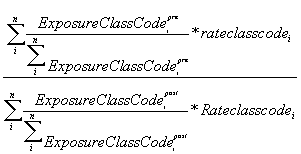
In practice, the mix of journeymen and apprentice electricians is similar at both carve-out and non-carve-out employers, both pre period and post period. In contrast, the occupational mix of non-electricians shifted during the period of this study to substantially fewer non-electrician crafts and relatively more clerical workers. The occupational shift would have made carve-out non-electricians appear increasingly safe over time, which emphasizes the need for the adjustment that we perform.
At the same time, the shifting occupational mix of non-electricians is a concern, because the adjustment relies on additional assumptions and increases measurement error. Thus we do not perform the most theoretically compelling analysis, comparing the rates of change of carve-out electricians versus carve-out non-electricians with the same at non-carve-outs. This difference-in-differences-in-differences analysis controls for common factors that affect all firms over time, all electricians over time, and all carve-out employees at a given time. It is also very sensitive to measurement error. Analysts with larger data sets may want to use this method.
Adjusting for Claims Mix in Individual Case Records
An adjustment was also performed to improve the comparability of the data on individual case reports. This involved weighting the claims to equalize the distribution of the severity of claims across both periods and all four groups. These claims are reported as 1) medical only, 2) temporary total disability only, 3) minor permanent disability, 4) major permanent disability, 5) permanent total disability, and 6) death. These claims have very different medical and indemnity characteristics. The adjustment weighted these claims to reflect the average distribution across both periods and all four groups.
The Workers’ Compensation Appeals Board on-line system tracks all litigated and permanent disability claims except those that are adjudicated within the carve-out programs. For purposes of this evaluation, the relevant data are dates of application for adjudication, declaration of readiness, mandatory settlement conferences, hearings, continuances, and decisions. The on-line system keeps a record of all such events.
These data were obtained for the NECA employees with reported injuries for 1991 through 1996. Even for workers injured at carve-out employers after introduction of alternative dispute resolution processes, the WCAB data was searched but not expected to yield cases for carve-out related claims. Litigation information for the carve-out mediations and arbitrations was collected through telephone contacts with the NECA-IBEW ombudsperson and checked against available records.
In this section we examine first the evidence for non-random selection of employers into carve-outs and the importance of using the difference-in-differences methodology. Then we evaluate safety, cost, and litigation outcomes for the NECA/IBEW carve-out.
Selection of Carve-out Employers
One motivation for using the difference-in-differences method is, that if employers opting to join the carve-out differed from those not choosing to join the method is important for correcting for this selection bias. We examined several measures of employers’ experience with workers’ compensation prior to formation of the carve-out.
Table 17: Weighted Average Experience Modification, Policy Years 1993 to 1995 |
||||||||
Carve-out |
Non-carve-out |
|||||||
| 1992 | 1993 | 1994 | 1995 | 1992 | 1993 | 1994 | 1995 | |
| Mean Ex-Mod |
.950 | .972 | .880 | .892 | .937 | .908 | .909 | .899 |
| Bureau Numbers | n = 201 | n = 251 |
Data are weighted by exposure.
Experience modification (Ex-Mod) is used by the Workers’ Compensation Insurance Rating Bureau (WCIRB) to gauge the safety experience of employers and assist insurers in adjusting premium. An Ex-Mod is a comparison of the experience of an employer over the last three policy years, not including the most recent policy year—an Ex-Mod for the 1993 policy year covers an employer’s experience for policy years 1989-1991. Current WCIRB methodology weights the frequency of reported claims more heavily than their monetary size. In addition, small employers’ experience affects their Ex-Mod less. Average experience modifications are 1.00, the median approximately 0.93. Decreases in the Ex-Mod between 1993 and 1995 would imply that the employer’s safety experience was improving during the period just prior to the carve-out.
Table 17 shows that while safety records of the non-carve-out employers improved more quickly in the early 1990s, the average Ex-Mod for carve-out employers is statistically indistinguishable from that of non-carve-out employers for the years 1994 and 1995. The Ex-Mod for these years reflects the safety experience of the employers across all occupations for the years 1990-1993. The comparisons do not support the hypothesis H1A. Employers joining the NECA/IBEW carve-out did not have safety experience different from that of employers not choosing to participate as measured by weighted average Experience Modification.
Premiums are another measure of the predicted safety experience of employers, as predicted by insurers’ underwriting units. In addition, premiums are the cost of business faced by employers while securing compensation coverage, and a key component of an employer’s decision to join or not join a carve-out program. There are other costs associated with carve-outs. For example, NECA carve-out employers pay a two percent surcharge on premiums for carve-out covered employees to pay the costs of operating the carve-out and alternative dispute resolution process. This cost is not included in the comparisons.
Carve-out |
Non-carve-out |
|||||||
| 1992-1993 | 1994-1995 adjusted* | % Chg. | 1992-1993 | 1994-1995 adjusted* | % Chg. | |||
| Electricians | .0509 | .0334 | -34.4% | .0487 | .0298 | -38.8% | ||
| Difference: % change carve-out – % change non-carve-out |
4.4% | |||||||
| Non-electricians | .0395 | .0249 | -37.0% | .0456 | .0284 | -37.7% | ||
| Difference: % change CO non-electricians – % change non-CO non-electricians | 0.7% | |||||||
*Adjusted for changes in distribution of class codes using 1992-1993 extant distribution.
Table 18 gives evidence to support Hypothesis H1C. Premium data do suggest that employers who opted to join the carve-out differed from employers who did not join. Premium rates for electrician class codes were different for these two groups of employers, and the difference is statistically significant [t-stat = 2.46]. Reported premium may be affected by factors other than the safety expectations of the insurers.
The H1B hypothesis receives weak support when we turn to claims rates (Tables 19, 20 and 21). Claims rates, as measured by claims per $1 million of exposure, were slightly lower for NECA employers who later joined the carve-outs.
Table 21 shows data on reported claims per $1 million of exposure. These data suggest that carve-out employers had better safety records for electricians (4.43 claims per $1 million exposure) before joining the carve-out than the non-carve-out employers (4.96 claims per $1 million exposure). This difference was statistically significant at near conventional levels [t-stat = 1.893, .059]. Though these data give some support to hypothesis H1B that employers joining carve-outs had better safety records than those who did not join, this result leads in the opposite direction from that of the evidence on premiums.
These data give mixed results regarding whether there is positive selection of systematically safety-conscious employers in the carve-out. At the same time, the higher premiums but better safety record of electricians at employers who would soon join the carve-out is strong evidence that it is important to control for unobserved heterogeneity in analyses of carve-out effects by using the difference-in-differences methodology.
Table 18 shows that premiums as a percentage of payroll for carve-out employers declined substantially between the two years prior to the carve-out and the two years following formation of the carve-out. However, a slightly larger—in both absolute and proportional terms—but not statistically different improvement is seen among the non-carve-out electrical contractors. Carve-out employers experienced a 34.4 percent reduction while non-carve-out employers experienced a 38.8 percent reduction in premiums for class codes covered by the carve-out. This does not support hypothesis H2A that carve-outs reduced premium costs for the employers, at least during the first years. It may be that insurers do not yet recognize the improvement in costs under the carve-out that should be translated into improvements in premium. However, there is nothing to indicate that paid or incurred losses have declined, leading to larger future premium reductions for carve-out employers.
Similar reductions were seen for the non-electrician class codes. Though the carve-out firm class codes not including electricians showed a slightly better percentage drop in their premium relative to payroll than electrician class codes covered by the carve-out, the difference was not statistically significant. These data do not support hypothesis H2B on premiums dropping more rapidly on electrician class codes covered by the carve-out program.
These data were adjusted for small changes over time in the ratio of journeypersons to apprentices among electricians, and for somewhat larger differences in the distribution of exposure by class code among non-electrician employment.
Electricians in the carve-out experienced a reduction in reported injury rates, claims per $1 million of exposure, of 26 percent (Table 19) from two years before carve-out startup to two years subsequent, difference significant at .001. This rate of improvement was slightly, but not significantly, better than the 23 percent reduction for electricians at the non-carve-out employers. The results do not support hypothesis H2C—carve-outs do not appear to improve safety for electricians beyond the trend toward industrywide improvement.
Table 19: Number of Claims per $1 Million Exposure (all reported claims)
Pre |
Post** |
Percent Change |
Difference |
Std. Error of Difference |
t-stat |
|
Carve-out Electricians |
||||||
Mean |
4.430 |
3.270 |
-26.2% |
-1.160 |
0.264 |
-4.396 |
n= |
171 |
171 |
||||
Non-carve-out Electricians |
||||||
Mean |
4.956 |
3.834 |
-22.6% |
-1.122 |
0.261 |
-4.296 |
n= |
197 |
197 |
||||
Carve-out Non-electricians |
||||||
Mean |
2.775 |
2.273 |
-18.1% |
-0.502 |
0.240 |
-2.095 |
n= |
174 |
174 |
||||
Difference in Differences |
Mean |
Std. Error |
t-stat |
|||
| Electricians: Carve-out minus Non-carve-out |
-.038 |
0.371 |
-0.102 |
|||
| Carve-out: Electricians minus Non-electricians |
-0.658 |
0.356 |
-1.846 |
n = number of separate entities (as indicated by Bureau Numbers) reporting data in both the pre (1992 and/or 1993) and post (1994 and/or 1995) periods.
** Figures for the post period (1994 and 1995 policy years) are adjusted to reflect the distribution of exposure by class code extant in the pre period (1992 and 1993 policy years).
If we adjust for within firm changes, the carve-outs still look slightly better. Injury rates for non-electricians fell 18 percent, which is less, but again not significantly less, than for electricians at the same firm. In short, consistent with the case study though not with the Pioneer Valley experience, after taking into consideration pre-carve-out differences, these results provide little evidence that carve-outs improved electricians’ safety. Unless for some reason safety worsened at carve-outs, these results also provide no evidence that carve-outs reduce employees’ proclivity to report injuries.
Union electricians showed statistically significant declines in disability claims (Table 20). Rates of disability claims also fell faster, 32 percent, for the carve-out electricians than for non-carve-out electricians, 20 percent. The difference is not statistically significant. The decline for carve-out electricians was faster, significant at the 5 percent level, than for carve-out non-electricians, 15 percent. Cautions follow on interpreting this statistic.
Table 20: Number of Disability Claims per $1 Million Exposure
Pre |
Post** |
Percent Change |
Difference |
Std. Error of Difference |
t-stat |
|
Carve-out Electricians |
||||||
Mean |
1.361 |
0.921 |
-32.3% |
-0.440 |
0.117 |
-3.777 |
n= |
171 |
171 |
||||
Non-carve-out Electricians |
||||||
Mean |
1.392 |
1.113 |
-20.0% |
-0.279 |
0.109 |
-2.550 |
n= |
197 |
197 |
||||
Carve-out Non-electricians |
||||||
Mean |
2.775 |
2.273 |
-18.1% |
-0.502 |
0.204 |
-2.095 |
n= |
174 |
174 |
||||
Difference in Differences |
Mean |
Std. Error |
t-stat |
|||
| Electricians: Carve-out minus Non-carve-out |
-0.038 |
0.371 |
-0.102 |
|||
| Carve-out: Electricians minus Non-electricians |
-0.658 |
0.356 |
-1.846 |
n = number of separate entities (as indicated by Bureau Numbers) reporting data in both the pre (1992 and/or 1993) and post (1994 and/or 1995) periods.
** Figures for the post period (1994 and 1995 policy years) are adjusted to reflect the distribution of exposure by class code extant in the pre period (1992 and 1993 policy years).
Looking at permanent disability claims only, we again see across the board declines in the rate of claims per $1 million of exposure (Table 21). Though the decline for carve-out electricians is again more rapid than for the two comparison groups, the difference-in-differences comparisons are not significant.
Table 21: Number of Permanent Disability Claims per $1 Million Exposure
Pre |
Post** |
Percent Change |
Difference |
Std. Error of Difference |
t-stat |
|
Carve-out Electricians |
||||||
Mean |
0.450 |
0.323 |
-28.2% |
-0.127 |
0.073 |
-1.742 |
n= |
171 |
171 |
||||
Non-carve-out Electricians |
||||||
Mean |
0.551 |
.0508 |
-7.8% |
-0.043 |
0.072 |
-0.598 |
n= |
197 |
197 |
||||
Carve-out Non-electricians |
||||||
Mean |
0.303 |
0.246 |
-18.8% |
-0.057 |
0.058 |
-0.984 |
n= |
174 |
174 |
||||
Difference in Differences |
Mean |
Std. Error |
t-stat |
|||
| Electricians: Carve-out minus Non-carve-out |
-0.084 |
0.102 |
-0.824 |
|||
| Carve-out: Electricians minus Non-electricians |
-0.070 |
0.093 |
-0.751 |
n = number of separate entities (as indicated by Bureau Numbers) reporting data in both the pre (1992 and/or 1993) and post (1994 and/or 1995) periods.
** Figures for the post period (1994 and 1995 policy years) are adjusted to reflect the distribution of exposure by class code extant in the pre period (1992 and 1993 policy years).
In general, considering each of the three classifications of claims, carve-out electricians showed slightly greater reductions in the number of claims per $1 million of exposure. Though this is consistent with hypotheses that carve-outs can improve safety, the evidence is weak. In addition, other explanations have been proposed for the decline in claims reported, including reduced ability of the injured worker to report claims in the absence of attorney representation to inform the worker that a claim may exist.
Incurred costs should be interpreted cautiously. Incurred costs are what the insurer expects to pay out over the life of the claim. To the extent that insurers factor in an expectation of a positive effect of carve-outs on the costs of claims, this is reflected in optimistic reserving practices, lower reserves, and lower reported incurred costs. More time is needed to see if any such optimism affected reserving practices, and whether the optimism was warranted. Consequently, we present both incurred and paid costs.
Incurred costs are drawn from the unit statistical report and include all reported claims. These data are presented as dollars incurred per $1 million of exposure. Paid data is only available for claims that insurers report to the WCIRB through the Individual Case Records. These claims are for the most costly one-third of claims and are 90 percent of costs. Since these data are for only a portion of claims, we report paid data as average dollars per claim.
Table 22: Total Benefit Dollars Incurred per $1 Million Exposure
Pre |
Post** |
Percent Change |
Difference |
Std. Error of Difference |
t-stat |
||
Carve-out Electricians |
|||||||
Mean |
$24,644 |
$21,296 |
-13.6% |
-$3,349 |
4063 |
-.082 |
|
n= |
171 |
171 |
|||||
Non-carve-out Electricians |
|||||||
Mean |
$24,874 |
$23,904 |
-3.9% |
-$970 |
4291 |
-0.22 |
|
n= |
197 |
197 |
|||||
Carve-out Non-electricians |
|||||||
Mean |
$20,675 |
$14,858 |
-28.1% |
-$5,817 |
3403 |
-1.71 |
|
n= |
174 |
174 |
|||||
Difference in Differences |
Mean |
Std. Error |
t-stat |
||||
| Electricians: Carve-out minus Non-carve-out |
-2379 |
5909 |
-0.40 |
||||
| Carve-out: Electricians minus Non-electricians |
2469 |
5300 |
0.46 |
||||
Table 22 gives average total incurred costs as dollars per $1 million of exposure. These data are reported for employers with exposure in both periods only. Costs relative to exposure declined for all groups observed. The decline for class codes covering electricians was slightly greater for carve-out employers but slightly less than for non-electrician class codes within the carve-outs. Neither comparison is statistically significant, suggesting that carve-outs did not substantially reduce benefit costs beyond industry trends.
Looking at indemnity and medical incurred costs separately (Tables 23 and 24), the same pattern is present as in total costs. Carve-out electricians had greater declines in both medical and indemnity costs incurred than electricians at non-carve-out employers. Within carve-out firms, electricians covered by the carve-out had smaller declines in costs than other occupations, at carve-out employers, but not covered by the carve-out program. These results suggest a hypothesis that any greater improvements for carve-out electricians relative to their non-carve-out electrician counterparts may have more to do with firm-specific characteristics, independent of carve-out programs. The evidence gives additional support for using difference-in-differences methodology to help control for such selection bias.
Table 23: Indemnity Incurred per $1 Million Exposure
Pre |
Post** |
Percent Change |
Difference |
Std. Error of Difference |
t-stat |
|
Carve-out Electricians |
||||||
Mean |
$14,491 |
$11,584 |
-20.1% |
-$2,907 |
2565 |
-1.13 |
n= |
171 |
171 |
||||
Non-carve-out Electricians |
||||||
Mean |
$15,074 |
$14,030 |
-6.9% |
-$1,044 |
2650 |
-0.39 |
n= |
197 |
197 |
||||
Carve-out Non-electricians |
||||||
Mean |
$12,486 |
$9,642 |
-22.8% |
-$2,844 |
2341 |
-1.21 |
n= |
174 |
174 |
||||
Difference in Differences |
Mean |
Std. Error |
t-stat |
|||
| Electricians: Carve-out minus Non-carve-out |
-$1,863 |
3688 |
-0.50 |
|||
| Carve-out: Electricians minus Non-electricians |
-$63 |
3743 |
-0.01 |
Table 24: Medical Incurred per $1 Million Exposure
Pre |
Post** |
Percent Change |
Difference |
Std. Error of Difference |
t-stat |
|
Carve-out Electricians |
||||||
Mean |
$10,153 |
$9,711 |
-4.3% |
-$441 |
1811 |
-0.24 |
n= |
171 |
171 |
||||
Non-carve-out Electricians |
||||||
Mean |
$9,800 |
$9,874 |
0.8% |
$74 |
1858 |
0.04 |
n= |
197 |
197 |
||||
Carve-out Non-electricians |
||||||
Mean |
$8,190 |
$5,216 |
-36.3% |
-$2,974 |
1222 |
-2.43 |
n= |
174 |
174 |
||||
Difference in Differences |
Mean |
Std. Error |
t-stat |
|||
| Electricians: Carve-out minus Non-carve-out |
-$515 |
2594 |
-0.19 |
|||
| Carve-out: Electricians minus Non-electricians |
$2,533 |
2185 |
1.15 |
n = number of separate entities (as indicated by Bureau Numbers) reporting data in both the pre (1992 and/or 1993) and post (1994 and/or 1995) periods.
** Figures for the post period (1994 and 1995 policy years) are adjusted to reflect the distribution of exposure by class code extant in the pre period (1992 and 1993 policy years).
Tables 26 through 28 present paid data, which like incurred data should be interpreted cautiously. These data are sensitive to the age and maturity of claims. With paid data, unlike incurred, the estimation and expectation elements are removed from the comparison. However, if carve-out programs change the speed with which payments are made, they will affect the comparison between carve-outs and non-carve-outs at any point prior to the settlement of all claims. Speeding up or slowing down the payment of indemnity, for example, by settling cases more quickly or slowly will make it appear that carve-out costs are higher or lower, even if total costs will eventually be the same.
One measure of faster benefit payment is the rate at which claims close. Faster closure on claims could signal faster benefit delivery. If carve-outs resolve cases more quickly or slowly, benefit payments will have been made more quickly or slowly and paid data measured at the same point in time will be biased up or down, relative to comparison groups. This will be particularly true of indemnity payments, since a substantial portion of indemnity payments are made as a lump-sum settlement when a claim is resolved.
Table 25 presents data on the rate of claim closure for reported claims on the individual case records. There is evidence that the claims closed more slowly for all groups in the post period. In addition, a smaller percentage of claims by electricians within carve-out firms were resolved, relative to electricians at non-carve-out firms and non-electricians at carve-out firms.
Table 25: Percentage of Disability Claims Closed
Fraction Closed Pre |
Fraction Closed Post** |
Percent Change |
Difference |
Std. Error of Difference |
t-stat |
|
Carve-out Electricians |
||||||
Mean |
0.60 |
0.39 |
-35.9% |
-0.22 |
0.06 |
-3.85 |
n= |
179 |
141 |
||||
Non-carve-out Electricians |
||||||
Mean |
0.61 |
0.49 |
-19.0% |
-0.12 |
0.04 |
-2.65 |
n= |
273 |
270 |
||||
Carve-out Non-electricians |
||||||
Mean |
0.51 |
0.43 |
-15.7% |
-0.08 |
0.09 |
-0.91 |
n= |
99 |
54 |
||||
Difference in Differences |
Mean |
Std. Error |
t-stat |
|||
| Electricians: Carve-out minus Non-carve-out |
-0.101 |
0.071 |
-1.42 |
|||
| Carve-out: Electricians minus Non-electricians |
-0.137 |
0.104 |
-1.32 |
n = number of individually reported disability claims.
**Data for post period are weighted to reflect similar distributions of indemnity claim types (temporary total disability, minor permanent disability, major permanent disability) as existed in the pre period.
With these cautions in mind, the evidence from paid data does not support hypothesis H3A that electricians in the carve-out had a greater rate of reduction in medical and indemnity benefits than electricians at non-carve-out firms. Mean medical costs per injury (Table 26) declined slightly for injuries to carve-out electricians, but also for non-carve-out electricians and for non-electricians at carve-out firms. While average payments differed across these groups in both periods, the proportional change between periods was virtually identical.
Table 26: Medical Paid on Individually Reported Claims
Pre |
Post** |
Percent Change |
Difference |
Std. Error of Difference |
t-stat |
|
Carve-out Electricians |
||||||
Mean |
$7,768 |
$7,405 |
-4.7% |
-$363 |
1416 |
-0.26 |
Median |
$4,865 |
$4,212 |
-13.4% |
-$653 |
||
n= |
184 |
142 |
||||
Non-carve-out Electricians |
||||||
Mean |
$8,737 |
$8,595 |
-1.6% |
-$142 |
1260 |
-0.11 |
Median |
$5,469 |
$5,751 |
5.2% |
$283 |
||
n= |
293 |
281 |
||||
Carve-out Non-electricians |
||||||
Mean |
$9,500 |
$8,987 |
-5.4% |
-$513 |
1760 |
-0.29 |
Median |
$5,751 |
$4,897 |
-14.9% |
-$854 |
||
n= |
105 |
57 |
||||
Difference in Differences |
Mean |
Std. Error |
t-stat |
|||
| Electricians: Carve-out minus Non-carve-out |
-$221.2 |
1896 |
-0.12 |
|||
| Carve-out: Electricians minus Non-electricians |
$150.5 |
2259 |
0.07 |
n = number of individually reported claims including medical only.
**Data for post period are weighted to reflect similar distributions of claim types (medical only, temporary total disability only, minor permanent disability, major permanent disability) as existed in the pre period.
In contrast to paid medical, average indemnity paid (Table 27) rose for all three groups, consistent with the trend in medical costs systemwide. Indemnity paid per disability claim was nearly identical for electricians covered by carve-out as well as non-carve-out electricians for both the pre and post periods. The non-electrician occupations showed greater, but not significant, increases in indemnity paid per disability claim than electricians within the same carve-out firms. This difference could have been affected by changes in the distribution of workers among class codes, which could affect injury costs. Changes in costs per injury for carve-out electricians were consistently in the middle of the two comparison groups, emphasizing the lack of significance of any changes.
Table 27: Average Indemnity Paid per Claim (disability claims)
Pre |
Post** |
Percent Change |
Difference |
Std. Error of Difference |
t-stat |
|
Carve-out Electricians |
||||||
Mean |
$12,507 |
$13,316 |
6.5% |
$809 |
1972 |
0.41 |
Median |
$5,676 |
$7,168 |
26.3% |
$1492 |
||
n= |
179 |
141 |
||||
Non-carve-out Electricians |
||||||
Mean |
$12,575 |
$12,909 |
2.7% |
$334 |
1452 |
0.23 |
Median |
$5,136 |
$6,002 |
16.9% |
$866 |
||
n= |
273 |
270 |
||||
Carve-out Non-electricians |
||||||
Mean |
$12,053 |
$14,754 |
22.4% |
$2,700 |
2992 |
0.90 |
Median |
$6,175 |
$8,225 |
33.2% |
$2,050 |
2992 |
|
n= |
99 |
54 |
||||
Difference in Differences |
Mean |
Std. Error |
t-stat |
|||
| Electricians: Carve-out minus Non-carve-out |
$476 |
2449 |
0.19 |
|||
| Carve-out: Electricians minus Non-electricians |
-$1891 |
2583 |
-0.53 |
n = number of individually reported disability claims.
**Data for post period are weighted to reflect similar distributions of indemnity claim types (temporary total disability only, minor permanent disability, major permanent disability) as existed in the pre period.
These data do not support hypotheses H3A or H3C that electricians at carve-out employers experienced greater reductions in medical or indemnity benefits than electricians at non-carve-out employers. Nor do these data support hypotheses H3B or H3D on electricians at carve-out employers experiencing greater reductions in medical or indemnity benefits than non-electricians within the same firms.
Conditional on receiving any permanent partial disability benefits, the amount of permanent partial disability paid to carve-out electricians rose 66 percent from before to after carve-out formation (Table 28). This rate of increase was substantially more rapid than for non-carve-out electricians with an 11 percent increase, or for carve-out non-electricians with a 33 percent decrease, although none of the difference in differences is statistically significant. The major consideration regarding these comparisons of paid permanent disability amounts is that permanent disability is paid late in claims, often as a lump sum at time of settlement. At this early stage in claim experience, most permanent disability has not been paid and small changes on a few claims can have disproportional effects. The fact that very large differences remain not statistically significant emphasizes the small sample size and highly skewed distribution of the figures analyzed. These data, however, do not support hypotheses H3A and H3B that the alternative dispute resolution process, employer control of the physician and limitations placed on representation reduced the indemnity awards to injured workers within carve-outs.
Table 28: Average Permanent Partial Disability (PPD) Paid per PPD Claim
Pre |
Post** |
Percent Change |
Difference |
Std. Error of Difference |
t-stat |
|
Carve-out Electricians |
||||||
Mean |
$2,991 |
$4,996 |
66.1% |
$1,976 |
1073 |
1.84 |
n= |
107 |
97 |
||||
Non-carve-out Electricians |
||||||
Mean |
$5,141 |
$5,663 |
10.2% |
$522 |
1112 |
0.47 |
n= |
195 |
207 |
||||
Carve-out Non-electricians |
||||||
Mean |
$4,872 |
$3,246 |
-33.3% |
-$1.624 |
2011 |
-0.81 |
n= |
62 |
38 |
||||
Difference in Differences |
Mean |
Std. Error |
t-stat |
|||
| Electricians: Carve-out minus Non-carve-out |
$1,454 |
1545 |
0.94 |
|||
| Carve-out: Electricians minus Non-electricians |
$3,600 |
2279 |
1.58 |
n = number of individually reported permanent partial disability claims.
**Data for post period are weighted to reflect similar distributions of indemnity claim types (minor permanent disability, major permanent disability) as existed in the pre period.
Table 29: Average Weeks of Temporary Total Disability per Indemnity Claim
Pre |
Post** |
Percent Change |
Difference |
Std. Error of Difference |
t-stat |
|
Carve-out Electricians |
||||||
Mean |
14.2 |
13.8 |
-2.4% |
-0.3 |
2.19 |
-0.15 |
Median |
7.1 |
8.3 |
17.2% |
1.2 |
||
n= |
179 |
141 |
||||
Non-carve-out Electricians |
||||||
Mean |
19.8 |
16.8 |
-14.7% |
-2.9 |
2.37 |
-1.22 |
Median |
9.4 |
7.5 |
-20.1% |
-1.9 |
||
n= |
273 |
270 |
||||
Carve-out Non-electricians |
||||||
Mean |
22.64 |
10.12 |
-55.3% |
-12.5 |
3.47 |
-3.60 |
Median |
11.4 |
1.4 |
-87.5% |
-9.9 |
||
n= |
99 |
54 |
||||
Difference in Differences |
Mean |
Std. Error |
t-stat |
|||
| Electricians: Carve-out minus Non-carve-out |
2.6 |
3.23 |
0.79 |
|||
| Carve-out: Electricians minus Non-electricians |
12.2 |
4.11 |
2.96 |
n = number of individually reported disability claims.
**Data for post period are weighted to reflect similar distributions of indemnity claim types (temporary total disability, minor permanent disability, major permanent disability) as existed in the pre period.
Table 29 examines mean weeks of temporary total disability, conditional on an injury resulting in an indemnity claim reported through the individual case record. Mean weeks of temporary total disability paid declined for carve-out electricians by .3 weeks, but this decline was smaller than for non-carve-out electricians at 2.9 weeks and for carve-out non-electricians at 12.5 weeks. Median weeks of temporary total disability rose for carve-out electricians, but not for the two comparison groups.
The relatively rapid decline in mean temporary total disability for carve-out non-electricians, compared with carve-out electricians, is statistically significant at conventional levels [t = 2.97]. When examining this result it is important to recall that this chapter includes more than 20 tests of statistical significance, and found only two comparison of means that were significant at the 5 percent level. Thus, no single test statistic can be examined in isolation.
In short, these findings provide no evidence for hypothesis H4A on carve-outs having a greater rate of reduction in time to return to work than non-carve-outs. This is consistent with the case study information that did not indicate that injured workers within the carve-out were any more able to take advantage of alternate or modified work in order to speed up their return to work. In the absence of opening up opportunities for modified work, quicker return would require better medical treatment, better relationships between employers and employees, or the absence of incentive to remain off the job to increase indemnity benefits.
This calculation is subject to numerous caveats. It is based on the average weeks of temporary total disability for employees with any total temporary disability. As such, it is biased up or down by any shift that might increase or decrease short-term cases of temporary total disability. Also, the distribution of occupations for non-electrician class codes changed substantially between the pre and post periods, which can have important implications for the return-to-work measures. For example, if the change is away from laborers and toward clerical workers, return to work may occur more rapidly. Also, return to work and successful return to work are not necessarily coincidental—an employee may return to a job that will subsequently result in re-injury. Moreover, return to work depends on the availability of work, which can fluctuate substantially within the construction industry.
Tables 30, 31, 32 and 34 describe the changes in dispute resolution costs. Several important caveats need to be kept in mind. Defense and applicant legal costs have different payment timing characteristics. Defense costs are generally acknowledged as paid when they are incurred, while the majority of applicant costs are reported and paid at the time of settlement. The approach used in this study controls for much of this. Comparisons of pre period to post period between either defense or applicant expenditures are more reliable if, as done here, the time periods over which paid data are calculated are similar.
Table 30: Average Total Legal Costs per Disability Claim
(applicant and defense legal plus applicant, defense, and independent medical-legal evaluation)
Pre |
Post** |
Percent Change |
Difference |
Std. Error of Difference |
t-stat |
|
Carve-out Electricians |
||||||
Mean |
$880 |
$823 |
-6.5% |
-$57 |
269 |
-0.213 |
n= |
179 |
141 |
||||
Non-carve-out Electricians |
||||||
Mean |
$1,525 |
$1,305 |
-14.5% |
-$221 |
257 |
-0.86 |
n= |
273 |
270 |
||||
Carve-out Non-electricians |
||||||
Mean |
$1,449 |
$897 |
-38.1% |
-$551 |
432 |
-1.28 |
n= |
99 |
54 |
||||
Difference in Differences |
Mean |
Std. Error |
t-stat |
|||
| Electricians: Carve-out minus Non-carve-out |
$163 |
372 |
0.44 |
|||
| Carve-out: Electricians minus Non-electricians |
$494 |
509 |
0.97 |
n = number of individually reported disability claims.
**Data for post period are weighted to reflect similar distributions of indemnity claim types (temporary total disability, minor permanent disability, major permanent disability) as existed in the pre period.
The timing of disputes and the timing of both defense and applicant paid data are affected if carve-outs speed up or slow down the settlement process. If carve-outs speed up the settlement process, paid data in the post period will appear higher relative to the pre period, even if there is no change in the costs. This will occur because more payments will be made earlier, and we are looking at data over the same length of time both pre and post.
Average total dispute resolution costs—applicant and defense costs as well as medical-legal costs—fell 6.5 percent for carve-out electricians (Table 29). Hypothesis H5A suggests that carve-out firms had a greater rate of reduction in dispute resolution costs per claim than the non-carve-out firms. In fact, the rate of reduction in dispute resolution costs was not better for carve-outs, given that the non-carve-out electricians experienced a 14.5 percent percent decline and non-electricians at carve-out firms experienced a 38 percent decline. These results do not appear driven by costs of a few high-cost cases (for example, Tony Costa v. WCAB) that were appealed—results (not shown) are similar if the three highest-cost cases are dropped from each category. Thus we find no support for the hypothesis that legal costs are lower in carve-outs.
Interestingly, the total legal cost for carve-outs at this stage of claim maturity is under $50,000 per accident year. It is unlikely that reducing dispute costs will ever suffice to pay for maintaining alternative dispute resolution unless there are other benefits to employees or employers.
Table 31: Average Defense Legal Costs Paid per Disability Claim
Pre |
Post** |
Percent Change |
Difference |
Std. Error of Difference |
t-stat |
|
Carve-out Electricians |
||||||
Mean |
$451 |
$562 |
24.6% |
$111 |
201 |
0.55 |
n= |
179 |
141 |
||||
Non-carve-out Electricians |
||||||
Mean |
$999 |
$700 |
-29.9% |
-$299 |
212 |
-1.40 |
n= |
273 |
270 |
||||
Carve-out Non-electricians |
||||||
Mean |
$706 |
$466 |
-34.0% |
-$240 |
296 |
-0.81 |
n= |
99 |
54 |
||||
Difference in Differences |
Mean |
Std. Error |
t-stat |
|||
| Electricians: Carve-out minus Non-carve-out |
$410 |
292 |
1.40 |
|||
| Carve-out: Electricians minus Non-electricians |
$351 |
358 |
0.98 |
n = number of individually reported disability claims.
**Data for post period are weighted to reflect similar distributions of indemnity claim types (temporary total disability, minor permanent disability, major permanent disability) as existed in the pre period.
Disaggregating the data does reveal at least one area of possible concern. Defense legal costs rose 25 percent on cases for carve-out electricians, but fell 30-34 percent in the two comparison groups. These figures are the average cost on indemnity claims reported under the individual case records. At the same time, applicant legal costs declined 55 percent for carve-out electricians while rising 10 percent for non-carve-out electricians. While these differences are not statistically significant, a question arises as to whether the additional costs for defense and reduced representation for the applicant will affect the balance of power between parties in future settlements. Alternately, if defense costs have risen it could mean that during the start-up phase of carve-outs defense costs are simply higher because the processes are new.
A reduction in applicant legal costs means savings to workers that would otherwise have come out of their settlement. If workers receive the same indemnity amounts for similar injuries under both systems, as earlier data suggested, the savings on applicant legal costs means a gain for employees. Table 32 exhibits the data on applicant legal costs. At this early stage in the legal process, carve-out electricians are showing considerable savings on their legal costs.
Table 32: Average Applicant Legal Costs Paid per Disability Claim
Pre |
Post |
Percent Change |
Difference |
Std. Error of Difference |
t-stat |
|
Mean |
$184 |
$82 |
-55.5% |
-$102 |
73.3 |
-1.40 |
n= |
179 |
141 |
||||
Non-carve-out Electricians |
||||||
Mean |
$221 |
$243 |
9.7% |
$21 |
74.7 |
0.28 |
n= |
273 |
270 |
||||
Carve-out Non-electricians |
||||||
Mean |
$417 |
$230 |
-44.8% |
-187 |
301.9 |
-0.31 |
n= |
99 |
54 |
||||
Difference in Differences |
Mean |
Std. Error |
t-stat |
|||
| Electricians: Carve-Out minus Non-carve-out |
-$123 |
104 |
-1.18 |
|||
| Carve-out: Electricians minus Non-electricians |
$85 |
310 |
0.27 |
n = number of individually reported disability claims.
**Data for post period are weighted to reflect similar distributions of indemnity claim types (temporary total disability, minor permanent disability, major permanent disability) as existed in the pre period.
Table 33: Percentage of Disability Claims Represented by an Attorney
Pre |
Post** |
Percent Change |
Difference |
Std. Error of Difference |
t-stat |
|
Carve-out Electricians |
||||||
Mean |
37.4% |
19.3% |
-48.4% |
-18.1% |
0.049 |
-3.67 |
n= |
179 |
141 |
||||
Non-carve-out Electricians |
||||||
Mean |
35.5% |
32.0% |
-9.9% |
-3.5% |
0.041 |
-0.87 |
n= |
273 |
270 |
||||
Carve-out Non-electricians |
||||||
Mean |
38.4% |
31.8% |
-17.2% |
-6.6% |
0.081 |
-0.82 |
n= |
99 |
54 |
||||
Difference in Differences |
Mean |
Std. Error |
t-stat |
|||
| Electricians: Carve-Out minus Non-carve-out |
-14.6% |
0.064 |
-2.28 |
|||
| Carve-out: Electricians minus Non-electricians |
-11.5% |
0.095 |
-1.21 |
n = number of individually reported disability claims.
**Data for post period are weighted to reflect similar distributions of indemnity claim types (temporary total disability, minor permanent disability, major permanent disability) as existed in the pre period.
The decline in applicant legal costs, while not statistically significant in the small sample of claims at this early stage of claim development, is supported by data showing a decline in attorney representation for carve-out electricians. Nearly all applicant legal costs are generated by applicant attorney contingency payments customarily 12-18 percent of indemnity payments. A decline in representation translates directly into a decline in applicant legal costs. Table 32 shows that the percentage of disability claims represented by an attorney has declined 45 percent between the two years prior to the carve-out and the two years subsequent to the carve-out’s formation. This change is statistically significant. Non-carve-out electricians showed a smaller decline, 6 percent. The difference between these two changes is statistically significant at .05. The decline for non-electricians at carve-out firms was smaller than for electricians and not statistically significant. In the period prior to carve-out formation, the percentage of disability claims represented by attorneys was similar for all three groups.
Medical-legal costs were an area where carve-outs were expected to have a substantial impact on costs. With the carve-out’s greater control over the treating physician and the ability to control selection of medical evaluators, medical-legal costs should be reduced. The data in Table 33 suggest that the carve-out may have accomplished this goal. There is weakly significant statistical inference (>90 percent) that carve-outs reduce medical-legal costs for claims by electricians by a greater amount than experienced on claims by electricians at non-carve-outs. Non-electricians at carve-outs also had medical-legal costs on their claims decline substantially, again suggesting that the improvement may be due to firm-specific factors rather than characteristics of the carve-out program.
Table 34: Total Medical-Legal Costs Paid (applicant, defense, and independent)
Pre |
Post** |
Percent Change |
Difference |
Std. Error of Difference |
t-stat |
|
Carve-out Electricians |
||||||
Mean |
$247 |
$87 |
-63.7% |
-$153.5 |
67.6 |
-2.27 |
n= |
179 |
141 |
||||
Non-carve-out Electricians |
||||||
Mean |
$290 |
$296 |
2.3% |
$6.6 |
55.0 |
0.12 |
n= |
273 |
270 |
||||
Carve-out Non-electricians |
||||||
Mean |
$412 |
$216 |
-47.6% |
-$195.8 |
152.4 |
-1.28 |
n= |
99 |
54 |
||||
Difference in Differences |
Mean |
Std. Error |
t-stat |
|||
| Electricians: Carve-out minus Non-carve-out |
-$160 |
87.2 |
-1.83 |
|||
| Carve-out: Electricians minus Non-electricians |
$42.3 |
166.7 |
0.25 |
n = number of individually reported disability claims.
**Data for post period are weighted to reflect similar distributions of indemnity claim types (temporary total disability, minor permanent disability, major permanent disability) as existed in the pre period.
Tables 35and 36 show how the rates of mandatory settlement conferences and hearings at the WCAB for electricians at carve-out firms before the carve-out compared with the rates of mediations and arbitrations after the carve-out was formed. Comparisons with carve-out non-electricians and non-carve-out electricians are also given. For brevity, we discuss only the latter comparison group.
Table 35: Mediations/Mandatory Settlement Conferences
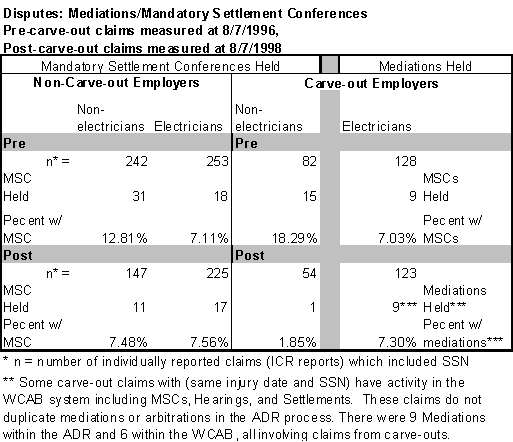
These data should be viewed cautiously. Mandatory settlement conferences are not directly equivalent to mediations, and hearings are not directly equivalent to arbitrations. We make these comparisons solely to get a qualitative feel for whether dispute rates have increased or decreased dramatically. The comparison is not apples to apples, but where it might be apples to oranges, it is also not apples to cows. Moreover, only a small percentage of the injuries lead to disputes, so we do not have a large enough sample to make meaningful comparisons of statistical significance.
Another consideration regarding dispute rates is the selection of injuries reported to the workers’ compensation insurer. To the extent that the carve-out has increased or decreased reporting of controversial claims, or decreased or increased reporting of claims that would not lead to dispute, the carve-out dispute rates are biased up or down.
For injuries reported by carve-out electricians during the post-carve-out period, there was a surprising level of activity reported in the WCAB system. This included both mandatory settlement conferences and hearings reported for the same Social Security Number and date of injury. Not included in the data reported in Tables 35 and 36, these data are denoted by a triple asterisk (***). Six mandatory settlement conferences and six hearings were held at the WCAB on claims apparently originating within the carve-out. These were in addition to the nine mediations but no arbitrations held within the carve-out alternative dispute resolution process during the period under evaluation.
Table 36: Arbitrations/Hearings
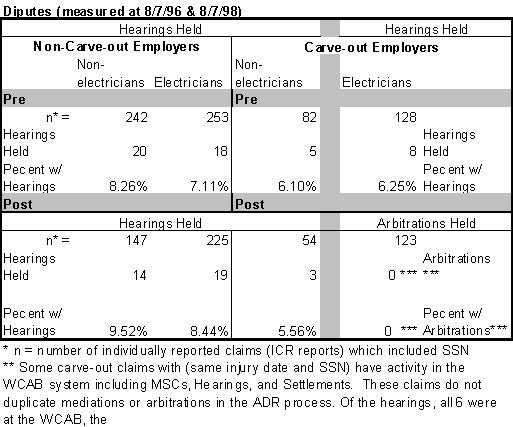
At this point we have not determined the origin of these claims, which include settlements before the WCAB. There are a number of possibilities: the insurer and injured worker chose to ignore the carve-out process; or the employee challenged the carve-out process, which resulted in a mandatory settlement conference or hearing; or a cumulative injury involved more than one employer, one of whom was not in the carve-out, and the employers and worker jointly agreed to adjudicate the claim within the statutory system. Additional data would resolve this question.
Cases within the WCAB raise the possibility that the number of disputes and the proportion of claims on which disputes occur are substantially greater within carve-outs than the tables indicate. The tables include only cases where carve-out electricians invoked the alternative dispute resolution process, and not other disputes on carve-out claims that were resolved through the WCAB. If these events were included, the percentage of Individual Case Record claims by electricians involving a mandatory settlement conference or mediation would be 12.2 percent, and the number involving a hearing or arbitration would be 4.9 percent for the post-carve-out period.
Using data in Tables 35 and 36, we see that before the carve-out, electricians at firms that joined the carve-out had similar rates of mandatory settlement conferences as electricians at firms that did not opt for the carve-out program—approximately 7 percent of individually reported disability claims. After the carve-out alternative dispute resolution process was introduced, these rates were virtually unchanged.
For electricians at firms not in the carve-out, the frequency of hearings was similar in both periods. For carve-out electricians there were no arbitrations. However, there were a number of hearings held at the WCAB on injuries apparently occurring within the carve-out.
The number of mandatory settlement conferences/mediations and hearings/arbitrations held is small for both groups when measured as a fraction of claims, even at this stage of the claim process three to four years after injury. These numbers nevertheless stand in marked contrast to data reported in the DWC annual reports. The DWC reported only eight mediations and two arbitrations for all injuries at all carve-outs for the first three years, 1995-1997. These are fewer mediations than reported in more mature data at just the NECA-IBEW carve-out, covering only a fraction of the same claims. The DWC reported on disputes at very early stages in the process, during the same calendar year as the injury. At that stage of the claim, very few are involved in the dispute process.
These results are quite preliminary, covering only 180 serious—that is, individually reported—injuries within the carve-out. The results may be quite sensitive to differences in injuries leading to claims and in claim maturity, to differences in the speed of closure for costly cases, and to the appearance by chance of a few high-cost claims. Nevertheless, the general pattern is fairly clear.
There is evidence that employers joining the carve-out had better safety records than did the non-carve-out electrical contractors. Claims frequency relative to exposure was lower across injury types—all, disabling, permanent disability—but premiums were significantly higher and experience modification levels were similar. To the extent this weak evidence is correct, that carve-out employers were systematically different before joining the carve-out, then valid comparisons among carve-out and non-carve-out participants require the difference-in-differences methodology used here.
The evidence for any effect of carve-outs on safety is weak. Claims frequency relative to exposure declined slightly more rapidly among carve-out employers, an effect more pronounced for more serious injuries. While none of these comparisons was statistically significant, the sign of the differences was consistent with modest improvements in safety. However, reduced reporting of claims would give the same result.
What is clear is that declines in frequency of claims were large for all groups of employees for the policy years under study. This trend makes it clear that analyzing carve-outs using a pre/post comparison requires a control group and the difference-in-differences methodology used here. Because the workers’ compensation system went through massive changes in California in the mid-1990s, failure to use a control group would lead to a serious overestimation of the carve-out effect on safety.
There is no evidence to suggest that carve-outs reduced medical or indemnity costs. Incurred costs, insurers’ estimates of claim costs paid and future obligations, as a percentage of exposure declined for all subgroups for both medical and indemnity. An exception was non-carve-out electrician medical costs, which were essentially unchanged. Rates of declines in incurred costs for electricians covered by the carve-out always fell between those of non-carve-out electricians and non-electricians within carve-out firms. In any case, no differences were statistically significant.
Paid data on benefits are subject to problems of immature claims, but are not subject to the effect of claims examiners’ expectations. With these cautions in mind, comparisons of changes in paid data also provided no support for early expectations that carve-outs would reduce costs. Similarly, the time between injury and return to work as measured by weeks of temporary total disability paid did not decline more quickly for injured workers within carve-outs.
The lack of effect of the NECA-IBEW carve-out on workers’ compensation benefits carries implications both favorable and unfavorable. On the favorable side, there is no evidence to suggest that the carve-out reduced benefits to which injured workers were entitled. This result may reduce concerns of organized labor. On the unfavorable side, because benefit payments are the major cost of workers’ compensation, there is no evidence to suggest that the carve-out substantially reduced employer costs. This result may reduce the enthusiasm of employers for forming new carve-outs.
Cost reductions were most anticipated in the area of dispute resolution. Though medical and indemnity benefits are only indirectly affected by carve-out mechanisms, the alternative dispute resolution process directly affects resolution costs. Total legal and medical-legal costs declined for all three subgroups. However, costs did not decline as rapidly for claims by electricians in the carve-out as for the other subgroups. Increases in defense legal costs offset the advantages of lower medical-legal and applicant legal costs.
Legal costs are to some extent driven by the level of disputes. There is no evidence that dispute frequency has been reduced by the alternative dispute resolution process and ombudsperson. Strong assumptions are required to compare dispute incidence between the alternative dispute resolution process and the statutory system. However, there are no big changes in the frequency with which either of the formal dispute processes are used. Contrary to conclusions drawn in earlier reports, disputes are not eliminated. Rather, they are infrequent in either system at early levels of claim maturity and relative to the large number of claims, including medical only, resolved quickly and simply.
In summary, selection bias of safer employers joining the carve-out is a possibility, and changes in the workers’ compensation system were great during the period of our study. For both of these reasons, the difference-in-differences approach used here is important, and other approaches may give misleading results. Even with this approach the analysis is hampered by small sample sizes and young claims—data are most often inconclusive. Moreover, these data come from a few years of experience at a single carve-out, and may not represent the experience of other carve-outs. With these caveats in mind, there is no evidence to suggest that carve-outs resulted in big changes that reduced the costs of workers’ compensation to employers, or that reduced the benefits received by workers.
Future Directions for Analyses
The curious discovery that carve-out claims seem to be adjudicated through the statutory system should be investigated further. This is fairly simple, requiring only some additional data from the Workers’ Compensation Appeals Board database. Comparison of data on the parties to dispute in each system should quickly bring answers. This would result in substantially improved analyses of the alternative dispute resolution process within carve-outs.
The most important analytic improvement is simply the collection of more data and more mature data. Serious injury claims, for example those involving permanent disability, are not common events. Many employers in these samples had no permanent disability claims over the entire period under review, and the carve-outs covered only a small percentage of all employers.
At the time of this analysis only data through the 1995 policy year were available. Currently, 1996 data is available along with the subsequent report level for the preceding years. This will increase the number of post-carve-out claims by about 50 percent, and the maturity of the post-carve-out claims. This will also augment both the statistical authority of the analysis through bigger samples and the quality of the data through more accurate estimates of incurred costs and a higher percentage of benefits paid in the paid data comparisons.
In addition, these analysis techniques can be extended to other carve-outs. In particular, a similar approach has been developed by the authors to analyze the impact of the carve-out on large projects covered under an owner controlled insurance plan. These projects include a substantial portion of the carve-out covered employment. The analysis relies on a difference-in-differences methodology. First the difference in workers’ compensation experience of contractors under an owner controlled insurance plan and their experience outside that plan is evaluated. Then these differences are compared across similar projects, some of which include a carve-out agreement covering all trades and some of which do not include a carve-out agreement. Data are available for at least two owner controlled insurance plans involving carve-out programs and at least one comparable project that did not include an agreement.
Ultimately, the best measure of the impact of carve-outs on injured workers is of their outcomes subsequent to injury when compared to similar workers covered under the statutory system. Dr. Robert Reville at RAND has developed a very effective methodology to evaluate these outcomes as measured by wage loss relative to carefully selected, matched controls. This method is the best current approach, but requires at least five years of post injury wage experience.
This chapter first summarizes the study and notes some of its limitations, then gives several recommendations. We conclude with a discussion of possible future research.
X-UIDL: ccb116f55136ca1efa0808c81824cecd
The structure of carve-outs varies enormously, even within the limited experience of California’s first programs, and conclusions about carve-outs in general should be considered with this variation in mind. For example, our two case studies had very different structures. The Eastside Reservoir project involved a one-time agreement of fixed duration for a single large construction project. The agreement was between a single self insured owner and all 17 construction trades for the local area. Contractors and subcontractors were required to participate in the carve-out as a condition of bidding on project work. The agreement between the National Association of Electrical Contractors (NECA) and the International Brotherhood of Electrical Workers (IBEW) is a periodically renegotiated agreement that is consequently of indefinite length. The agreement covers all IBEW locals statewide. NECA contractors can choose whether or not to participate in the carve-out.
In addition, carve-outs are new and continually changing. Though large projects have fixed project labor agreements covering carve-out programs, each new large project builds upon past structures and the experience of the participants. Agreements that involve periodic renegotiations develop internally as parties better comprehend the carve-out structure or come to understand the trade-off between the carve-out addendum and other parts of the collective bargaining process.
As carve-outs become better understood and more common, employers, union locals, insurers, and service providers with possibly a different balance of interests will bring new ideas and continual evolution. A larger number of insurers, especially multiple insurers offering coverage within the same carve-out, is likely to improve premium experience for employers who participate in carve-outs through safety groups. Similarly, provider networks may offer products especially tailored for carve-outs. In particular, with unlimited medical control forms of capitation become possible within carve-out programs that are less workable under the statutory system.
A valuable aspect of the diversity in structure among carve-outs is the opportunity to evaluate different innovations that may be useful to the statutory system as well as to other carve-outs. Different carve-out structures may present appropriate solutions for different situations. For example, we note dichotomies in ombudsperson medical versus legal backgrounds and proactive versus reactive approaches to the job that roughly match the distinction between single owner, geographically limited projects and multiple employer, statewide carve-outs. The differences in background and approach offer learning through experimentation. The ombudsperson differences relative to project structure offer insight into how the carve-out structure can allow customized solutions to fit different situations.
Overview of Preliminary Results
The data we collected on the NECA-IBEW carve-out is very preliminary. Nevertheless, two generalizations can be made. First, the most optimistic predictions about carve-outs’ effects on increased safety, lower dispute rates, far lower dispute costs, and significantly more rapid return to work have not been realized. Second, the most pessimistic predictions about carve-outs’ effects on reduced benefits and access to representation have not appeared. Given the preliminary state of the data and the fact that they are from only a single carve-out, it is possible that one set of predictions will receive further verification. Additional data are also likely to give us a more detailed view of the effects of carve-outs.
Because the data are new and cover a limited number of claims, and because the changes are not large, each comparison is not likely to be statistically significant. However, this does not mean that there are not positive or negative changes that are smaller and will become apparent as the data mature. Moreover, looking across all of the measures, there is weak evidence that the NECA-IBEW carve-out might be moderately successful at accomplishing some of its objectives.
The following table summarizes comparisons made in Chapter 8 to evaluate the NECA-IBEW carve-out. Instead of making statistical tests of the difference-in-differences, this table ranks the change on a particular measure for each of the three groups: carve-out electricians and the two controls of non-carve-out electricians and non-electricians at carve-out firms. For each measure, a ‘1’ indicates the group with the largest and a ‘3’ with the smallest percentage change in the given measure. For benefits paid per claim, a ranking of 1 is for the largest increase, consistent with a trend toward higher average benefits per claim in the system and concern that workers’ rights to benefits, particularly indemnity benefits, should be protected. For all other measures, the ranking of 1 applies to the largest percentage decrease in the measure.
Table 37: Overview of Quantitative Results
Non-carve-out Electricians |
Carve-out Electricians |
Non-electricians at carve-out firms |
|||
Ranking decline in frequency per payroll |
|||||
| Claims per $1 million exposure | 2 |
1 |
3 |
||
| Disability claims per exposure | 2 |
1 |
3 |
||
| Permanent disability claims per exposure | 3 |
1 |
2 |
||
Ranking largest decline in cost per payroll |
|||||
| Total benefits per exposure | 3 |
2 |
1 |
||
| Indemnity benefits per exposure | 3 |
2 |
1 |
||
| Medical benefits per exposure | 3 |
2 |
1 |
||
Ranking largest increase in benefits per claim |
|||||
| Medical paid per claim | 1 |
2 |
3 |
||
| Temporary total disability paid per claim | 2 |
1 |
3 |
||
| Permanent disability paid per claim | 2 |
1 |
3 |
||
Ranking largest decline in cost per claim |
|||||
| Total legal paid per disability claim | 2 |
3 |
1 |
||
| Defense legal per disability claim | 2 |
3 |
1 |
||
| Applicant legal per disability claim | 3 |
1 |
2 |
||
| Medical-legal per disability claim | 3 |
1 |
2 |
||
Ranking largest decline in formal dispute frequency per disability claim |
|||||
| Mediation and/or Mandatory settlement conference | 3 |
2 |
1 |
||
| Arbitration and/or Hearing | 3 |
1 |
2 |
||
Ranking of other declines |
|||||
| % Disability claims represented | 3 |
1 |
2 |
||
| % Disability claims closed | 2 |
3 |
1 |
For the three claims categories—all claims, disability claims, permanent disability claims—the NECA-IBEW carve-out showed greater declines in claims frequency than did the two control groups. Differences were small but consistent across the categories.
Regarding indemnity benefits paid per claim for the two major benefit categories, workers in the carve-out had permanent disability benefits increase more and temporary total disability benefits decline less than for those in the two control groups. Again, differences were small but consistent across the categories.
These data could be interpreted as weak support for positive safety effects and evidence that workers’ benefits were protected under alternative dispute resolution. A second interpretation would be that some characteristic of the carve-out, such as alternative dispute resolution or restrictions on attorneys, reduced the reporting of minor claims—leading to fewer reported claims and higher average benefits.
The consequence of few claims but higher average benefits paid per claim is that employers do not appear to have experienced savings on overall costs as measured against payroll. Here the carve-out electricians are in the middle of the two control groups for medical, indemnity and total benefits. This is consistent with the finding that the premium cost decreases for carve-outs were nearly identical to premium decreases for both control groups.
Data on legal costs under alternative dispute resolution are mixed and at this stage inconclusive. Carve-outs had lower medical-legal and applicant legal costs than did both control groups. Total legal costs declined less than for either control group because defense legal costs increased under the carve-out while declining for both control groups. Attorney representation showed a much larger decline for carve-out workers, suggesting that as these data mature applicant legal costs will remain low. However, the rate of claim closure declined more rapidly for carve-out claims, resulting in a higher percentage of open claims at the time of the study. As more claims are resolved, the applicant and defense legal costs, medical-legal costs and number of disputes on this set of disability claims are likely to increase.
These data are preliminary, based on young claims and encompassing only two years pre period and two years post period experience for approximately 15,000 workers. While there is no evidence of the big changes anticipated by early proponents of carve-outs, there is some evidence that the NECA-IBEW carve-out demonstrated modest positive results. The comparison of carve-out electricians to non-carve-out electricians that controls for occupation-specific characteristics is more convincing than the comparison between electricians and non-electricians at carve-out firms that controls for firm-specific characteristics. It is difficult to rule out the possibility that characteristics specific to firms opting to join the carve-out are responsible for the modest improvements suggested by the ranking test.
Perhaps the most hopeful evidence for carve-outs was the decline in injury rates at the Massachusetts Pioneer Valley project (see Chapter 2). In contrast, the case studies in California did not give evidence that would lead to expectations of improvement in safety.
That is, both NECA employers and the contractors at the Eastside Reservoir project appeared to follow good work practices with active safety committees. At the same time, no respondent claimed an improvement in safety due to cooperation on workers’ compensation issues.
Reported injury rates declined substantially at both carve-out and non-carve-out employers in California during the study period. Consistent with the case study, our preliminary data analysis of NECA-IBEW did not find significantly more rapid declines in reported injury rates for electricians within the carve-out than in comparison groups.
It is possible that the impressive reduction in reported injuries at Pioneer Valley was due to better safety, yet it may also have been due to random fluctuation, normal improvement in safety as the project progressed, reduced fraud, or discouraging legitimate claims because of reduced attorney representation.
Medical Treatment and Evaluation
At the case study sites and at some other California carve-outs, employees had access to an extensive list of medical providers. Use of such a list shows an increase in access to medical doctors during the first month of treatment, when medical choice is usually restricted under the statutory system. At the same time, restriction to a list after the first 30 days shows a decrease in access to medical doctors after the first month of treatment, when medical choice is nearly unrestricted under the statutory system. Given the size of the lists, we did not expect to see any reduction in medical costs.
In fact, for the NECA-IBEW case study the preliminary data analysis indicates the rate of decline in incurred medical costs as a percentage of payroll was between that of the rates of change for the two control groups. Similarly, paid medical costs per claim fell at a rate between that for the two control groups. These findings do not support the hypothesis that the carve-out substantially reduced medical benefits for employees. Correspondingly, there is also no evidence that the carve-out program resulted in savings on medical costs for participating employers.
For the NECA-IBEW carve-out and most others, restriction to the agreed list of medical providers continues for the life of the claim. Medical costs are driven by costs incurred on a small percentage of high-cost claims, which are usually of long duration. Carve-outs might realize cost savings in the long run that are not apparent in early data. All cost data that we analyzed relied on either a subset of payments or on insurers’ estimates, and they will change over time. We did not have data on employees’ satisfaction with their medical care.
Though medical-legal costs per claim declined more quickly for carve-out electricians than for the other two control groups, the differences were not statistically significant. In addition, a lower percentage of carve-out claims had been resolved at the time of the study, suggesting that more medical-legal costs are likely to develop in the carve-out as the remaining claims are resolved.
Opponents of carve-outs expressed concerns that possible limitations on due process and restrictions on the involvement of lawyers would reduce indemnity payments received by injured workers. At the NECA-IBEW carve-out indemnity payments did not decline disproportionately for employees covered by the carve-out. This result is subject to cautions, as paid benefits are evaluated early in the process and incurred benefits depend on employers’ possibly biased estimates of future benefits. Moreover, we can make only limited adjustments for the severity of injuries.
If indemnity benefits declined slightly in a carve-out and the use of lawyers declined substantially, then employees’ net benefits after paying roughly 12-18 percent of their award to a lawyer can actually increase. Conversely, even if injured workers’ indemnity benefits, net of legal costs, are similar or higher within carve-outs, workers could still miss a range of benefits that were not evaluated here—such as serious and willful violations, wrongful termination claims or penalties for unreasonable delay. In addition, other benefits—such as through the Americans With Disabilities Act or third-party claims against employers—that are outside the system could be reduced by lack of representation. These potential benefits were also not part of the data we evaluated.
Identifying High-quality Caregivers
The early results provide no evidence for any difference in the speed or quality of care, or of more rapid return to work.
Selection of medical doctors and vocational rehabilitation providers offers an opportunity for integrative bargaining by unions and management. Specifically, the two parties can bargain for a list of providers that restricts the most egregious company doctors or applicants doctors. Because the primary treating physician has a presumption of correctness in medical-legal evaluation and treatment decisions, ensuring a mainstream choice can improve care and cut costs.
In the detailed case studies as well as the survey of carve-outs we do not find unions and employers making such a bargain. At the Eastside Reservoir project and NECA-IBEW carve-outs, an extensive list of medical doctors was provided. Though bias against employees was low, the cost savings may have been foregone. By contrast, at the Cherne carve-outs the company chose a tightly restricted list of treating doctors and qualified medical examiners (QMEs). This may have lowered costs, yet at the risk of treatment and evaluations biased against employees. Again, the integrative solution was not chosen.
One obstacle to the integrative solution is that unions often do not have the detailed knowledge of doctors that might be useful when negotiating the carve-out. Applicant lawyers may have this knowledge and might not share it with the unions, with whom they have an adversarial relationship over carve-outs. Several carve-out administrators acknowledged reluctance to seek the assistance of the applicant or defense bar in selecting physicians. Employers have access to this knowledge through the carve-out insurer. Given this asymmetric knowledge, it is logical that where the union bargaining position was strong the provider lists were relatively unrestricted, maybe sub-optimally for both groups, and where labor’s position was weaker the provider lists were sometimes highly restrictive and favoring the employer.
To some extent the failure of cost reduction may be due to a carve-out’s lack of using the tools at its disposal. Carve-outs provide a natural model for integrating occupational and non-occupational care. This model ensures employees a choice of physician, including probably their own non-occupational physician.
Permitting employees to visit their own doctor is a powerful check on employers’ incentives to pick company doctors. At the same time, at the isolated Eastside Reservoir project and for the small number of employees the research team interviewed in the NECA-IBEW case study, most employees received all of their care from the doctor to whom they were initially directed by the employer at the time of injury.
Alternative Dispute Resolution
The claimed advantages of alternative dispute resolution can be understood in terms of efficiency and process. Efficiency arguments supporting alternative dispute resolution are that it is a faster, and therefore less expensive, process than statutory litigation. Efficiency rationales are by far the most commonly cited justifications for adoption of alternative dispute resolution in workers’ compensation carve-outs. However, the quantitative analysis did not support efficiency rationales. The process was not significantly cheaper and the claims did not close faster. The limited data on dispute resolution timeframes do suggest that while claims close more slowly, once a dispute reaches the formal resolution stages of mediation/mandatory settlement conference or arbitration/hearing, the process is quicker in the carve-outs.
Process rationales suggest that the alternative dispute resolution process is more satisfying and produces better outcomes through less contentious methods of dispute resolution. The position of ombudsperson is critical to the process rationales. The ombudsperson plays an important role as a source of information to avoid disputes, and as an early negotiator between parties to resolve disputes before they reach the more formal stage of mediation or arbitration.
The Role of Ombudspersons
The classic ombudsperson is a staff position. While standard disputes in a workplace go through a grievance procedure, up the managerial chain of command, the ombudsperson provides an alternative avenue for dispute resolution that is not part of the standard process. The ombudsperson also works for systemic change to avoid future disputes and inequities. The classic organizational ombudsperson is a designated neutral or impartial dispute resolution practitioner whose major function is to provide confidential information and informal assistance to managers and employees, and clients of the employer: patients, students, suppliers or customers.
Within carve-out alternative dispute resolution the ombudsperson is a hybrid of the classical and organizational traditions. In addition, the ombudsperson stage is the first in all dispute resolution, and has a role that is written into both the statute and the collective bargaining agreements. Corresponding to the greater role in all disputes, the ombudsperson is not a consultant to the organizations’ heads and does not work for systemic change. At the same time, the case studies and interviews presented a number of examples where ombudspersons made important contributions to the development and improvement of the carve-out agreements. Consequently, many comments on early drafts of this report argued that the term ombudsperson was misleading and should not be applied to this hybrid position, even though the term was used in the originating legislation. At present the ombudsperson duties often combine both the classical and organizational traditions with the addition of new responsibilities. This combination of roles is not without problems.
One implication of the non-traditional role that carve-out ombudspersons played is a weaker attachment to the professional norms of the ombudsperson role, particularly that of confidentiality. The code of ethics of the American Ombudsmen Association requires written permission before the facts of any case are discussed (see Appendix 5). By contrast, some of the ombudspersons we interviewed would have been willing to testify at arbitration. The extreme of the confidentiality norm probably should not apply to carve-outs—if an employee asks for help getting a late check, it does not make sense for the ombudsperson to require written permission to discuss the situation with the insurer. Nevertheless, in disputes it is essential that employees know their discussions will be held in confidence.
Some ombudspersons also face the problem of an appearance of impropriety. This can arise in two ways. Some work directly for the employer, which reduces the credibility of neutrality. Others are formally independent but find themselves looking for more employers and unions to sign up with them. To the extent such carve-out entrepreneurs have more difficulty signing up employers than unions, they have an incentive to reduce costs—potentially at the expense of employees. In California during this study employers tended to be more difficult to sign up than unions. The incentives for ombudspersons would be reversed in cases where employers wanted carve-outs more than unions did. The incentives to reduce costs can be especially troublesome in cases of potential serious and willful violations, where the employer and not the insurer pays any penalty.
One important motive for establishing carve-outs was to reduce employee confusion about the workers’ compensation system, particularly dispute resolution. Because carve-outs are novel, they can actually worsen the confusion if an injured employee receives mixed information from colleagues, union officials or lawyers. Several employees and union officials provided examples of such confusion. Employees often did not appear aware of the carve-out prior to injury, and in a number of cases the officials of the union locals were likewise uninformed.
The expanded role of the ombudsperson within carve-outs, especially the critical role of information source, highlights two important dichotomies that were detailed earlier, proactive versus reactive approach to contacting workers and medical versus legal background. Given the promise of the informational role, the proactive ombudsperson—contacting each employee at the time of injury—appears more appropriate than for the ombudsperson to await contact from an employee. The proactive model seemed the one toward which most carve-outs were aiming during the study period.
The dichotomy of medical versus legal background was more difficult to judge. Carve-out ombudspersons with medical and case management backgrounds were closely associated with early, large projects that had on-site medical care. Newer large project carve-outs have split over this approach. The National Ignition Facility in Livermore, California opted for legal background while the Inland Feeder project opted for medical background.
The tendency has been to move toward legal background. And the survey and case studies conducted by the research team revealed legal issues to be the most common questions and important areas of dispute faced by ombudspersons. However, ombudspersons with medical and case management backgrounds were responsible for initiating the proactive approach. It remains to be seen whether the proactive approach becomes the norm. and whether the background of the ombudsperson is important to implementing this role effectively.
We found a gap between employee perception of access to lawyers and ombudsperson and insurer claims of informing workers. The ombudspersons all claimed to inform workers of their rights to an attorney, and the letters that we have seen from two of the insurers were clear on the issue. At the same time, virtually all of the injured workers reported that they were told they could not have an attorney. Apparently the message was not communicated successfully.
We also found a set of injuries that involve gray areas of the law. For these it is unlikely that an employee will be well served without a lawyer to push the claim. It was appropriate for the ombudspersons to recommend employees work with lawyers in such cases, as they sometimes did.
The carve-out program has several difficulties with respect to lawyers. Payment mechanisms for work performed by lawyers are not well delineated in the carve-out agreements. To date, this has not been a prominent problem. The settlements are reviewed and the lawyers paid as in the statutory system. But there are potential problems. For example, the language in the statutory system awards payment for "representation before the Board." However, in carve-outs where attorneys may be present at mediation but not represent the worker, settlements may be reached at mediation and arrangements for attorney payment could be in doubt. In addition, the parties that have negotiated carve-out agreements with the intention of limiting the role of attorneys may be the same parties that select the mediator and/or arbitrators that determine attorney contingency payments. The carve-outs might operate more efficiently if this process were more clearly defined..
Given the short history of the carve-outs, we have no evidence on which to base an analysis of arbitrations. Traditionally in alternative dispute resolution, arbitrators are permitted wide latitude to achieve substantive justice, even if they do not follow precedent. On the one hand, this flexibility permits solutions that best fit the facts. A major purpose of carve-outs is to increase flexibility and promote decentralization. On the other hand, arbitrators should follow WCAB precedents to avoid inequity, increase predictability and ensure that, as required by law, the alternative dispute resolution process does not harm workers.
One important advantage of arbitration in other contexts was not a potential advantage in carve-out alternative dispute resolution. Traditionally, arbitration allowed parties to choose an arbitrator with a specialized knowledge of the subject area in dispute. There is not an advantage in carve-outs. In the statutory system, workers’ compensation administrative law judge specialize in this particular area of administrative law. In fact, the arbitrators chosen to date by carve-outs have all been retired workers’ compensation judges.
Proponents of carve-outs hoped that they would greatly reduce dispute rates and costs. Opponents of carve-outs feared that lower dispute rates would indicate a lack of benefits and access to representation. Differences in definitions of dispute and level of dispute resolution, the small sample of cases, and the fact that we analyzed data from only two carve-outs limit the generalization of our findings. Nevertheless, dispute rates thus far are not substantially different between carve-outs and the statutory system. Representation by lawyers is significantly lower in carve-outs, yet still common. Thus, we do not support the hypothesis that employees have no recourse to appeal ombudsperson and insurer decisions. The downside of these finding is that dispute resolution costs within carve-outs do not appear lower than in the statutory system.
Wrongful Termination, Serious and Willful, and Third-Party Claims
Carve-outs are intended to deal with workers’ compensation claims. The situation is complicated because many workers’ compensation claims, particularly the most serious, can involve wrongful termination, and claims of serious and willful violations. These bring about a conflict of interest for the ombudsperson, hired in part by the employer but helping an employee sue the employer for a serious safety violation.
Third-party claims are more complex. At some work sites the third party could be, for example, an equipment maker, and the ombudsperson would have no conflict of interest. On a project labor agreement the third party could be another subcontractor whose liability costs, including third-party claims, are paid by the project owner under a large deductible, owner controlled insurance plan. When the ombudsperson’s employment at this site or future sites depends on satisfying the project owner, such third-party claims can also present a conflict of interest.
Some ombudspersons would prefer to move these issues to the statutory system. However, this leads to problems of jurisdiction shopping, if the entire claim moves to the statutory system, or to delays and extra hearings if the case must be heard once in carve-out alternative dispute resolution and once in the statutory system.
The principle of carve-outs is that employers and unions can develop a successful alternative to the statutory system. A presumption is that both sides will know whether the new system is meeting their members’ needs. A critical component of a successful internal responsibility system is careful scrutiny by both sides.
In fact, few union leaders were following the progress of the carve-out. As far as we could tell, no union leader surveyed or systematically spoke with injured employees about the impact of the carve-out. In the case study of the NECA-IBEW carve-out and several interviews with union officials, it was consistently mentioned that at the level of the union local there was very little understanding or even knowledge of carve-outs.
The statutory system developed incrementally through a balance of political forces representing various coalitions of interest groups. Though the balance of power among interest groups varies over time, any change is usually incremental. Carve-outs are more experimental and subject to wider variation in their structure. Consequently, the balance of power between the negotiating parties and the resulting agreements have potentially more impact on outcomes for injured workers. Preliminary work (shown in Appendix 7) suggests that current carve-outs favoring injured workers may reflect in part the strength of union and management bargaining power when the carve-out was negotiated. When unions are strong and well-informed, relative to management, the agreements are more favorable toward injured workers. Knowledge gained through monitoring current agreements can improve the likelihood that carve-outs benefit workers and thus the unions’ willingness to participate.
Carve-outs cannot fully carve out a new system for injured workers.
In our cases we saw interactions of carve-outs with unfair termination, serious and willful and third-party claims, the WCAB and the court system. Injured workers also can receive benefits from SDI, SSDI, and the Department of Rehabilitation. Employers must contend with regulations of Cal/OSHA, ADEA (age discrimination) and the Americans With Disabilities Act (ADA). Problems may arise when employees switch among employers, particularly after a carve-out ends. The initiation of 24-hour care reduces some complexities, but adds new forms of interaction concerning payments for long-term medical care between the workers’ compensation insurer, the worker receiving a lump sum payment for a work-related injury, and the union-management health and welfare trust. Each of these interactions has its own complex logic and history. For example, few argue that employers and unions should be able to opt out of ADA protections. At the same time, the linkages limit the ability of the participants in the new program to set up a coherent alternative process for injured employees. That is, too often participants think about an alternative system of workers’ compensation, but from the injured employee’s perspective or that of a small business, workers’ compensation is but a piece of the puzzle they confront.
Related to the complexities of the interactions we describe, the workers’ compensation system even with carve-out programs remains incredibly complex. Carve-outs can help streamline some aspects to facilitate coherence from the injured worker’s perspective, as for example, permitting employees to use their regular doctors. However, the program remains incomprehensible to most participants. The length of this report, and some of the remaining errors it contains after careful writing and reading by experts in the field, is testament to the complexity. From the perspective of injured workers and all but the largest employers, creating a simpler system is crucial to providing proper incentives for prevention, and for appropriate care and incentives after an injury.
Evaluations of carve-outs should be considered preliminary, because carve-outs are new structures. We do not have true medical or indemnity cost data on claims, for example.
Carve-outs should develop good practices, implying that future carve-outs will have fewer problems than the first ones. The initial costs of starting a carve-out , such as writing contracts, should decline as the documents become more standardized. Costs for litigating the legality of carve-outs should also decline as courts clarify their legal status.
To the extent that employers and unions most interested in new ways of working together are the first to adopt carve-outs, future adopters may have less success.
Case studies are few and without controls.
Even if they were mature cases, the two case studies presented here can only provide suggestive evidence of how carve-outs operate generally. It is always risky to generalize from a sample of two.
Moreover, even if the sample were larger, it lacks an appropriate comparison group. The statutory system underwent massive changes in the 1990s. In addition, a number of large employers are moving to managed care, better loss prevention and improved return to work. Any improvement in these areas is logically separate from privatization of dispute resolution within workers’ compensation.
Several of the employers we interviewed contrasted their experience in the state workers’ compensation system with that of the carve-out. In general, they referred to their experience under a statutory system that no longer existed. Many of the problem areas of the pre-1993 workers’ compensation system show substantial improvement since reform.
The quantitative study is imperfect.
The quantitative analysis is subject to its own limitations. Most obviously, we examined only a single case. Given the encouraging reports coming from other states, the general lack of effect of this carve-out may not be representative.
The carve-out is also new, the sample size is small, data are incomplete and may not be comparable, and many data are estimates made by insurance companies.
It is crucial to understand whether the carve-out changed injured employees’ entry into the workers’ compensation system. Any system can look good by reducing the proportion of injuries that are reported, and we do not measure changes in reporting practices.
There are additional limitations to identifying hours worked by non-electricians. Moreover, we did not have access to workers’ risk characteristics, such as age. The research could not examine medical outcomes: Was good care given? Were medical outcomes good? Were workers satisfied with care?
An important technical point is that on average the NECA carve-out participants had probably slightly better safety records than non-participants before the carve-out. Thus a simple comparison of carve-out experience would yield a misleadingly favorable impression of the causal effects of carve-outs. Future research will need to carefully control for the characteristics of participants and non-participants, as we were able to in the difference-in-difference analysis for NECA-IBEW.
As detailed in Appendix 7, the NECA-IBEW carve-out was a well-balanced agreement between two relatively well informed and well matched parties to the negotiation. A quantitative study of less balanced agreement between two less evenly matched parties might give less favorable results from the point of view of one of the parties.
RecommendationsSubject to the many qualifications noted, this section gives recommendations to the parties involved in carve-outs—unions, employers, insurers, lawyers, ombudspersons, and the state.
neGenerally we found no evidence that carve-outs operating in California in 1997 made employees worse off. Thus we do not find evidence that carve-outs should be curtailed. We also find no evidence against expanding carve-outs to other industries in settings where both employers and unions agree they can be mutually beneficial.
The logic of decentralizing the workers’ compensation system requires that employees be represented in designing the alternative program. Thus expanding carve-outs to nonunion settings seems quite problematic.
The same logic implies that employees are less likely to benefit from carve-outs unless unions actively monitor the experience of their members with providers and the dispute resolution process. We did not observe much evidence of such monitoring.
We also found little evidence that the few carve-outs we studied in detail successfully reduced costs. Given the anecdotal, limited quantitative evidence from other states that does suggest substantial cost savings, future research is clearly called for. In the meantime, we next describe several possible policies that unions and employers can adopt to realize cost savings without reducing quality of care. Other recommendations may raise costs, but can improve the quality of decision making and medical care.
Identify High-quality Caregivers
Unions and employers should work together to eliminate the doctors, QMEs and vocational rehabilitation providers with records of extremely high-cost service or of extremely limited service. Eliminating these service providers from the list of potential providers should permit both higher quality care and lower cost.
Develop a Comprehensive Regulation
California should develop regulations to bring uniformity to some elements of the carve-outs while permitting experimentation in individual carve-outs. It should address the following topics. To the extent that no regulation covers these topics, collective bargaining agreements should ensure that employees have appropriate protections.
The regulations any collective bargaining agreement should require that ombudspersons demonstrate familiarity or a plan to acquire familiarity and continued learning on:
- workplace safety and health
- workers’ compensation
- occupational medicine
- mediation
- negotiation
- ethics
- role of the ombudsperson
Required competence could be demonstrated by prior job descriptions—for example, a vocational nurse shows competence in workplace safety and health, a retired workers’ compensation judge shows familiarity with workers’ compensation—or a relevant continuing education class within the last six months. Such continued learning includes related subscriptions to trade publications, participation in conferences and professional associations, and annual refresher courses. Alternatively, training standards could be mandated—for example, a continuing education requirement included in reporting to the Division of Workers’ Compensation.
Unions and employers should ask ombudsperson candidates to describe some of the gray areas of workers’ compensation law as a demonstration of the extent of their knowledge. Ombudspersons also need to understand that for some difficult cases with potentially large settlements, it is appropriate and important to recommend that the injured worker seek consultation with an attorney.
Remove Appearance of Ombudsperson Partiality
The regulation and collective bargaining agreement should require ombudspersons to work for a joint management-labor workers’ compensation trust, rather than the employer alone, or to be protected by specifically enumerated contractual terms that include rules to ensure neutrality and avoid the appearance of conflicts of interest in hiring, training and retention. An ombudsperson marketing carve-out programs will have strong incentive to focus on the needs of the party who is most leery of the new processes. Thus limitations on marketing may also be regulated.
The regulation and collective bargaining agreement should prohibit ombudspersons from disclosing information to any of the parties without consent. Though such consent would be implied when an employee asks for assistance in matters such as a late check, confidentiality should be guaranteed in matters of conflict. The ombudsperson should not be permitted to testify during mediation and arbitration stages without the written consent of all parties.
Wrongful Terminations, Serious and Willful, Multiple-employer Disputes
The interaction of carve-outs with wrongful terminations and serious and willful claims is not easy to resolve. At a minimum, the steps described to improve ombudsman neutrality are necessary.
Some collective bargaining agreements specifically exclude these types of disputes. And when not excluded from alternative dispute resolution, the ombudspersons were generally in favor of moving these disputes to the statutory system. The ombudsperson’s discomfort is due in part to statutory provisions that the penalty on any award for serious and willful or wrongful termination violations is paid by the employer, not the insurer. Unfortunately, movement of these cases to the statutory system creates other problems.
It would be possible to pursue such disputes in the statutory system while the case-in-chief is pursued in the carve-out. The process could require determination of violations in one venue and penalties as a percentage of award in the other, though it would slow decision making, increase costs, and reduce the ability to negotiate compromise.
If the serious and willful or wrongful termination claims trigger jurisdiction by the statutory system for the whole case, then venue shopping lawyers could attach one of these as an issue to any case they want brought to the statutory system instead of to the carve-out alternative dispute resolution.
We have no specific recommendation here, other than further experimentation with different systems and monitoring actual rates of use, outcomes for employees and transaction costs for each venue.
To date there have been no problems in resolving multiple-employer claims. However, it is not clear whether the injured worker has the discretion to choose where to bring a claim, and whether an employer could object to a claim being resolved in one system or the other. One solution proposed was to have these claims arbitrated under the statutory system Section 5272 arbitration procedures. Alternately, the adjudication could take place within the system of the employer first notified. Since benefits are supposed to be equivalent across systems, there should be no systemic bias in favor of either party.
How are carve-out injuries adjudicated after the carve-out has ended? The statutory system always exists as a venue for resolution of a workers’ claim when no carve-out is in place. Some collective bargaining agreements specifically designate this authority devolves to the statutory system. Some collective bargaining agreements have less clear language, and only specify that the carve-out will adjudicate all issues on claims filed within 90 days of the expiration of the carve-out agreement. Claims filed after that would be the responsibility of the WCAB. This ignores the issue of claims filed prior to carve-out expiration on which disputes arise months or years in the future. Clearer language within the collective bargaining agreement would direct disputes occurring after the dissolution of the carve-out to revert to the statutory system.
There is a one-year statute of limitations on filing claims. The WCAB or an appropriate regulation should note that application for mediation or arbitration of an issue within a carve-out would be sufficient to establish application within the WCAB for purposes of meeting the requirements of the statute of limitations.
Carve-outs should have all settlements reviewed for adequacy by an arbitrator or agreed legal authority. In such a program the mechanism is in place to assign attorney fees just as they are in the statutory system. The arbitrator would set the fees at settlement, just as they are set in the statutory system. There have been no issues raised concerning attorney fees within the carve-outs on the numerous represented cases, but this rule would resolve any potential issues in the area and establish procedures that are not present in some agreements for review of settlements for adequacy.
EDD and other lien claimants may not know of the methods for attaching liens to cases that are filed but not systematically or centrally recorded in the carve-outs. This is especially true when the lien claimant is EDD. One partial solution is to require that all settlements be registered with the WCAB for purposes of notifying lien claimants, especially medical treatment post-settlement and EDD liens.
Several interested parties have raised particular technical issues in connection with
the carve-out alternative dispute resolution process. Some of these issues remain to be
clarified, and some have not proved to pose problems in the actual operation of
carve-outs, at least up to the present time. The legal issues were referred to legal
professionals within the workers’ compensation system who generously offered advice.
Statutory penalties fall into three categories: unreasonable delay penalties against the insurer or self insured employer, wrongful termination penalties against the employer, and serious and willful penalties against the employer. Each of these violations results in substantial penalties paid to the injured worker. The penalties are compensation under the law, and failure to allow assessment would therefore diminish entitlement to compensation. Since arbitrator decisions have the same force and effect as decisions of workers’ compensation referees, these penalties can be applied within the carve-outs. A number of wrongful termination and serious and willful violations have already been adjudicated within carve-outs. We are not aware that the issue of unreasonable delay penalties has been raised. Though there may yet be challenges to unreasonable delay penalties, legal opinions obtained for this report agreed that these penalties can be applied by arbitrators and would withstand challenge.
Two issues have not been clearly resolved: first, whether the mediator or arbitrator can compel a party to agree to be deposed, as a workers’ compensation judge is able to do; second, whether an arbitrator has the discretion, not available to a workers’ compensation judge, to limit depositions. This has not yet occurred in carve-outs, and clarification may be required in the collective bargaining agreement. If the limit of these protections is applied within collective bargaining, it may be easier to avoid the same cumbersome and expensive civil procedures that characterize the statutory system. One focus of alternative dispute resolution is informal information and exchange. Traditionally, rules of evidence have been more informal within alternative dispute resolution and the mediator or arbitrator has held this discretion. Ultimately, reconsideration before the WCAB allows for a party to raise the issue of additional evidence. The WCAB, unlike the court of appeals, has the authority to try an issue de novo.
To what extent do the rules of evidence apply within carve-outs?
As long as evidence and procedures satisfy due process requirements as articulated by the courts, discretion is with the mediator and arbitrator. Each carve-out agreement or the trustees are able to modify the rules within this general guideline.
The option to appeal the decision of the arbitrator to the statutory system is necessary to meet federal constitutional requirements. Both employers and injured workers have appealed carve-out decisions to the statutory system.
Should there be requirements for the record kept at arbitrations?
WCAB rule 10875 provides for the record of proceedings within the statutory system, including the transcript of proceedings, a summary of testimony if the proceedings were not transcribed, the documentary evidence submitted by each of the parties, and an opinion which sets forth the rationale for the decision. These procedures have been followed thus far by carve-outs conducting arbitrations, and are necessary to allow efficient reconsideration of a decision by the WCAB. Legislation related to carve-outs and collective bargaining agreements establishing carve-outs should specify similar rules for arbitrations.
Worker Contact and Information
The principle benefit of the ombudsperson program for injured workers is ready access to information and personal assistance in the resolution of problems arising from workplace injuries. This assistance ideally can prevent unnecessary escalation of conflicts that are information-based from maturing into or being recharacterized as conflicts that are rights-based and therefore costlier for both the stakeholders and the system. All carve-outs in place during our study were first-generation programs, each with features both redeeming and troubling. When the best of the programs are pulled together into a single vision, it is evident that the ombudsperson office has the potential to provide comprehensive services to injured workers: as a personal guide for workers through the process from injury to settlement, as a clearinghouse for medical and legal information including references to doctors, and ultimately as an agent of change to improve health services while minimizing conflicts and improving workplace safety. If realized, such potential would not only call for continuation of carve-out programs in the construction industry, it would encourage expansion of carve-outs to other industries. Carve-outs might also act as a template for expansion of information and assistance efforts by the regulatory agency in the statutory system.
Collective bargaining agreements should consider adoption of proactive contact by the ombudsperson, so that all injured employees know of their rights and have information on how to contact the ombudsperson. Development of carve-outs in this direction is strong evidence of the effectiveness of this approach. In the section on future research we propose a study to determine objectively the impact of the proactive approach.
Reduced Reporting Requirements
As our analyses show, the data reporting requirements placed on carve-out participants result in data that are hard to interpret, easy to misinterpret. The regulations require reporting too early in the claims process. Requiring later reporting would be redundant, given the requirement to report to the WCIRB. The early reporting requirements should be eliminated, except for the requirement to report the dates of all mediations and arbitrations, and the dates of injury on claims being mediated or arbitrated. Such reporting should be for all mediations and arbitrations occurring in the calendar year, regardless of date of injury.
Otherwise, data from the WCIRB and the methodology presented here should be used for future DWC efforts to evaluate carve-outs. Though current evaluations do the best possible with limited data, they have been shown to have low validity.
Insurers and employers automatically receive information on workers’ compensation costs. Unions do not automatically receive information on outcomes for employees. Thus for effectiveness and continuous improvement of carve-outs, union leaders should follow up with injured employees. For example, a short phone call or a one-page survey asking about quality of care and dispute resolution might be helpful. The mere presence of this feedback will give insurers and ombudspersons more incentive to provide high-quality service to injured employees.
Given the busy schedule of most union officials and the relatively small number of seriously injured employees, the effect of this recommendation is unclear. At the same time, the credibility of decentralized regulation depends on ongoing participation by union leaders.
Attorney Participation in Alternative Dispute Resolution
Attorney participation in alternative dispute resolution is controversial in at least two important respects: whether they should be involved in the process at all, and if they are, what their proper role should be. On the first, some contend that attorneys should not be involved in mediation at all because mediation is a party-driven process that seeks to get beyond legal issues to the underlying causes of the dispute, and the presence of lawyers only leads to the domination of legal standards in a process seeking to get beyond such standards. Because of the problem of power imbalances, this is increasingly a minority view. The issue of role then becomes more important. Whether the lawyers should assume their traditional role of primary spokesperson and advocate for their clients, and standards by which they should assess and provide counsel on the ultimate mediation agreement, are the subject of vigorous debate in the dispute resolution community.
Recommendations may be made moot by two developments. First, the courts may take up the issue of restrictions on employee representation that the appellate court so clearly wanted to address in the Costa case. Second, the role of the proactive ombudsperson is meant to eliminate many issues that can result in dispute, intervene in disputes early and reduce the need for mediation, and assist workers at mediation. As such, this early proactive intervention is expected to eliminate many of the disputes in which opponents think attorney participation is counter-productive. Restrictions on attorney representation at mediation may be unnecessary if the ombudsperson is proactive. This is even truer if injured workers are well informed on the cost of attorney contingency fees, and if future research confirms our finding that employees’ benefits are protected within carve-outs despite lesser attorney participation.
Attorneys play an important role, even in alternative dispute resolution, in resolving difficult cases. Due to the apparent conflict of interest, ombudspersons should not directly refer injured workers to lawyers. One alternative is to refer the worker to the union business agent for attorney representation. The business agent may want to provide a list of recommended lawyers to the ombudsperson to reduce delays.
Employee vs. Employer Representation
An unrepresented party is often disadvantaged when contesting a decision against a party with legal representation. The data section reviewed data from a carve-out that suggest this imbalance may be a problem. Some collective bargaining agreements require the insurer to pay legal costs for the worker if that worker prevails at latter stages of the alternative dispute resolution process. Collective bargaining parties may want to review the agreements to strengthen protections for the unrepresented worker.
Construction is a large sector of California industries. And the experience of California carve-outs carries wider implications—carve-outs in other states should draw from the lessons learned.
If carve-outs are successful in construction, they may be permitted in other industries in California. Construction is a leading contender for carve-outs because of high injury rates and workers’ compensation costs. As the study makes clear, the short duration of almost all jobs greatly complicates carve-outs. Our results present a number of cautions about how carve-outs effectively protect employees. At the same time, we found no evidence of harm from carve-outs that should inhibit adapting them to other industries.
More generally, the principles of alternative dispute resolution may be helpful in other spheres of employment regulation. For example, the principle of carving out—conditional privatization if a high-quality program exists that has been approved by the employees’ representative—may apply to other spheres of regulation, such as unemployment insurance or safety regulation (Levine, 1997). A lesson learned in the California construction industry is that unions must remain active partners for deregulation to achieve its goals. However, trade union leaders have little time for the minutiae of workers’ compensation.
Experimentation and Learning are Crucial
Carve-outs permit experimentation. Nobody knows how to develop a coherent workers’ compensation system that best reduces injuries, has low costs, and guarantees the injured workers’ standard of living. The workers’ compensation system must be open to experimentation and learning. This conclusion has two implications.
First, those who interpret the statute proscription that carve-outs not reduce benefits to workers as requiring that carve-outs not reduce benefits to a single employer are unrealistic. It makes more sense to require that each employee be made better off by joining the program at the time of joining, even if some risks are shifted.
For example, consider the case where in the state system with a given set of facts a judge would hold half the time for the injured worker, and half the time for the employer. Thus the employee would receive either $1000 or zero. Because the facts are quite close in this case, from the employees’ point of view the decision is random. Further, assume, as CAAA claims is likely, that an arbitrator in the carve-out splits the difference and provides a sure $500. In this situation a risk-averse employee would prefer the carve-out, though ex post half of the workers find themselves worse off than in the state system. Interpreting current law to make this situation illegal leaves workers worse off since it does not harm employers and it makes employees better off in an ex ante sense. It should suffice that a rational employee should prefer at the time of injury to be in the carve-out, not that they never are harmed by the move to alternative dispute resolution.
Second, experimentation is only valuable if there are mechanisms in place for evaluation and feedback. Employers, insurers and unions all have a stake in studying what is working and what is not. As noted, the research in this report is very preliminary. At the same time, carve-outs are perhaps worth having only if follow-up studies help stakeholders monitor what is working and modify what is not. Such monitoring is a public good because many of the lessons can apply to other carve-outs and to the statutory system as well. Thus it is appropriate for the state to be involved in such studies.
Evaluating Carve-out Innovations in the Statutory System: the Role of Information and Assistance Officers
Experiments within carve-outs have potential to improve the statutory system as well as future carve-outs. One important innovation with important implications that could easily be tested in the statutory system is the proactive efforts of ombudspersons. A straightforward and compelling evaluation of the effect of a more proactive role by the DWC information and assistance officers would involve a randomized experiment. Doctors’ First Reports of Injury forms are filed with the Department of Industrial Relations, generally within five days of an injured worker’s initial contact with a treating physician. Over a period of several months, the Division of Workers’ Compensation (DWC) receives disability claims based on the first reports. Half of these claims would be distributed to information and assistance officers for immediate contact offering information and future assistance. The other half of the claims would be held in reserve as a control group.
Periodically over the next 18 months to two years, the DWC would follow up these claims from various sources—WCIRB for insurer paid and incurred data, DEU for ratings data, WCAB for dispute and settlement information, and EDD for employment and earning information. A survey could be included to measure worker satisfaction.
Such a study with randomized selection into control and intervention groups would give convincing evidence on the effectiveness of information and assistance intervention for a number of indicators with important policy implications: medical and indemnity costs, medical-legal costs, defense and applicant legal costs, attorney representation, frequency of disputes, employment and earnings outcomes, and rates of compensated wages loss.
Follow-up on Injured Employee Earnings
A powerful methodology for evaluating long-term effects of carve-outs on employees is to follow up their earnings over time. (RAND has used this method for studying the replacement ratio of workers’ compensation benefits to lost earnings in the statutory system [see Peterson, et. al, 1997, and Reville, 1999].)
To understand this research methodology, consider a set of easily observed injuries, such as broken limbs, that provide similar disability ratings in the statutory system and carve-out program. If the carve-out is equally generous in providing benefits, then after the injury the earnings of the two sets of employees should be similar. If the carve-out is less generous and/or provides worse return-to-work services of medical care plus vocational rehabilitation, then employees with similar injury ratings from the carve-out should have lower post-injury earnings. Conversely, generous ratings and/or good return-to-work services will lead carve-out employees to have higher post-injury earnings.
The method is weaker in cases where the employee might make a claim in one system, but not the other. To the extent that even in the statutory system lawyers are usually not involved until an employee files a case, the difference should be small. If a difference in claim rates for a given injury exists, the appropriate method uses all employees, including those not injured, to see if a carve-out experience lowers or raises future earnings. A weakness of the latter test is that some carve-outs, such as the Eastside Reservoir project, are part of a project labor agreement that also has a component of employee screening.
Both tests suffer from the problem of not measuring third-party damages. These are present in a relatively small proportion of cases, but because they can lead to high damages per case, may be a significant proportion of total damages. They are also difficult to measure because they are sometimes not recorded as third-party and often settled without trial.
RAND’s results indicate that reliable estimates require at least five years of post-injury data from the Employment Development Department’s Base Wage File. It is unlikely that sufficient time and a sufficient number of claims will be available until at least 2002.
Comparing Carve-out and Statutory System Benefit Accuracy
If workers’ compensation provides replacement of lost earnings, then for an
injured worker the present value of earnings after an injury plus workers’
compensation benefits should equal the present value of earnings for similar workers who
were not injured. In a regression framework, if we estimate—
present value of lost earnings = a + b (present value of workers’ compensation
benefits)
—full replacement with high accuracy implies the estimate that ‘a’ is near zero, ‘b’ is near unity and the "fit" of the regression is high..
If the carve-out system is more or less accurate than the statutory system, the estimate of ‘b’ should be higher or lower. Intuitively, the correlation between lost earnings and workers’ compensation benefits will be lower for the system with less accuracy. For any given level of lost earnings or type of injury, it is possible to estimate predicted earnings replacement [= a + b (present value of workers’ compensation benefits)], and see if one system is systematically more or less generous.
As carve-outs mature, it may be useful to contrast their patterns of behavior with those of the statutory system. It may be informative to design scenarios of injured employees and submit them to ombudspersons and arbitrators, and contrast the decisions with those of WCAB judges. A complementary study would have WCAB judges evaluate actual carve-out cases, arbitrators and ombudspersons evaluate actual WCAB cases.
A panel of neutral medical experts could evaluate medical care under a set of scenarios, without knowing which came from carve-outs and which from the statutory system. The experts could evaluate the appropriateness and quality of care.
These studies have the problem that an employee may have a more complete medical file if represented by a lawyer.
Examining Choice of Medical Providers
Studies of permitted care providers can be useful to spot potential biases in the selection of providers. Certain medical providers have reputations for not providing adequate services or for inaccurately reporting severity of injuries. We could ask workers’ compensation judges, unions, or applicants attorneys if they recognize any medical providers within carve-outs as particularly notorious.
Examining the Proportion of Injuries Reported as Occupational
Workers often are afraid to file within the workers’ compensation system for fear of layoffs. They file after their last paycheck when the job ends at a project such as Eastside Reservoir. It is possible that the lack of lawyers heightens this fear in carve-outs. Lack of lawyers may also reduce the employees’ information on their rights to benefits.
For workers with short-term employment relations—more so laborers than operating engineers, more so at Eastside Reservoir than NECA-IBEW—they can choose to file some non-acute injuries at carve-out or non-carve-out jobs. They will file whichever they perceive as more generous, or wherever they receive better information on benefits.
Both of these factors lead to the hypothesis that the proportion of back-related non-auto injuries for which the health and welfare trust pays and that are not recorded in the workers’ compensation system is higher in carve-outs than in the state system. Conversely, the proportion of acute non-auto should be similar, because they cannot be easily gamed. (Victor van Bourg suggested this hypothesis and study design.)
Extending the Findings Using More Claims and More Mature Data
At the time of this analysis only data through the 1995 policy year were available. Currently or in the near future, 1996 data will be available, as well as the subsequent report level for the preceding years. This will increase the number of post carve-out claims by about 50 percent and the maturity of post-carve-out claims. This will also increase both the statistical authority of the analysis through bigger samples, and the quality of the data by more accurate estimates of incurred and a higher percentage of benefits paid. Other carve-outs that include associations of employers and a craft union may soon be large enough to evaluate.
Analyzing a Large Project with Single Owner and Multiple Unions
Several of the carve-outs involve large projects. Several study designs compare the experience of these large projects with that of other projects. The problem lies in identifying other projects that are sufficiently similar.
We can compare experience of a big contractor or insurance company or owner in a carve-out with their experience on other projects. The comparison could be with any other projects or with the companies’ experience in general, if they collect appropriate data and standardize for difficulty. Ideally we would compare with another wrap-up because wrap-ups are more similar to carve-outs than most projects: they have similarities such as large size and partial self insurance.
We can also ask a contractor or owner to compare the safety records at a carve-out with those at other projects they work on. Conversely, we can examine several projects that are covered by the same insurer. This comparison is particularly relevant for comparing dispute resolution outcomes.
Large sample sizes could improve comparability by examining the same contractors and subcontractors at different jobs but with the same owner, general contractor or insurer. Because most subcontractors specialize in a subset of construction tasks, this measure largely controls for craft and specialty. This design also holds constant issues such as subcontractor management style, safety emphasis and training. However, obtaining a sufficiently large sample, given the limited number of approximately two dozen owner controlled insurance plan projects, and the even smaller number of five that are operating with carve-out programs, is not feasible.
The simplest comparisons are of two projects. Such a case study is useful but limited. It does not control for differences in project danger, management style, and other factors that might influence injury rates and costs. Even when comparing multiple subcontractors on a pair of matched projects, the analysis is largely a case study comparison of the carve-out against the wrap-up. A more convincing design examines multiple carve-outs and multiple wrap-ups or other comparison projects.
Large projects with carve-out programs are structured as owner controlled insurance plans (OCIP). These programs involve assumption of responsibility for insurance and liability for workers’ compensation injuries by the project owner. However, policies are written individually for each contractor and subcontractor. The policies are in addition to policies covering these same contractors and subcontractors for work performed outside of the owner controlled insurance plan. Therefore, a contractor working in an owner controlled insurance plan and other projects outside of the carve-out or wrap-up will have two policies filed with the Rating Bureau. Experience will be reported on both policies. This offers an opportunity to compare the same employers’ experience in the carve-out or wrap-up with their experience outside these programs. Each contractor’s experience is recorded at the WCIRB under a unique bureau number, even if the contractor has worked under multiple policies during the same policy year.
Figure 6: Evaluating Carve-outs involving Owner Controlled Insurance Plans
| Eastside Reservoir Project Carve-out |
Ontario Airport Wrap-up |
||
| Contractors’ experience in OCIP | A | X | |
| Contractors’ experience outside OCIP | B | Y | |
| Difference | A-B = DC | X-Y = DW | |
| Difference of Differences | DC-DW or DC/DW |
Because the owner controlled insurance plans involve different insurance arrangements with additional levels of oversight concerning safety and insurance loss control, one can hypothesize that the experience of contractors within owner controlled insurance plans will be different from the same contractor’s experience outside. Further, since within owner controlled insurance plans the owner faces the cost of insurance and accidents and the contractors face the same cost of accidents as they do under their own policy impact on Experience Modification, we could hypothesize that the safety and loss experience will be better within large projects.
As noted, the research did not examine medical outcomes or employees’ reactions. A follow-up study could survey employees on the quality of care they received. New York is sponsoring such a study through Cornell University.
All of these research proposals suffer from the problems of generalizing. The behavior of current carve-outs is an imperfect indicator of how future carve-outs will perform. For example, if carve-outs have excellent outcomes, their ombudspersons may just be more competent than future ombudspersons. Conversely, if carve-outs have poor outcomes, future carve-outs may learn from them and perform better.
Appendix 1: Carve-Out Project Advisory Committee
Robert H. Alvarado, Bay Counties District Council of Carpenters
Robert L. Balgenorth, State Building and Construction Trades Council of California
David Bellusci, Workers' Compensation Insurance Rating Bureau
Julianne Broyles, California Chamber of Commerce
Chuck Cake, International Brotherhood of Electrical Workers
Colleen S. Casey, Workers’ Compensation Appeals Board
Sue Evans, Ombudsperson - Petroleum Workers
Richard Gannon, Administrative Director, Division of Workers Compensation
Mark Gerlach, California Applicants’ Attorneys Association (CAAA)
Dan Hall, Attorney – Carpenters’ Joint Management-Labor Workers’ Compensation Trust
Sharlene Horn, Ombudsperson - Building and Construction Trades, Eastside Reservoir Project
Lori Kammerer, Californians for Compensation Reform (CCR)
Mark H. Lipton, Attorney at Law
Robert Lopez, Ombudsperson - Southern California Laborers
Joe Markey, California Self-Insurers Association (CSIA)
Mike Massey, Ombudsperson - Pipe Trades and Steamfitters Agreements
Bob Menicucci, ARC Electric
Mary-Lou Misrahy, Fremont Indemnity
Serge Morgan, California Casualty Management Company
Jamie Myers, Department of Personnel Administration
Dr. Knut Ringen, Center to Protect Workers’ Rights
Richard Robyn, Ombudsperson - Electrical Workers
Lloyd Rowe, California Applicants’ Attorneys Association (CAAA)
Frank Russo, California Applicants’ Attorneys Association (CAAA)
Linda Stutzman, Ombudsperson - Building and Construction Trades, Los Vaqueros Project
Juliann Sum, Labor Occupational Health Program
Victor Van Bourg, Esq., Attorney at Law
Willie Washington, California Manufacturers Association (CMA)
Edward C. Woodward, California Workers’ Compensation Institute (CWCI)
Casey L. Young, Former Administrative Director, Division of Workers’ Compensation
Richard W. Younkin, Division of Workers’ Compensation
Appendix 2: BILL NUMBER: SB 983
INTRODUCED BY Senator Greene
(Coauthors: Senators Johnston and Leonard)
(Coauthor: Assembly Member Peace)
MARCH 5, 1993
An act to add Section 3201.5 to the Labor Code, relating to workers' compensation, and declaring the urgency thereof, to take effect immediately.
LEGISLATIVE COUNSEL'S DIGEST
SB 983, Greene. Workers' compensation: collective bargaining agreements.
Existing law requires the enforcement of any collective bargaining agreement between an employer and a labor organization.
Existing law also requires the submission for arbitration of disputes between an employer and an employee involving specified issues.
This bill would require the Department of Industrial Relations and the courts of this state to recognize as valid and binding any provision in a collective bargaining agreement between a private employer or groups of employers engaged primarily in construction, construction maintenance, and related activities and a recognized or certified exclusive bargaining representative that establishes an alternative dispute resolution system, as specified, the use of an agreed list of providers of medical treatment, as specified, the use of an agreed, limited list of qualified medical evaluators and agreed medical evaluators, as specified, joint labor management safety committees, a light-duty, modified job or return-to-work program, as specified, or a vocational rehabilitation or retraining program, as specified.
This bill would disallow any collective bargaining agreement that diminishes the entitlement of an employee to compensation payments for total or partial disability, temporary disability, vocational rehabilitation, or medical treatment fully paid by the employer. It also would require that any agreement in violation of that provision be declared null and void.
The bill would provide that the premium rate for a policy of insurance issued pursuant to these provisions is not subject to certain restrictions relating to rates.
This bill would also impose specified reporting requirements on the Administrative Director of the Division of Workers' Compensation.
This bill would become operative only if AB 110, AB 119, AB 1300, and SB 484 are also enacted.
This bill would declare that it is to take effect immediately as an urgency statute.
THE PEOPLE OF THE STATE OF CALIFORNIA DO ENACT AS FOLLOWS:
SECTION 1. Section 3201.5 is added to the Labor Code, to read:
3201.5. (a) Except as provided in subdivisions (b) and (c), the Department of Industrial Relations and the courts of this state shall recognize as valid and binding any provision in a collective bargaining agreement between a private employer or groups of employers engaged in construction, construction maintenance, and related activities and a recognized or certified exclusive bargaining representative that establishes
any of the following:
(1) An alternative dispute resolution system governing disputes between employees and employers or their insurers that supplements or replaces all or part of those dispute resolution processes contained in this division, including, but not limited to, mediation and arbitration. Any system of arbitration shall provide that the decision of the arbiter or board of arbitration is subject to review by the appeals board in the same manner as provided for reconsideration of a final order, decision, or award made and filed by a workers' compensation judge pursuant to the procedures set forth in Article 1 (commencing with Section 5900) of Chapter 7 of Part 4 of Division 4, and the court of appeals pursuant to the procedures set forth in Article 2 (commencing with Section 5950) of Chapter 7 of Part 4 of Division 4, governing orders, decisions, or awards of the appeals board. The findings of fact, award, order, or decision of the arbitrator shall have the same force and effect as an award, order, or decision of a workers' compensation judge. Any provision for arbitration established pursuant to this section shall not be subject to sections 5270, 5270.5, 5271, 5272, 5273, 5275, and 5277.
(2) The use of an agreed list of providers of medical treatment that may be the exclusive source of all medical treatment provided under this division.
(3) The use of an agreed, limited list of qualified medical evaluators and agreed medical evaluators that may be the exclusive source of qualified medical evaluators and agreed medical evaluators under this division.
(4) Joint labor management safety committees.
(5) A light-duty, modified job or return-to-work program.
(6) A vocational rehabilitation or retraining program utilizing an agreed list of providers of rehabilitation services that may be the exclusive source of providers of rehabilitation services under this division.
(b) Nothing in this section shall allow a collective bargaining agreement that diminishes the entitlement of an employee to compensation payments for total or partial disability, temporary disability, vocational rehabilitation, or medical treatment fully paid by the employer as otherwise provided in this division. Any agreement that violates this subdivision shall be declared null and void.
(c) Subdivision (a) shall apply only to the following:
(1) Private employers developing or projecting an annual workers' compensation premium, in California, of two hundred fifty thousand dollars ($250,000) or more.
(2) Groups of employers engaged in a workers' compensation safety group complying with Sections 11656.6 and 11656.7 of the Insurance Code, and established pursuant to a joint labor management safety committee or committees, which develops or projects annual workers' compensation insurance premiums of two million dollars ($2,000,000) or more.
(d) The premium rate for a policy of insurance issued pursuant to this section shall not be subject to the requirements of Section 11732 or 11732.4 of the Insurance Code.
(e) A copy of the collective bargaining agreement and the approximate number of employees who will be covered thereby shall be filed with the Administrative Director of the Division of Workers' Compensation. The director shall review the agreements for compliance with this section, shall notify the parties in the event any provisions are not in compliance, and shall recommend appropriate action to bring the agreements into compliance.
(f) Commencing July 1, 1994, and annually thereafter, the Division of Workers' Compensation shall report to the Director of the Department of Industrial Relations the number of collective bargaining agreements received and the number of employees covered by these agreements.
(g) By June 30, 1996, the Administrative Director of the Division of Workers' Compensation shall prepare and notify Members of the Legislature that a report authorized by this section is available upon request. The report based upon aggregate data shall include the following:
(1) Person hours covered by agreements filed.
(2) The number of claims filed.
(3) The average cost per claim shall be reported by cost components whenever practicable.
(4) The number of litigated claims, including the number of claims submitted to mediation, the appeals board, or the court of appeals.
(5) The number of contested claims resolved prior to arbitration.
(6) The projected incurred costs and actual costs of claims.
(7) Safety history.
(8) The number of workers participating in vocational rehabilitation.
(9) The number of workers participating in light-duty programs.
The division shall have the authority to require those employers and groups of employers listed in subdivision (c) to provide the data listed above.
(h) The data obtained by the administrative director pursuant to this section shall be confidential and not subject to public disclosure under any law of this state. However, the Division of Workers' Compensation shall create derivative works pursuant to subdivisions (f) and (g) based on the collective bargaining agreements and data. Those derivative works shall not be confidential, but shall be public.
SEC. 2. If any provision of this act or the application thereof to any person or circumstances is held invalid, that invalidity shall not affect other provisions or applications of the act which can be given effect without the invalid provision or application, and to this end the provisions of this act are severable.
SEC. 3. This act shall become operative only if Assembly Bill 110, Assembly Bill 119, Assembly Bill 1300, and Senate Bill 484 of the 1993-94 Regular Session are all enacted and become effective on or before January 1, 1994.
SEC. 4. This act is an urgency statute necessary for the immediate preservation of the public peace, health, or safety within the meaning of Article IV of the Constitution and shall go into immediate effect. The facts constituting the necessity are:
In order to facilitate the prompt commencement of numerous construction projects employing large numbers of workers, it is necessary for this act to take effect immediately.
Appendix 3: CALIFORNIA CONSTITUTION--ARTICLE 14 LABOR RELATIONS
SEC. 4. The Legislature is hereby expressly vested with plenary power, unlimited by any provision of this Constitution, to create, and enforce a complete system of workers' compensation, by appropriate legislation, and in that behalf to create and enforce a liability on the part of any or all persons to compensate any or all of their workers for injury or disability, and their dependents for death incurred or sustained by the said workers in the course of their employment, irrespective of the fault of any party. A complete system of workers' compensation includes adequate provisions for the comfort, health and safety and general welfare of any and all workers and those dependent upon them for support to the extent of relieving from the consequences of any injury or death incurred or sustained by workers in the course of their employment, irrespective of the fault of any party; also full provision for securing safety in places of employment; full provision for such medical, surgical, hospital and other remedial treatment as is requisite to cure and relieve from the effects of such injury; full provision for adequate insurance coverage against liability to pay or furnish compensation; full provision for regulating such insurance coverage in all its aspects, including the establishment and management of state compensation insurance fund; full provision for otherwise securing the payment of compensation; and full provision for vesting power, authority and jurisdiction in an administrative body with all the requisite governmental functions to determine any dispute or matter arising under such legislation, to the end that the administration of such legislation shall accomplish substantial justice in all cases expeditiously, inexpensively, and without incumbrance of any character; all of which matters are expressly declared to be the social public policy of this State, binding upon all departments of the state government.
The Legislature is vested with plenary powers, to provide for the settlement of any disputes arising under such legislation by arbitration, or by an industrial accident commission, by the courts, or by either, any, or all of these agencies, either separately or in combination, and may fix and control the method and manner of trial of any such dispute, the rules of evidence and the manner of review of decisions rendered by the tribunal or tribunals designated by it; provided, that all decisions of any such tribunal shall be subject to review by the appellate courts of this State. The Legislature may combine in one statute all the provisions for a complete system of workers' compensation, as herein defined.
The Legislature shall have power to provide for the payment of an award to the State in the case of the death, arising out of and in the course of the employment, of an employee without dependents, and such awards may be used for the payment of extra compensation for subsequent injuries beyond the liability of a single employer for awards to employees of the employer.
Nothing contained herein shall be taken or construed to impair or render ineffectual in any measure the creation and existence of the industrial accident commission of this State or the state compensation insurance fund, the creation and existence of which, with all the functions vested in them, are hereby ratified and confirmed.
Appendix 4: Labor Code 3201 & 3201.5
3201. This division and Division 5 (commencing with Section 6300) are an expression of the police power and are intended to make effective and apply to a complete system of workers' compensation the provisions of Section 4 of Article XIV of the California
Constitution.
3201.5. (a) Except as provided in subdivisions (b) and (c), the Department of Industrial Relations and the courts of this state shall recognize as valid and binding any provision in a collective bargaining agreement between a private employer or groups of
employers engaged in construction, construction maintenance, or activities limited to rock, sand, gravel, cement and asphalt operations, heavy-duty mechanics, surveying, and construction inspection and a union that is the recognized or certified exclusive
bargaining representative that establishes any of the following:
(1) An alternative dispute resolution system governing disputes between employees and employers or their insurers that supplements or replaces all or part of those dispute resolution processes contained in this division, including, but not limited to, mediation and arbitration. Any system of arbitration shall provide that the decision of the arbiter or board of arbitration is subject to review by the appeals board in the same manner as provided for reconsideration of a final order, decision, or award made and filed by a workers' compensation judge pursuant to the procedures set forth in Article 1 (commencing with Section 5900) of Chapter 7 of Part 4 of Division 4, and the court of appeals pursuant to the procedures set forth in Article 2 (commencing with Section 5950) of Chapter 7 of Part 4 of Division 4, governing orders, decisions, or awards of the appeals board. The findings of fact, award, order, or decision of the arbitrator shall have the same force and effect as an award, order, or decision of a workers' compensation judge. Any provision for arbitration established pursuant to this section shall not be subject to sections 5270, 5270.5, 5271, 5272, 5273, 5275, and 5277.
(2) The use of an agreed list of providers of medical treatment that may be the exclusive source of all medical treatment provided under this division.
(3) The use of an agreed, limited list of qualified medical evaluators and agreed medical evaluators that may be the exclusive source of qualified medical evaluators and agreed medical evaluators under this division.
(4) Joint labor management safety committees.
(5) A light-duty, modified job or return-to-work program.
(6) A vocational rehabilitation or retraining program utilizing an agreed list of providers of rehabilitation services that may be the exclusive source of providers of rehabilitation services under this division.
(b) Nothing in this section shall allow a collective bargaining agreement that diminishes the entitlement of an employee to compensation payments for total or partial disability, temporary disability, vocational rehabilitation, or medical treatment fully paid by the employer as otherwise provided in this division. The portion of any agreement that violates this subdivision shall be declared null and void.
(c) Subdivision (a) shall apply only to the following:
(1) An employer developing or projecting an annual workers' compensation insurance premium, in California, of two hundred fifty thousand dollars ($250,000) or more, or any employer that paid an annual workers' compensation insurance premium, in California, of two hundred fifty thousand dollars ($250,000) in at least one of the previous three years.
(2) Groups of employers engaged in a workers' compensation safety group complying with Sections 11656.6 and 11656.7 of the Insurance Code, and established pursuant to a joint labor management safety committee or committees, which develops or projects annual workers' compensation insurance premiums of two million dollars ($2,000,000) or more.
(3) Employers or groups of employers that are self-insured in compliance with Section 3700 that would have projected annual workers' compensation costs that meet the requirements of, and that meet the other requirements of, paragraph (1) in the case of employers, or paragraph (2) in the case of groups of employers.
(4) Employers covered by an owner or general contractor provided wrap-up insurance policy applicable to a single construction site that develops workers' compensation insurance premiums of two million dollars ($2,000,000) or more with respect to those employees covered by that wrap-up insurance policy.
(d) Employers and labor representatives who meet the eligibility requirements of this section shall be issued a letter by the administrative director advising each employer and labor representative that, based upon the review of all documents and materials submitted as required by the administrative director, each has met the eligibility requirements of this section.
(e) The premium rate for a policy of insurance issued pursuant to this section shall not be subject to the requirements of Section 11732 or 11732.4 of the Insurance Code.
(f) No employer may establish or continue a program established under this section until it has provided the administrative director with all of the following:
(1) Upon its original application and whenever it is renegotiated thereafter, a copy of the collective bargaining agreement and the approximate number of employees who will be covered thereby.
(2) Upon its original application and annually thereafter, a valid and active license where that license is required by law as a condition of doing business in the state within the industries set forth in subdivision (a) of Section 3201.5.
(3) Upon its original application and annually thereafter, a statement signed under penalty of perjury, that no action has been taken by any administrative agency or court of the United States to invalidate the collective bargaining agreement.
(4) The name, addresses, and telephone number of the contact person of the employer.
(5) Any other information that the administrative director deems necessary to further the purposes of this section.
(g) No collective bargaining representative may establish or continue to participate in a program established under this section unless all of the following requirements are met:
(1) Upon its original application and annually thereafter, it has provided to the administrative director a copy of its most recent LM-2 or LM-3 filing with the United States Department of Labor, along with a statement, signed under penalty of perjury, that the document is a true and correct copy.
(2) It has provided to the administrative director the name, address, and telephone number of the contact person or persons of the collective bargaining representative or representatives.
(h) Commencing July 1, 1995, and annually thereafter, the Division of Workers' Compensation shall report to the Director of the Department of Industrial Relations the number of collective bargaining agreements received and the number of employees covered by these agreements.
(i) By June 30, 1996, and annually thereafter, the Administrative Director of the Division of Workers' Compensation shall prepare and notify Members of the Legislature that a report authorized by this section is available upon request. The report based upon aggregate data shall include the following:
(1) Person hours and payroll covered by agreements filed.
(2) The number of claims filed.
(3) The average cost per claim shall be reported by cost components whenever practicable.
(4) The number of litigated claims, including the number of claims submitted to mediation, the appeals board, or the court of appeals.
(5) The number of contested claims resolved prior to arbitration.
(6) The projected incurred costs and actual costs of claims.
(7) Safety history.
(8) The number of workers participating in vocational rehabilitation.
(9) The number of workers participating in light-duty programs.
The division shall have the authority to require those employers and groups of employers listed in subdivision (c) to provide the data listed above.
(j) The data obtained by the administrative director pursuant to this section shall be confidential and not subject to public disclosure under any law of this state. However, the Division of Workers' Compensation shall create derivative works pursuant to subdivisions (h) and (i) based on the collective bargaining agreements and data. Those derivative works shall not be confidential, but shall be public. On a monthly basis the
administrative director shall make available an updated list of employers and unions entering into collective bargaining agreements containing provisions authorized by this section.
Appendix 5: Model Standards of Conduct For Mediators
The Model Standards of Conduct for Mediators were prepared from 1992 through 1994 by a joint committee composed of two delegates from the American Arbitration Association, John D. Feerick, Chair, and David Botwinik, two from the American Bar Association, James Alfini and Nancy Rogers, and two from the Society of Professionals in Dispute Resolution, Susan Dearborn and Lemoine Pierce.
The Model Standards have been approved by the American Arbitration Association, the Litigation Section and the Dispute Resolution Section of the American Bar Association, and the Society of Professionals in Dispute Resolution.
Reporters: Bryant Garth and Kimberlee K. Kovach
Staff Project Director: Frederick E. Woods
The views set out in this publication have not been considered by the American Bar Association House of Delegates and do not constitute the policy of the American Bar Association.
Introductory Note
The initiative for these standards came from three professional groups: The American Arbitration Association, the American Bar Association, and the Society of Professionals in Dispute Resolution.
The purpose of this initiative was to develop a set of standards to serve as a general framework for the practice of mediation. The effort is a step in the development of the field and a tool to assist practitioners in it--a beginning, not an end.
The model standards are intended to apply to all types of mediation. It is recognized, however, that in some cases the application of these standards may be affected by laws or contractual agreements.
Preface
The model standards of conduct for mediators are intended to perform three major functions: to serve as a guide for the conduct of mediators; to inform the mediating parties; and to promote public confidence in mediation as a process for resolving disputes. The standards draw on existing codes of conduct for mediators and take into account issues and problems that have surfaced in mediation practice. They are offered in the hope that they will serve an educational function
and provide assistance to individuals, organizations, and institutions involved in mediation.
I. Self-Determination: A Mediator shall recognize that Mediation is based on the Principle of Self-Determination by the Parties.
Self-determination is the fundamental principle of mediation. It requires that the mediation process rely upon the ability of the parties to reach a voluntary, uncoerced agreement. Any party may withdraw from mediation at any time.
Comments
The mediator may provide information about the process, raise issues, and help parties explore options. The primary role of the mediator is to facilitate a voluntary resolution of a dispute. Parties shall be given the opportunity to consider all proposed options.
A mediator cannot personally ensure that each party has made a fully informed choice to reach a particular agreement, but is a good practice for the mediator to make the parties aware of the importance of consulting other professionals, where appropriate, to help them make informed decisions.
II. Impartiality: A Mediator shall Conduct the Mediation in an Impartial Manner.
The concept of mediator impartiality is central to the mediation process. A mediator shall mediate only those matters in which she or he can remain impartial and evenhanded. If at any time the mediator is unable to conduct the process in an impartial manner, the mediator is obligated to withdraw.
Comments
A mediator shall avoid conduct that gives the appearance of partiality toward one of the parties. The quality of the mediation process is enhanced when the parties have confidence in the impartiality of the mediator.
When mediators are appointed by a court or institution, the appointing agency shall make reasonable efforts to ensure that mediators serve impartially.
A mediator should guard against partiality or prejudice based on the parties' personal characteristics, background or performance at the mediation.
III. Conflicts of Interest: A Mediator shall disclose all Actual and Potential Conflicts of Interest Reasonably Known to the Mediator. After Disclosure, the Mediator shall Decline to Mediate unless all Parties Choose to Retain the Mediator. The Need to Protect Against Conflicts of Interest also Governs Conduct that Occurs During and After the Mediation.
A conflict of interest is a dealing or relationship that might create an impression of possible bias. The basic approach to questions of conflict of interest is consistent with the concept of self-determination. The mediator has a responsibility to disclose all actual and potential conflicts that are reasonably known to the mediator and could reasonably be seen as raising a question about impartiality. If all parties agree to mediate after being informed of conflicts, the mediator may proceed with the mediation. If, however, the conflict of interest casts serious doubt on the integrity of the process, the mediator shall decline to proceed.
A mediator must avoid the appearance of conflict of interest both during and after the mediation. Without the consent of all parties, a mediator shall not subsequently establish a professional relationship with one of the parties in a related matter, or in an unrelated matter under circumstances which would raise legitimate questions about the integrity of the mediation process.
Comments
A mediator shall avoid conflicts of interest in recommending the services of other professionals. A mediator may make reference to professional referral services or associations which maintain rosters of qualified professionals.
Potential conflicts of interest may arise between administrators of mediation programs and mediators and there may be strong pressures on the mediator to settle a particular case or cases. The mediator's commitment must be to the parties and the process. Pressure from outside of the mediation process should never influence the mediator to coerce parties to settle.
IV. Competence: A Mediator shall Mediate Only When the Mediator has the Necessary Qualifications to Satisfy the Reasonable Expectations of the Parties.
Any person may be selected as a mediator, provided that the parties are satisfied with the mediator's qualifications.
Training and experience in mediation, however, are often necessary for effective mediation. A person who offers herself or himself as available to serve as a mediator gives parties and the public the expectation that she or he has the competency to mediate effectively. In court-connected or other forms of mandated mediation, it is essential that mediators assigned to the parties have the requisite training and experience.
Comments
Mediators should have information available for the parties regarding their relevant training, education and experience.
The requirements for appearing on the list of mediators must be made public and available to interested persons.
When mediators are appointed by a court or institution, the appointing agency shall make reasonable efforts to ensure that each mediator is qualified for the particular mediation.
V. Confidentiality: A Mediator shall Maintain the Reasonable Expectations of the Parties with Regard to Confidentiality.
The reasonable expectations of the parties with regard to confidentiality shall be met by the mediator. The parties' expectations of confidentiality depend on the circumstances of the mediation and any agreements they may make. The mediator shall not disclose any matter that a party expects to be confidential unless given permission by all parties or unless required by law or other public policy.
Comments
The parties may make their own rules with respect to confidentiality, or other accepted practice of an individual mediator or institution may dictate a particular set of expectations. Since the parties' expectations regarding confidentiality are important, the mediator should discuss these expectations with the parties.
If the mediator holds private sessions with a party, the nature of these sessions with regard to confidentiality should be discussed prior to undertaking such sessions.
In order to protect the integrity of the mediation, a mediator should avoid communicating information about how the parties acted in the mediation process, the merits of the case, or settlement offers. The mediator may report, if required, whether parties appeared at a scheduled mediation.
Where the parties have agreed that all or a portion of the information disclosed during a mediation is confidential, the parties' agreement should be respected by the mediator.
Confidentiality should not be construed to limit or prohibit the effective monitoring, research, or evaluation of mediation programs by responsible persons. Under appropriate circumstances, researchers may be permitted to obtain access to the statistical data and, with the permission of the parties, to individual case files, observations of live mediations, and interviews with participants.
VI. Quality of the Process: A Mediator shall Conduct the Mediation Fairly, Diligently, and in a Manner Consistent with the Principle of Self-Determination by the Parties.
A mediator shall work to ensure a quality process and to encourage mutual respect among the parties. A quality process requires a commitment by the mediator to diligence and procedural fairness. There should be adequate opportunity for each party in the mediation to participate in the discussions. The parties decide when and under what conditions they will reach an agreement or terminate a mediation.
Comments
A mediator may agree to mediate only when he or she is prepared to commit the attention essential to an effective mediation.
Mediators should only accept cases when they can satisfy the reasonable expectations of the parties concerning the timing of the process. A mediator should not allow a mediation to be unduly delayed by the parties or their representatives.
The presence or absence of persons at a mediation depends on the agreement of the parties and the mediator. The parties and mediator may agree that others may be excluded from particular sessions or from the entire mediation process.
The primary purpose of a mediator is to facilitate the parties' voluntary agreement. This role differs substantially from other professional-client relationships. Mixing the role of a mediator and the role of a professional advising a client is problematic, and mediators must strive to distinguish between the roles. A mediator should, therefore, refrain from providing professional advice. Where appropriate, a mediator should recommend that parties seek outside professional advice, or consider resolving their dispute through arbitration, counseling, neutral evaluation, or other processes. A mediator who undertakes, at the request of the parties, an additional dispute resolution role in the same matter assumes increased responsibilities and obligations that may be governed by the standards of other processes.
A mediator shall withdraw from a mediation when incapable of serving or when unable to remain impartial.
A mediator shall withdraw from a mediation or postpone a session if the mediation is being used to further illegal conduct, or if a party is unable to participate due to drug, alcohol, or other physical or mental incapacity.
Mediators should not permit their behavior in the mediation process to be guided by a desire for a high settlement rate.
VII. Advertising and Solicitation: A Mediator shall be Truthful in Advertising and Solicitation for Mediation
Advertising or any other communication with the public concerning services offered or regarding the education, training, and expertise of the mediator shall be truthful. Mediators shall refrain from promises and guarantees of results.
Comments
It is imperative that communication with the public educate and instill confidence in the process.
In an advertisement or other communication to the public, a mediator may make reference to meeting state, national, or private organization qualifications only if the entity referred to has a procedure for qualifying mediators and the mediator has been duly granted the requisite status.
VIII. Fees: A Mediator shall fully Disclose and Explain the Basis of Compensation, Fees, and Charges to the Parties.
The parties should be provided sufficient information about fees at the outset of a mediation to determine if they wish to retain the services of a mediator. If a mediator charges fees, the fees shall be reasonable, considering among other things, the mediation service, the type and complexity of the matter, the expertise of the mediator, the time required, and the rates
customary in the community. The better practice in reaching an understanding about fees is to set down the arrangements in a written agreement.
Comments
A mediator who withdraws from a mediation should return any unearned fee to the parties.
A mediator should not enter into a fee agreement which is contingent upon the result of the mediation or amount of the settlement.
Co-mediators who share a fee should hold to standards of reasonableness in determining the allocation of fees.
A mediator should not accept a fee for referral of a matter to another mediator or to any other person.
IX. Obligations to the Mediation Process: Mediators have a Duty to Improve the Practice of Mediation.
Comment
Mediators are regarded as knowledgeable in the process of mediation. They have an obligation to use their knowledge to help educate the public about mediation; to make mediation accessible to those who would like to use it; to correct abuses; and to improve their professional skills and abilities.
Appendix 6: The Ombudsman Code of Ethics
The ombudsman, as a designated neutral, has the responsibility of maintaining strict confidentiality concerning matters brought to his/her attention unless given permission to do otherwise. The only exceptions, at the sole discretion of the ombudsman, are where there appears to be imminent threat of serious harm.
The ombudsman must take all reasonable steps to protect any records and files pertaining to confidential discussions from inspection by all other persons, including management.
The ombudsman should not testify in any formal judicial or administrative hearing about concerns brought to his/her attention.
When making recommendations, the ombudsman has the responsibility to suggest actions or policies that will be equitable to all parties.
The Standards of Practice of The Ombudsman Association
1. We adhere to The Ombudsman Association Code of Ethics
2. We base our practice on confidentiality
2.1 An ombudsman should not use the names of individuals or mention their employers without express permission.
2.2. During the problem-solving process an ombudsman may make known information as long as the identity of the individual contacting the office is not compromised.
2.3 Any data that we prepare should be scrutinized carefully to safeguard the identity of each individual whose concerns are represented.
2.4 Publicity about our office conveys the confidential nature of our work
3.1 We assert that there is a privilege with respect to communications with the ombudsman and we resist testifying in any formal process inside or outside the organization
3.1 Communications between an ombudsman and others (made while the ombudsman is serving in that capacity) are considered privileged. Others cannot waive this privilege.
3.2 We do not serve in any additional function in the organization which would undermine the privileged nature of our work (such as compliance officer, arbitrator, etc.)
3.3 An ombudsman keeps no case records on behalf of the organization. If an ombudsman finds case notes necessary to manage the work, the ombudsman should establish and follow a consistent and standard practice for the destruction of any such written notes.
3.4 When necessary, the ombudsman’s office will seek judicial protections for staff and records of the office. It may be necessary to seek representation by separate legal counsel to protect the privilege of the office.
4. We exercise discretion whether to act upon a concern of an individual contacting the office. An ombudsman may initiate action on a problem he or she perceives directly
5. We are designated neutrals and remain independent of ordinary line staff and staff structures. We serve no additional role (within the organization where we serve as ombudsman) which would compromise this neutrality.
5.1 An ombudsman strives for objectivity and impartiality.
5.2 The ombudsman has a responsibility to consider the concerns of all parties known to be involved in a dispute.
5.3 We do not serve as advocates for any person in a dispute within an organization; however, we do advocate for fair processes and their fair administration.
5.4 We help develop a range of responsible options to resolve problems and facilitate discussion to identify the best options. When possible, we help people develop new ways to solve problems themselves.
5.5. An ombudsman should exercise discretion before entering into any additional affiliations, roles or actions that may impact the neutrality of the function within the organization.
5.6 We do not make binding decisions, mandate policies or adjudicate issues for the organization.
6. We remain an informal and off-the-record resource. Formal investigations – for the purposes of adjudication – should be done by others. In the event that an ombudsman accepts a request to conduct a formal investigation, a memo should be written to file noting this action as an exception to the ombudsman role. Such investigations should not be considered privileged.
6.1 We do not act as agent for the organization and we do not accept notice on behalf of the organization. We do always refer individuals to the appropriate place where formal notice can be made.
6.2 Individuals should not be required to meet with an ombudsman. All interactions with the ombudsman should be voluntary.
7. We foster communication about the philosophy and function of the ombudsman’s office with the people we serve.
8. We provide feedback on trends, issues, policies and practices without breaching confidentiality or anonymity. We identify new problems and we provide support for responsible systems change.
9. We keep professionally current and competent by continuing education and training relevant to the ombudsman profession.
10. We will endeavor to be worthy of the trust placed in us.
Appendix 7: Preliminary Evaluation of Party Negotiating Strength and Carve-out Agreement Balance
This appendix offers a preliminary look at how the strength of each the employer or group of employers and union or group of unions could affect the balance of a carve-out agreement. We scored the relative bargaining power of the two parties and the relative balance of the agreement. We then examined if union-management pairs where the union had more bargaining power also had agreements with terms that were likely to favor employees.
The parties were first evaluated on six dimensions of relative bargaining power. By convention a plus score (+1) means a dimension favored the union. For example, if the agreement will be covered by prevailing wage laws, then the unions’ position is stronger because union scale will be paid on the job by law. Conversely, if the employer has negotiated several similar agreements and the union has not, the score –1 is applied.
Each of twelve current and past carve-outs for which agreements were available were then assessed for the relative balance of the agreement; that is, does the agreement favor employers or unions. Each agreement was assessed on eight dimensions. Again, by convention a plus score was assigned when an aspect of an agreement favored labor. For example, if the agreement allows the worker access to a large number of medical providers during the first thirty days and that list includes the union’s Health and Welfare Trust preferred provider network, the score is +1. Conversely, if the provider list is highly restricted the score is –1.
These scores have meaning only relative to each other. That is, a score of +1 for the balance of an agreement has no meaning except to suggest that the agreement is less favorable to workers that one with a score of +3 and more favorable than one with a score of –2. For the graphical presentation, all scores were adjusted so that the values centered on the intersection of the x and y axes (0,0).
We analyzed only one scoring system. Other systems with different values, say 1 to 5 for each dimension, or weighting some dimensions more heavily, or including different dimensions across which party strength and agreement balance are measured could result in different rankings for each agreement.
With these caveats in mind, the data suggest that if unions were in a weaker position relative to employers when negotiating a carve-out agreement, the agreements were more favorable to employers. That is, the data appear to fall along a positively sloped line through the intersection of the axes. If strength did not matter, we would expect the data points to be scattered with no apparent alignment. The rank-order correlation is .748, which is statistically significantly different from zero at the .004 level.
This is a very preliminary analysis. Other researchers might code the bargaining strengths and the agreement balances differently. Additional items might be added, weights could be adjusted, and some analysts might even reverse the sign of how we coded some items. Moreover, a second coding of the agreements, even using the same coding scheme, might lead to slightly different values. In short, this analysis is suggestive but far from conclusive.
A more complete test of the hypothesis that bargaining strength matters would come from evaluating strength relative to employees' outcomes. If bargaining strength matters then we expect to see lower costs per payroll dollar, lower benefits per claim, and lower benefits relative to future wage losses when the employers are strong relative to unions. This analysis would require comparing data on multiple carve-outs in a manner similar to the difference-in-differences methodology presented in this report.
For the present, this preliminary analysis should serve as an additional caution when interpreting the data in the report. The report evaluates the NECA/IBEW carve-out, to which received a neutral value for relative party strength under this analysis. The analysis in this appendix suggests that other agreements with more or less favorable provisions for either side might have different outcomes.
It should be noted that the evaluation of the balance of an agreement reflects point of view of an injured worker. During the bargaining process, union negotiators may be trading lower workers’ compensation benefits for higher benefits in other areas (e.g., higher wages, more jobs, etc.). After an injury (ex post), the worker may have preferred a different agreement. However at the time of the negotiation (ex ante) the agreement may reflect a reasonable trade-off between higher wages or steadier employment and the risk of being injured and receiving lower benefits.
Chart 8: Comparing Balance of Agreements to Strength of Parties
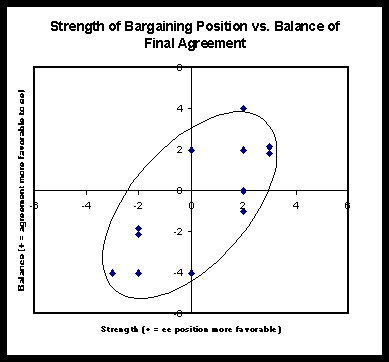
Spearman’s rho nonparametric test: Correlation coefficient = .748, significant at .01 level
(note: Pearson parametric test gives identical results)
Table 38: Coding Bargaining Strength
|
Positive scores indicate strong union bargaining position |
||
Topic |
Scoring | |
| Prevailing wage | In a project controlled by prevailing wage laws, the employee has less to gain by an agreement that lowers employer costs; thus, power shifts to the union. | Project covered by prevailing wage law = +1 No prevailing wage = -1 |
| Multi-union | Agreements requiring multi-trade participation (PLA) likely favor the unions because employer must meet needs of all trades simultaneously. | Project labor agreement (PLA) = +1 Otherwise = 0 |
| Repeat players | The side with repeat experience has upper hand | Union repeat player = +1 Employer repeat player = -1 Neither or both = 0 |
| Experience of negotiators | Experience of negotiators matters. Local-level organizations are less experienced than state-level, who are less experienced than national-level. | Union local = -1 Union regional or state = 0 Union national = +1 Employer local = +1 Employer state = 0 Employer national = -1 |
| Percent of trade unionized (US) | +1 if above national average -1 if below national average |
|
| Workers’ compensation cost relative to all construction | +1 if above average -1 if below average ($6.3/$100) |
Table 39: Coding Agreement Balance
|
Positive scores indicate the item favors the employee. |
||
| Issues | Scoring | |
| Predesignation | Elimination of predesignation indicates restriction on choice available in statutory system. Predesignation is neutral to the system | No predesignation = -1 Predesignation = 0 |
| Medical Provider Restrictiveness | in statutory system, worker is restricted to er choice for 1st 30 days. If worker has er plus ee selected for 1st 30 that is plus. Broad selection but employer determines xx is neutral. Very restricted er is a minus | Employer + union PPO = +1 Employer limited restriction = 0 Employer very restricted = -1 |
| Medical-Legal Provider Restrictiveness | Statutory system has no restriction . | No restriction = +1 Some restriction = 0 very restricted = -1 |
| Ombudsperson Payor | If the employer pays the ombudsperson, it is coded negative, the employee coded positive. Management-labor trust is neutral. | Union pays = +1 m/l joint trust = 0 Employer pays = -1 |
| Mediation | Management-labor committee is less generous than neutral mediator. One party as mediator is bigger problem. | Neutral mediator = +1 Management-labor committee = 0 Mediator chosen by employer = -1 |
| Arbitration | Some arbitrators are selected from rotating agreed list. One carve-out has arbitrator selected by employer representative | Employee selected = +Rotating list = 0 Employer selected = -1 |
| Inclusion of Wrongful Termination (132(a)) and Serious and willful violations under ADR | If not included, workers' chance of recovering is reduced, because these recoveries are attached to claims and would require dual litigation. | 0 if included -1 if excluded |
| Lawyer participation | Restricting legal representation is a loss for employees. | Representation at all levels = +1 No representation at ombudperson stage = 0 No representation at mediation = -1 |
Note: Positive and negative scores are relative to each other, not to the statutory system.
1. Are you employed by:
a. Employer
b. Union
c. Joint Labor Management Trust
d. Other: Please specify
2. Is your primary office on-site or off-site? If off-site, do you have an office onsite where you can meet with workers?
3. Are you employed as an ombudsman on a full-time or part-time basis?
4. Highest Educational Degree
a. high school diploma or equivalence?
b. bachelor's degree? If so, please specify:
c. Master's degree? If so, please specify:
c. professional degree? If so, please specify:
5. Do you belong to any professional membership organizations? If so, what are they:
6. Have you had any specialized training as an ombudsman? If so, please describe: none
7. What is your annual salary, or, if applicable, hourly or per case rate?
Who pays it?
8. If you are an ombudsman on a part-time basis, please describe the rest of your client base:
9. If you are an ombudsman on a full-time basis, is the ombudsman function your only responsibility? If not,
a. What other functions do you perform?
b. What percentage of your overall responsibilities does your ombudsman work entail?
10. Please describe the structure of your office in terms of administrative staff:
11. Do you have a standardized record-keeping system that you use for each case? If so, please describe the information you collect. (Can you provide samples of your forms?)
12. When are you available to discuss matters with injured workers? (Circle all applicable)
a. Mornings
b. Afternoons
c. Evenings
d. All workdays
e. Only certain workdays
f. Weekends
g. Holidays
13. How often do you see injured workers in person?
a. Always
b. Sometimes
c. Rarely
14. Which best describes how you and injured workers get in touch with each other:
a. I contact the injured worker early on, before there is a problem
b. I intervene only when there is a problem or the worker contacts me
15. How many reported case files did you open in:
a. 1995:
b. 1996:
c. 1997
16. When do you open a case file? All injuries? Disabling injuries? All workers who contact you? Or when you are required to take action on a case? Other times?
17. For disabling injuries, do you have information on the date of injuries, date of your intervention and date of final settlement/decision (if it's happened)? If so, can you provide it to us by the end of the year?
a. 1995
b. 1996
c. 1997
18. Is there a specific time limit in which you need to get disputes resolved at your stage? If so, at what point does it start, when does it end, and how much time is allowed?
19. How would you allocate your time as an ombudsman between providing information and resolving disputes?
20. Of the time you work on resolving disputes, what percentage of your time do you work on resolving the following types of disputes: (This should total 100 percent).
a. Injury Date
b. AOE/COE (i.e., whether injury is occupational)
c. Medical
d. Compensation, including permanent disability
e. Lien Claims
f. Apportionment
g. Penalties
21. Please rank from 1 (low) to 9 (high) the following in terms of the frequency of the roles that you perform?
__ a. deciding the dispute
__ b. helping the parties decide their dispute
__ c. determining what the facts are so that someone else can make the decision
__ d. advocate for a party (which one)
__ e. negotiating the settlement of a dispute
__ f. providing information and case management service
__ g. facilitator of general improvements in the carve-out system.
__ h. providing information
__ i. Other (please specify)
22. Which do you think are the three most important functions you perform as an ombudsman?
a.
b.
c.
23. Do you get involved in the return-to-work plan? If so, what is your role?
24. Who actually writes up the return-to-work plan?
25. Have you used your position as ombudsman to change the way carve-outs operate? If so, can you give three examples?
26. Do you provide written information to workers?
If yes, does it describe:
a. The ombudsman's role
b. The larger ADR process
c. Workers' legal rights
d. Other (please specify)
(Do you have a procedures manual that you can send us a copy of?)
27. When is the information provided to the workers?
a. At hiring
b. At post-injury contact
c. Upon request
d. Other
28. How informed would you say the local union officers are about carve-outs?
29. How often do you perceive that an injured worker has consulted with an attorney prior to or during the ombudsman stage?
A. In more than 75 percent
B. Between 50 and 75 percent
C. Between 25 and 50 percent
D. Less than 25 percent
30. Do you tell workers that they may consult an attorney in every case? If so, what do you tell them?
31. How often have you affirmatively recommended that an injured worker consult an attorney?
a. Rarely
b. Sometimes
c. Frequently
32. If so, why?
33. How often does an injured worker ask to have an attorney at the ombudsman stage?
a. Always
b. Sometimes
c. Rarely
34. How often was an attorney actively advising an injured worker through the ombudsman stage?
A. More than 75 percent
B. Between 50 and 75 percent
C. Between 25 and 50 percent
D. Less than 25 percent
35. Would you encourage an injured worker to be represented at:
a. Mediation
b. Arbitration
36. Apart from your encouragement, how often was an attorney representing or actively advising a worker during the mediation stage?
A. More than 75 percent
B. Between 50 and 75 percent
C. Between 25 and 50 percent
D. Less than 25 percent
37. How often was an attorney representing or actively advising a worker during the arbitration stage?
A. More than 75 percent
B. Between 50 and 75 percent
C. Between 25 and 50 percent
D. Less than 25 percent
38. How does the lawyer affect the ADR process in carve-outs?
a) positively
b) negatively
Why?
39. Do you have the authority to direct a worker, employer, insurer or other interested party to take certain actions. If so, please describe.
40. At the beginning at the interview you mentioned that you were employed by trust. How is the independence of your judgment preserved?
41. Have you been pressured by the worker, employer or union to take actions that you felt compromised your independence or the purpose of the program? If so, please explain.
42. Do you try to remain current on legal developments affecting workers' compensation? If so, how?
43. In what percentage of issues do you feel you need to have substantive knowledge of the law to address the matter?
a. More than 75 percent
b. Between 50 and 75 percent
c. Between 25 percent and 50 percent
d. Less than 25 percent
44. In what percentage of issues do you feel you need to have substantive knowledge of medicine to address the matter?
a. More than 75 percent
b. Between 50 and 75 percent
c. Between 25 percent and 50 percent
d. Less than 25 percent
45. Do you handle "serious and willful" claims?
46. Do you handle wrongful termination claims, i.e., 132(a) complaints?
47. What kinds of disputes have you been unable to resolve?
48. How often have you refused to permit a claim to move forward to mediation or arbitration?
a. Rarely, if ever
b. Frequently
c. Almost always
49. How many cases moved to mediation in:
a. 1995
b. 1996
c. 1997
50. How many cases moved to arbitration in: total:
a. 1995
b. 1996
c. 1997
51. Please rank the following in terms of your perception of importance in the selection of the pool of mediators and arbitrators:
a. knowledge of the law
b. medical knowledge
c. knowledge of the mediation, arbitration processes
52. May the same person who served as a mediator serve as an arbitrator in the same case, if the case moves to arbitration?
53. What role, if any, do you play in the mediation process?
a. provide information
b. provide testimony
c. provide records
d. other (please specify):
54. What role, if any, do you play in the arbitration process?
a. provide information
b. provide testimony
c. provide records
d. other (please specify)
55. What kind of a record is available after the arbitration process, if the case is appealed up to the WCAB?
56. A. What is your perception of the workers' comfort level with the overall ADR process?
B. What is your perception of the union's comfort level with the overall ADR process?
C. What is your perception of the employers' comfort level with the overall ADR process?
57. What is your greatest source of frustration about the delivery of ombudsman services?
58. How do you think that this process could be improved?
Other comments:
Allen, Steven, "Declining Unionization in Construction." Industrial and Labor Relations Review 41:343-359. April, 1998.
Association, California Applicants' Attorneys.. "Analysis of the DWC Report, 'The Construction Carve-Out Program'." February 1998.
Auerbach, Jerold S., Justice without law? New York : Oxford University Press. 1983.
Bok, Derek & John, Dunlop. Labor and the American Community. New York: Simon and Schuster. 1970.
Burger, Warren, "Isn’t there a Better Way?," 68 A.B.A. J. 274 (1982)
California Workers' Compensation Institute, "Medical Treatment," CMS #98-2 March 19, 1998. .
Census, U.S. Bureau of the. "Historical Statistics of the United States." Washington, D.C.: U.S. Government Printing Office. Various years.
Census, U.S. Bureau of the. "Statistical Abstract of the United States." Washington, D.C.: U.S. Government Printing Office. Various years.
Commission on the Future of Worker-Management Relations, "Report to Ron Brown Secretary of Commerce." 1994
Council of Economic Advisors. "Economic Report of the President." 1994.
Division of Workers' Compensation, State of California Department of Industrial Relations, "Fundamentals for Applying California Schedule for Rating Permanent Disabilities," Undated.
Division of Workers' Compensation, State of California Department of Industrial Relations, "Schedule for Rating Permanent Disabilities," 1997
Division of Workers' Compensation, State of California Department of Industrial Relations, "The Construction Carve-Out Program: Report of Activities in Calendar Year," September 1996.
Division of Workers' Compensation, State of California Department of Industrial Relations, "The Construction Carve-Out Program," Plotz, John and Neil Maizlish, September 1997
Ernst & Young, LLP, "Supporting Documentation for Treatment Guidelines for Low Back Injuries." June 27, 1996.
Fisher, Roger & Ury, William. Getting to Yes. Boston, Houghton Mifflin, 1981.
Folberg, Rosenberg &. 1994. "Alternative Dispute Resolution: An Empirical Analysis." Stanford Law Review 1487:1487-91.
Gabriel M. Wilner, Gabriel M., ed. Domke on commercial arbitration (The law and practice of commercial arbitration). Wilmette, Ill. 1997
Gadlin, Howard and Pino, Elizabeth Walsh. "Challenges to Neutrality." in Neutrality: What an Organizational Ombudsperson Might Want to Know: The Ombudsman Association. 1997
GAO. 1992. "Workplace Safety and Health Programs Show Promise, Testimony before the House Committee on Education and Labor." in GAO/T-HRD-92-15.
Gellhorn, Walter, Ombudsmen and Others: Citizens' Protectors in Nine Countries, Cambridge, Harvard University Press, 1966.
Goldberg. 1982. "The Mediation of Grievances Under a Collective Bargaining Contract: An Alternative to Arbitration." Nw. U.L. Rev. 270.
Howard, Charles L. & Gulluni Maria A.. "The Ombudsman Confidentiality Privilege: Theory and Mechanics 2." 1996 The Ombudsman Association. Dallas, Texas.
Industrial Medical Council, State of California Department of Industrial Relations,. "Physician's Guide: Medical Practice in the California Worker's Compensation System." 1996.
Institute, Ernst & Young LLP for the California Workers' Compensation.. "Treatment Guidelines for Low Back Injuries: A Qualitative and Quantitative Analysis of the Industrial Medical Council and the Agency for Health Care Policy and Research Low Back Guidelines." June,1996.
J.D. Rosenberg and H.J. Folberg, Alternative Dispute Resolution in a Civil Justice Reform Act Demonstration District: Findings, Implications and Recommendations, University of San Francisco School of Law, 1993
Jeffrey S. Kahana, Reevaluating the Nursing Home Ombudsman's Role with a view Toward Expanding the Concept of Dispute Resolution, J. Disp. Resol. (1994)
Lambros, Thomas. "The Summary Jury Trial." 103 F.R.D. 461 1984..
Lind, E. Allan and Thomas R. Tyler, The Social Psychology of Procedural Justice. New York : Plenum Press. 1988
Margaret, Shaw.. "Selection, Training, and Qualifications of Neutrals in State Courts." CPR Institute for Dispute Resolution. 1994
McGovern, Frances, "Beyond Efficiency: A Bevy of ADR Justifications (An un-footnoted Summary)," 3 Dispute Resolution Magazine 12-13 (1997)]
"Mini-Trails: Opportunities for Compromise, 51 Tex. B.J. 34." 1988..
Mnookin, Robert and Tony Kornhauser, "Bargaining in the Shadow of the Law," 88 Yale L.J. 950 (1979).
Moore, Christopher W. editor, Practical Strategies for the Phases of Mediation, San Francisco: Jossey-Bass. 1987.
Moscowitz, E. & Van Bourg, V. 1995. "Carve-outs and the Privatization of Worker's Compensation in Collective Bargaining Agreements." Syracuse Law Review 46:1-60.
Neuhauser, Frank and Andrew Koehler, "Evaluating the Reforms of the Medical-Legal Process Using the WCIRB Permanent Disability Survey." The Commission on Health and Safety and Workers' Compensation . 1996
Neuhauser, Frank and Andrew Wiegand, "Evaluating the Reforms of the Medical-Legal Process Using the WCIRB Permanent Disability Survey." The Commission on Health and Safety and Workers' Compensation . 1997
Ozurovich, M. 1995. Pitfalls in collective bargaining can cause serious harm to injured workers and their unions. LRP Publications, 1995.
Peterson, M.A.; Reville, R.T.; Stern, R.K.. "Compensating Permanent Workplace Injuries: A Study of the California System." RAND . 1997
Plous, Scott. 1993. The Psychology of Judgement and Decision-making." New York. McGraw-Hill, 1993.
Posner. 1986. "The Summary Jury Trial and Other Alternative Methods of Dispute Resolution: Some Cautionary Observations." 53 U. Chic.L.Rev. 366 .
Raven, Robert, "Alternative Dispute Resolution: Expanding Opportunities," 43 Arbitration Journal 44 (1988)
Reuben, Richard C. 1997. "Public Justice: Toward a State Action Theory of Alternative Dispute Resolution." California Law Review 85.
Reuben, Richard, C. "The Lawyer Turns Peacemaker," ABA Journal, 54 (Aug.) 1996.
Reville, Robert T., "The Impact of Permanently Disabling Workplace Injury on Labor Force Participation and Earnings," in Lane, Julia, ed. "The Creation and Analysis of Linked Employer-Employee Data, Contributions to Economic Analysis," Elsevier Sciences, North-Holland. 1999.
Riskin, Leonard L. 1984. "Toward New Standards for the Neutral Lawyer in Mediation." Arizona Law Review 26:329.
Riskin, Leonard L. 1997. "Mediation Training Guide." Pp. 340-341 in Dispute Resolution and Lawyers, edited by James Westbrook.
Riskin, Leonard L., "Mediation and Lawyers," 43 Ohio St. L.J. 29 (1982)
Rogers, Nancy and Craig McEwen,. "Mediation Law, Policy, Practice." Pp. Chapter 10 . Rochester, N.Y. : Lawyers Co-operative Pub. Co. San Francisco, Calif. Bancroft-Whitney, 1989.
Rosenber, J.D. & Folberg, H.J. 1993. "Alternative Dispute Resolution in a Civil Justice Reform Act Demonstration District: Findings, Implications and Recommendations." University of San Francisco School of Law.
Rowat, Donald Cameron. The Ombudsman, Citizen's Defender., Edited by Donald C. Rowat. London, Allen & Unwin. 1965.
Schultz, K.D.. "Florida's Alternative Dispute Resolution Demonstration Project: An Empirical Assessment", Florida Dispute Resolution Center. 1990
Simon, William, "Informality and Redistributive Politics," 19 Clearinghouse Review 384 (1985)
SPIDR Commission on Qualification, Report at the Annual Meeting BNA/ADR, Report No. 392. 1988.
Sum, Juliann. "Navigating the California Workers' Compensation System: Injured Workers' Experience, An Evaluation of Services to Inform and Assist Injured Workers in California." Labor Occupational Health Program, University of California, Berkeley. . July 1997
Tyler, Thomas R., Why People Obey the Law, New Haven: Yale University Press. 1990.
U.S. Department of Labor, Occupational Health and Safety Agency, "Reinventing OSHA", U. S. Government Printing Office, 1995.
U.S. Department of Labor, Occupational Health and Safety Agency, "Review and Analysis of State-Mandated and other Worker Protection Programs," U. S. Government Printing Office, June 1995
U.S. Department of Labor, Occupational Health and Safety Agency, "Oregon Safety Committees Touted." September 1993
U.S. Department of Labor. 1991. "Employment, Hours, and Earnings, United States 1909-1990." Washington, D.C.: U.S. Government Printing Office.
Welch, Edward, ed. "On Workers' Compensation." Newsletter, Vol. 7:1. February 1998
Workers' Compensation Executive, Vol. 8, No. 10. May, 27,1998.
Workers' Compensation Insurance Rating Bureau "Annual Report: Workers Compensation Losses and Expenses," 1996 1997, 1998.
Workers' Compensation Insurance Rating Bureau. "California Workers' Compensation Unit Statistical Plan." 1993.
Workers' Compensation Insurance Rating Bureau. "WCIRB Bulletin No, 99-01", March 16, 1999.
Cases Cited:
Alexander v. Gardner-Denver Co., 415, U.S. 36. 1974.
Buckley v. Gallo Sales Corp., 949 F. Supp. 737 (1997)
Gilmer v. Interstate Johnson-Lane Corp., 500 U.S. 20 (1991)
Moore v. Local 569 of the International Brotherhood of Electrical Workers, 53 F. 3d 1054 (1995)
Rex A. Minniear vs. Mt. San Antonio Community College District, WCAB No. SBR 257801 61 Cal. Comp. Cases 1055.
Tony Costa vs. WCAB, et. al., Case No G022181, Court of Appeal, Fourth Appellate District, Division Three.
Wright v. Universal Maritime, 97-889 119 S. Ct 391, 1998.