Welcome to the Department of Industrial Relations
IBuiltIt.org logo - California Apprenticeship

Health Care Construction - Public Private Partnership button

director's award image image
DIRECTOR'S AWARD
for Excellence in Supporting Women in the Building Trades

Caltrans-DIR contruction skilled labor workforce initiative image

Veteran image

Director's Advisory Committee on Public Works - Logo
Overview of DAS

Division of Apprenticeship Standards (DAS) mission

Division of Apprenticeship Standards (DAS) creates opportunities for Californians to gain employable lifetime skills and provides employers with a highly skilled and experienced workforce while strengthening California's economy.

The Division of Apprenticeship Standards (DAS) carries out this mission by administering California apprenticeship law and enforcing apprenticeship standards for wages, hours, working conditions and the specific skills required for state certification as a journeyperson in an apprenticeable occupation. DAS promotes apprenticeship training through creation of partnerships, consults with program sponsors and monitors programs to ensure high standards for on-the-job training and supplemental classroom instruction. Through this effort, the retiring skilled workforce is replenished with new skilled workers to keep California's economic engine running strong.

DAS annually awards completion certificates to the graduates of the 611 currently active apprenticeship programs in more than 500 occupations. DAS goals are two-fold: to match the needs of workers-for the skills to get and keep a decent paying job-with those of employers-for motivated workers with the skills to do the job; and to strengthen the apprenticeship alliance among industry, labor, education and government for recruiting workers and teaching the skills they and their employers need.

Professional staff of the division establishes new apprenticeship programs in any of the 800 recognized apprenticeable occupations. DAS works with the apprenticeship program sponsors and monitors their on-the-job training coupled with related instruction to ensure the high standards set by the division.

The foundation of California's apprenticeship system

California's apprenticeship system is a partnership among industry, labor, education and government.
Industry funded and industry driven, the apprenticeship system provides an effective balance between learning by doing and theoretical instruction, and developing workers with marketable skills.
California's industries and employers voluntarily sponsoring or participating in an apprenticeship program find this system of training efficient and cost effective because it eliminates expensive recruitment programs for people who are already trained, creates a diversified and flexible pool of employees with desired skills, and reduces costs of high labor turnover.

Employees show high morale and company loyalty when an apprenticeship program offers upward mobility through career development, and adapts to include training for new skills in demand by industry.

Consulting locally on new apprenticeships

From offices around the state, DAS consultants work locally with employers-and their collective bargaining partners where applicable-to develop new apprenticeship programs, determining the length of training and specific skills necessary to perform at the level required in the occupation. They help the new program sponsors locate and make arrangements with local education agencies to provide the classroom instruction that augments the on-the-job training.

DAS consultants can also help new sponsors with the standards for their program operation, as well as apprentice registration procedures, a wage progression for apprentices, and completing the elements comprising apprenticeship program standards. They arrange for payment of veterans training benefits to eligible apprentices, and assist in outreach activities to attract apprentice applicants.

Apprentices 2002 2003 2004 2005 2006
Total 66,934 71,171 72,822 73,920 68,502
Non-minority 30,392
(45.4%)
31,230
(43.9%)
30,832
(42.3%)
29,773
(40.3%)
27,682
(40.4%)
Minority 36,542
(54.6%)
39,941
(56.1%)
41,990
(57.7%)
44,147
(59.7%)
40,820
(59.6%)
Women 4,973
(07.4%)
5,364
(07.5%)
4,924
(06.8%)
4,511
(06.1%)
3,064
(04.4%)

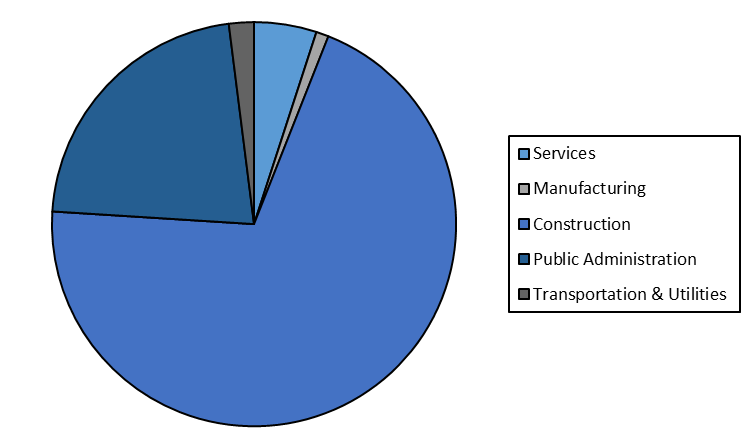
California Apprentices by Industry

  • Services 3%
  • Manufacturing 1%
  • Construction 79%
  • Public Administration 14%
  • Transportation &
  • Utilities 3%

Just about 70,000 apprentices in California are maintaining a time-honored system that has proved adaptable to change. As some traditional jobs disappear, new high-tech and service jobs take their place, and California's apprentices are achieving a higher level of skills than ever before to earn a living in the global marketplace.

Keeping track

The division's Program Planning and Review Unit reviews all new and revised apprenticeship program standards for compliance with California apprenticeship law. The Records Unit fulfills a vital role as centralized record keeper for active apprentices statewide, in addition to graduates in the last 20 years or more.
DAS also provides statistical reports to the federal Apprenticeship Training, Employer and Labor Services, the U.S. Veterans Administration and other interested parties.

Auditing to maintain high standards

Recent legislation strengthens the regulation of apprenticeship programs in California by providing for audits of DAS-approved programs to ensure they meet the high standards necessary for preparing apprentices for the workplaces of the future, and to prevent apprentice exploitation by employers or program sponsors.

Public works enforcement

DAS verifies apprentice registration and status, and enforces requirements of Labor Code Section 1777.5 mandating employment of apprentices on all public works projects. DAS monitors these projects by investigating the complaints filed with the division. When an investigation reveals a violation of the law, DAS may assess a civil penalty or debarment for up to three years, depending upon the seriousness or recurrence of the violation.

The DAS Public Works team has assessed penalties in more cases in the first quarter of 2007 than was previously done in all of 2005 and 2006.

Year

Cases Assessed

Dollars Assessed

2005

16

$ 56,590

2006

16

$ 79,075

2007 1st Qtr

25

$116,200

The Public Works team has also participated in public forums to help contractors and contract compliance organizations better understand apprenticeship-related requirements in the labor code.

Training fund created by legislation

Assembly Bill 2481 (Romero) revised statutes on collection and distribution of apprenticeship training contributions received from employers on public works projects.

DAS collects training contributions and deposits them into a new Apprenticeship Training Contribution Fund at the end of each fiscal year. The division distributes grant funds to approved apprenticeship programs in the craft and geographic area each serves.

Apprentice complaints

The division's Investigations Unit also handles complaints or appeals filed by apprentices regarding their program sponsors. Following conclusion of investigations and hearings, a formal determination is issued by the administrator of apprenticeship, DIR's director. From Jan. 1, 2006, to Dec. 31, 2006, the division received 26 complaints from apprentices who charged that actions by their program sponsors were unfair or unreasonable, ranging from selection procedures to dismissal from a program. Of these cases, 19 have been closed by dismissal for lack of merit, withdrawn by the complainant or gone to hearing and were settled. None of the cases were appealed to the California Apprenticeship Council. The remaining cases are still under investigation.

Contributing to One-Stop Centers

California's apprenticeship system is one link of the California Workforce Investment Board's (CWIB) federal Workforce Investment Act (WIA) One-Stop Centers located throughout the state. The centers provide a full range of services for job seekers and employers. CWIB staff is working with DAS, the California community colleges and Department of Education to link apprenticeship programs with training and services offered through the one-stop system.

Veterans - Learn, earn and collect

DAS offers a unique opportunity for veterans. DAS is authorized by the federal Department of Veterans Affairs to administer the Montgomery GI Bill benefit for veterans participating in an apprenticeship program or on-the-job (OJT) training program. This allows an eligible veteran the unique opportunity to earn a living, learn a lifelong career skill and collect their GI bill benefit.
The federal/state partnership dates back to the GI Bill of Rights signed into law in 1944. In its advocacy role the division is responsible for:

  • Program approval, evaluating the training quality according to state and federal criteria, revising to remain current with rapid technology changes and school-to-work programs
  • Facility oversight, classroom and training center visits to determine compliance with state and federal regulations and evaluate new programs
  • Liaison, acting as the state liaison between military installations and schools, employers, labor groups and state veterans organizations to provide information and promote GI Bill use
  • Contract management, establishing a plan of operation, performance standards and employee qualification standards to ensure effectiveness, and providing required reports

Electrician certification program

Assembly Bill (AB) 931, signed by the governor in October 1999, required the DAS to establish and validate minimum standards for the competency and training of electricians who are or work under a licensed C-10 electrical contractor. The electrician certification program is the result of that requirement. The classifications include general and residential electricians, fire/life/safety, voice/data/video and non-residential lighting technicians.
Electricians required to be certified number close to 70,000. Of those, over 65,000 have fulfilled the legal requirements to work in the state of California. Efforts are being made to ensure all electricians come into compliance.

Rosie the Riveter leaves legacy for tradeswomen

Promoting women's participation in construction trade apprenticeships is the goal of a coalition of labor and government groups, including DAS, as they plan events aimed at local high school girls and community college women. One event was a celebration at the newly-dedicated Rosie the Riveter Memorial in Richmond, California.

Dedicated in October 2000 during a ceremony that attracted 100 Rosies, the Rosie the Riveter memorial honors those six million women who, during World War II, traded in their pots, pans and brooms for wrenches and welding rods to support the defense industry. The Kaiser shipyards in Richmond served as a magnet for the migration of women from home to workplace.

This memorial, the only one in the nation honoring women's contributions to the World War II home front, helps illuminate the lives of defense industry workers such as Katie Grant. She moved with her husband and infant daughter from Oklahoma to California in 1943 to pack fruit before ending up at the Richmond shipyards while her husband served in the Pacific with the Marines.

"I worked the graveyard shift 12-8 a.m. in the shipyard," Grant wrote in a short memoir. "I took classes on how to weld. I had leather gloves, leather pants, big hood, goggles and a leather jacket. They said you weld like you crochet. They put me 40 feet down in the bottom of the ship to be a tacker. I filled the long seams of the cracks in the ship corners full of hot lead and then brushed them good and you could see how pretty it was. The welders would come along and weld so it would take the strong waves and deep water and heavy weight. I liked it pretty good."
The celebration began a statewide campaign to increase the number of women in construction trades apprenticeships and coincided with Women's History Month. Along with guided tours of the monument, the event offered apprenticeship information booths and hands-on demonstrations in welding, heavy equipment operation and ironwork. A program featured Rosies, tradeswomen and the premiere of an oral history film about women employed in the defense industries during World War II.
The celebration was sponsored by Tradeswomen Inc., Contra Costa Central Labor Council, City of Richmond, State Building and Construction Trades Council of California, the Department of Industrial Relations and DAS, the Employment Development Department and Richmond Works, One Stop Downtown, U.S. Department of Labor Women's Bureau Region IX, Glaziers Local 718 and the law firm of Kazan, McClain, Edises, Simon and Abrams.

Apprenticeship in the United States

California is one of 27 states who set their own standards for apprenticeship. California has significantly higher standards for apprenticeship than the Department of Labor.

  • California with 70,000 apprentices is significantly larger than the next largest states of New York and Illinois with 20,000 and 18,500 respectively.
  • There are 150,000 construction trade apprentices in the country, California has 52,300.

On the Internet from DAS: http://www.dir.ca.gov/apprenticeship.html

  • notice of public meetings
  • Apprenticeship Information Guide
  • public works apprenticeship committees directory
  • public works forms
  • electrical certification program information
  • frequently asked questions
  • School-to-Career/A Guide for Educators
  • orientation to apprenticeship resource guide
  • governor's proclamation honoring California
  • testimonials
  • Title 8 regulations
  • Annual Report on Activities to the Legislature and the Public
  • office locations statewide