



 Heat Illness Prevention
Training Elements of Your Written Program and Effective Work Practices
What is in T8CCR 3395?
T8CCR 3395(h) Training states the following:
(h) Training.
- (1) Employee training.
Effective training in the following topics shall be provided to each supervisory and non-supervisory employee before the employee begins work that should reasonably be anticipated to result in exposure to the risk of heat illness:- (A) The environmental and personal risk factors for heat illness, as well as the added burden of heat load on the body caused by exertion, clothing, and personal protective equipment.
- (B) The employer's procedures for complying with the requirements of this standard, including, but not limited to, the employer's responsibility to provide water, shade, cool-down rests, and access to first aid as well as the employees' right to exercise their rights under this standard without retaliation.
- (C) The importance of frequent consumption of small quantities of water, up to 4 cups per hour, when the work environment is hot and employees are likely to be sweating more than usual in the performance of their duties.
- (D) The concept, importance, and methods of acclimatization pursuant to the employer's procedures under subsection (i)(4).
- (E) The different types of heat illness, the common signs and symptoms of heat illness, and appropriate first aid and/or emergency responses to the different types of heat illness, and in addition, that heat illness may progress quickly from mild symptoms and signs to serious and life threatening illness.
- (F) The importance to employees of immediately reporting to the employer, directly or through the employee's supervisor, symptoms or signs of heat illness in themselves, or in co-workers.
- (G) The employer's procedures for responding to signs or symptoms of possible heat illness, including how emergency medical services will be provided should they become necessary.
- (H) The employer's procedures for contacting emergency medical services, and if necessary, for transporting employees to a point where they can be reached by an emergency medical service provider.
- (I) The employer's procedures for ensuring that, in the event of an emergency, clear and precise directions to the work site can and will be provided as needed to emergency responders. These procedures shall include designating a person to be available to ensure that emergency procedures are invoked when appropriate.
- (2) Supervisor training.
Prior to supervising employees performing work that should reasonably be anticipated to result in exposure to the risk of heat illness effective training on the following topics shall be provided to the supervisor:- (A) The information required to be provided by section (h)(1) above.
- (B) The procedures the supervisor is to follow to implement the applicable provisions in this section.
- (C) The procedures the supervisor is to follow when an employee exhibits signs or reports symptoms consistent with possible heat illness, including emergency response procedures.
- (D) How to monitor weather reports and how to respond to hot weather advisories.
Guidance, Best Practices and Warnings
Importance of Training
Cal/OSHA investigations (Study 2) showed that in 2006, in workplaces where heat illness occurred:- 92% did not address all the required training elements of the Cal/OSHA Heat Illness Prevention Standard (T8 CCR Section 3395)
- 75% did not have training on acclimatization
- 57% of supervisors were not trained (in fatal cases that occurred)
- 35% of supervisors were not trained (in non-fatal cases that occurred)
- A lack of training on early signs and symptoms (e.g., weakness, nausea,
muscle cramps) lead to delayed recognition and reporting of heat illness.
This caused:
- progression to more serious symptoms(e.g., fainting, seizures, disorientation, high internal body temperatures)
- increased diffic illness
- the need for immediate medical attention and treatment
Cal/OSHA investigations showed that in 2005 that none of the victims of heat illness had any workplace training on acclimatization.
Training of employees and supervisors is extremely important for the prevention of heat illness at workplace. Employers need to train employees and supervisors in their heat illness prevention plans and procedures.
Effective Training
- Employers must train all employees, both supervisory and non-supervisory, on the policies and procedures related to heat illness prevention as required for their workplaces.
- Training must be provided before the beginning of work involving a risk of heat illness. Training that is given close in time to the hot season is more effective than training given during colder seasons without follow-up refresher training.
- To be effective, training must be understood by employees and given in a language the employees understand.
- Employers must ensure that their work procedures are consistent with the information provided in the training.
- Maintain records of the training
Best Practices
Effective Training
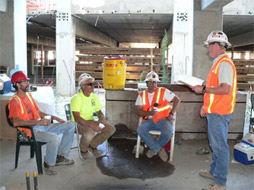
Effective training is a key in the prevention, recognition, and response to heat illness. To assist you in developing and conducting training for your employees and supervisors the following information is provided:
- When to Train
- How to Train Effectively
- Checking for Understanding
When to Train
Cal/OSHA investigations showed that:
- 46% of the reported cases of heat illness occurred on the employee's first day on the job
- 80% of the reported cases of heat illness occurred within the first four days of employment
- None of the victims of heat illness had any workplace training on acclimatization
All workers and supervisors must be fully trained on all aspects of heat illness prevention, recognition and response before they are assigned to work in locations where they are at risk. Refresher training should be provided as needed. Training should be re-enforced by having a designated person hold daily short tailgate meetings to review information including but not limited to:
- the weather
- job location
- heat illness prevention and response
- reminders to drink water frequently
- noticing and immediately reporting the signs and symptoms of heat illness
- the availability of shade upon request
- acclimatization
- procedures to follow during high heat and a heat wave
- emergency response procedures
When high heat occurs or is anticipated, employers need to alert workers and supervisors prior to the work shift of the potential increase in temperature, impact of high heat on the body, and any adjustments in work activities and scheduling that are needed.
How to Train Effectively
Effective training communicates information in a language and by a method understandable to all employees and supervisors. Information should be specific to employees' and supervisors' actual work conditions and activities. To increase effectiveness repeat training as needed and hold short tailgate meetings before each workday.
To increase training effectiveness, use training techniques and aides including:
- discussions on real life examples of heat illness incidents
- question and answer sessions where employees and supervisors share their experiences
- eTools
- posters
- pictures
- pamphlets
- paycheck stuffers
- videos
- audios
- practical demonstrations
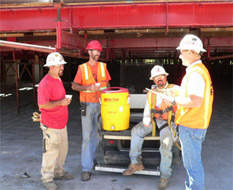
Checking for Understanding
Always make sure that the employees and supervisors understand the information provided to them in trainings. Once trained, check to see if they have understood and put into practice the information they received. You can do this in a number of ways including:
- asking for feedback on the material
- having employees demonstrate safe work practices
- holding question and answer sessions
- providing opportunities to practice and discuss new learning
- using worksite observations
Based on input from employees and supervisors and your observations, periodically review and update your training programs as necessary to maintain their effectiveness.