Group 16. Control of Hazardous Substances
Article 107. Dusts, Fumes, Mists, Vapors and Gases
| Return to index New query |
§5155. Airborne Contaminants, Appendix to Section 5155
(A) Computation for Exposures to Contaminants with Independent Health Effects.
The 8-hour time-weighted average concentration (TWA) of a single substance to which an individual is exposed during a workday shall be calculated using the following formula to determine compliance with the PEL specified in Table AC-1.
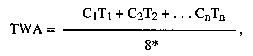
where T is the duration in hours of the exposure to a substance at the concentration C. For multiple
substances with independent health effects, an independent comparison of each TWA with the corresponding
PEL shall be made to determine compliance.
*Note: Eight (8) is used as denominator regardless of total hours of workday.
EXAMPLE: To illustrate the use of this formula, assume Substance A has an 8- hour time weighted average permissible exposure limit of 100 ppm noted in Table AC-1 and an employee is exposed to an airborne concentration of Substance A of 150 ppm for 2 hours, 75 ppm for 3 hours, and 50 ppm for 4 hours during a 9-hour workday:
TWA = [(150 x 2) + (75 x 3) + (50 x 4)]/8* = 91 ppm.
The series of exposures in this example are equivalent to an 8-hour exposure at a concentration of 91 ppm which is below the PEL value of 100 ppm specified for Substance A.
(B) Computation for Exposures to Contaminants with Additive Health Effects.
In the absence of information to the contrary, the adverse health effects of exposure to two or more toxic materials during the workday shall be considered additive and the following formula shall be used for calculating D, the fraction of the allowable daily exposure.

where TWA is the time-weighted average concentration of a particular substances involved in the exposure
(as calculated by the formula in Section (A) of this Appendix), and PEL is the corresponding permissible
exposure limit for that substance as specified by Table AC-1. The value of D shall not exceed unity.
Example : To illustrate the use of this formula, consider the following exposures:
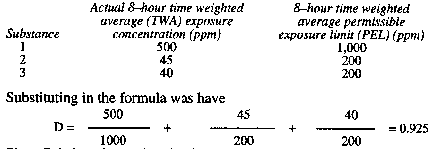
Since D is less than unity (1), the exposure to multiple contaminants is within acceptable limits.
Health effects for multiple contaminants are not considered additive when different organs of the body
are affected by individual substances, or where the same effect (such as narcosis) is produced by two
substances but the PEL for one substance is based on another effect. For example, vinyl chloride and
toluene can both cause narcotic effects, however, the PEL for vinyl chloride is established to protect
against cancer while the PEL for toluene is established to protect against non-carcinogenic effects.
Table AC-1
PERMISSIBLE EXPOSURE LIMITS FOR CHEMICAL CONTAMINANTS
Note: Authority cited: Section 142.3, Labor Code. Reference: Sections 142.3 and 144.6, Labor Code.
HISTORY
1. Editorial correction of printing errors (Register 84, No. 4). For prior
history, see Register 83, No. 45.
2. Amendment of Table AC-1 filed 3-8-84; effective thirtieth day thereafter (Register 84, No. 10).
3. Amendment of Tables AC-2 and AC-3 filed 8-30-84; effective thirtieth day thereafter (Register 84, No. 35).
4. Amendment of Table AC-2 filed 9-26-84; effective thirtieth day thereafter (Register 84, No. 39).
5. Amendment of Table AC-3 filed 12-13-84; effective thirtieth day thereafter (Register 84, No. 50).
6. Amendment of Table AC-1 filed 1-16-85; effective thirtieth day thereafter (Register 85, No. 3).
7. Editorial correction of printing error of mppcf designation for Talc (fibrous, nonfibrous and mixtures) in Table AC-3 (Register 85, No. 12).
8. Amendment of Table AC-1 and footnote (j) filed 11-21-86; effective thirtieth day thereafter (Register 86, No.47).
9. Amendment of subsection (c), (d), (f), Tables AC-1, AC-2 and AC-3 filed 2-3-87; effective thirtieth day thereafter (Register 87, No. 6).10. Amendment filed 7-26-90; operative 8-25-90 (Register 91, No. 1).
11. Amendment of Table AC-1 and footnotes to Table AC-1 filed 11-21-90; operative 12-21-90 (Register 91, No. 1).
12. Editorial correction of graphic correcting spelling of Beryllium and adding measurements omitted (Register 91, No. 23).
13. Amendment of Table AC-1 and Note filed 4-7-92; operative 5-7-92 (Register 92, No. 14).
14. Editorial correction of printing error repositioning Grain dust (Register 92, No. 34).
15. Amendment of Table AC-1 filed 3-3-93; operative 4-2-93 (Register 93, No. 11).
16. Amendment of Table AC-1 filed 4-30-93; operative 5-31-93 (Register 93, No. 18).
17. Change without regulatory effect amending Table AC-1 Formaldehyde filed 12-7-94 pursuant to section 100, title 1, California Code of Regulations (Register 94, No. 49).
18. Amendment of subsections (a)(2) and (c)(2)(B) and Table AC-1 filed 4-3-95; operative 5-3-95 (Register 95, No. 14).
19. Editorial corrections (Register 95, No. 24).
20. Change without regulatory effect amending Table AC-1 filed 6-12-95 pursuant to section 100, title 1, California Code of Regulations (Register 95, No. 24).
21. Change without regulatory effect amending Table AC-1 filed 6-29-95 pursuant to section 100, title 1, California Code of Regulations (Register 95, No. 26).
22. Editorial correction repositioning "Particulates not otherwise regulated" (Register 95, No. 35).
23. Amendment of Table AC-1 (1,3 Butadiene) filed 5-29-97; operative 8-27-97 (Register 97, No. 22).
24. Amendment of Table AC-1 (methylene chloride) filed 8-4-97; operative 11-2- 97 (Register 97, No. 32).
25. Change without regulatory effect amending Table AC-1 (silver) filed 1-6-98 pursuant to section 100, title 1, California Code of Regulations (Register 98, No. 2).
26. Change without regulatory effect amending table AC-1 filed 2-16-2000 pursuant to section 100, title 1, California Code of Regulations (Register 2000, No. 7).
27. Change without regulatory effect repealing Appendix footnote (q) filed 6- 27-2000 pursuant to section 100, title 1, California Code of Regulations (Register 2000, No. 26).
28. Editorial correction of placement of appendix footnote (h) reference (Register 2000, No. 51).
29. Change without regulatory effect amending subsection (c)(1)(B) and amending appendix filed 12-21-2000 pursuant to section 100, title 1, California Code of Regulations (Register 2000, No. 51).
30. Amendment of Table AC-1 filed 1-4-2001; operative 2-3-2001 (Register 2001, No. 1).
31. Editorial correction of Table AC-1, entries for styrene, sulfometuron methyl and 4-vinyl cyclohexene (Register 2001, No. 24).
32. Change without regulatory effect amending Table AC-1 entry for dicyclohexylmethane-4,4i-diisocyanate filed 7-19-2001 pursuant to section100, title 1, California Code of Regulations (Register 2001, No. 29).
33. Editorial correction of Table AC-1, entries for aluminum alkyls, 4,4'-diaminobiphenyl, 2,6-Di-tert-butyl-p-cresol, rubber solvent, TEPP and tetramethyl thiuram disulfide (Register 2001, No. 49).
34. Change without regulatory effect amending appendix and Table AC-1 filed 1-17-2002 pursuant to section 100, title 1, California Code of Regulations (Register 2002, No. 3).
35. Amendment of Table AC-1 filed 10-1-2004; operative 10-31-2004 (Register 2004, No. 40).
36. Amendment of Table AC-1, including new footnote (s), filed 10-4-2004; operative 11-3-2004 (Register 2004, No. 41).
37. Amendment of Table AC-1, including new footnotes (t) and (u), filed 6-6-2006; operative 7-6-2006. (The ceiling limit of 0.05 ppm for Glutaraldehyde will take effect 7-6-2008) (Register 2006, No. 23).
38. Editorial correction of Table AC-1, Beryllium and Methyl 2-cyanoacrylate (Register 2006, No. 29).
39. Amendment of subsection (a)(2) and amendment of Table AC-1 filed 9-19-2006; operative 9-19-2006. Submitted to OAL for printing only pursuant to LaborCode section 142.3(a)(3) (Register 2006, No. 38).
40. Editorial correction of Table AC-1 - Methyl chloride (Register 2007, No. 32).
41. Change without regulatory effect repealing Table AC-1 footnote u filed 9- 23-2008 pursuant to section 100, title 1, California Code of Regulations (Register 2008, No. 39).
42. Editorial correction of Table AC-1, footnote (k) (Register 2009, No. 21).
43. Amendment of Table AC-1 and footnotes (n) and (q) and new footnote (u) filed 2-3-2010; operative 8-3-2010 (Register 2010, No. 6).
44. Change without regulatory effect amending Table AC-1 filed 5-31-2011 pursuant to section 100, title 1, California Code of Regulations (Register 2011, No. 22).
45. Change without regulatory effect amending Table AC-1, footnote (n) filed 1-24-2012 pursuant to section 100, title 1, California Code of Regulations (Register 2012, No. 4).
46. Amendment of Table AC-1 filed 2-16-2012; operative 3-17-2012 (Register 2012, No. 7).
47. Editorial correction of Table AC-1 (Register 2012, No. 37).
48. Amendment of Table AC-1, entry for ethylbenzene, filed 8-27-2013; operative 10-1-2013 (Register 2013, No. 35).
49. Editorial correction of Table AC-1 entry for 1,2-Dibromoethane (Register 2013, No. 50).
50. Amendment of Table AC-1 adding new entry for N-Methylpyrrolidone filed 1-7-2014; operative 4-1-2014 (Register 2014, No. 2).
51. Amendment of Table AC-1 entry for naphthalene filed 6-24-2014; operative 10-1-2014 (Register 2014, No. 26).
52. Amendment of Table AC-1 entry for hydrogen chloride filed 11-26-2014; operative 1-1-2015 (Register 2014, No. 48).
53. Amendment of Table AC-1 filed 10-17-2016; operative 10-17-2016. Submitted to OAL for filing and printing only pursuant to Labor Code section 142.3(a)(3) (Register 2016, No. 43).
54. Editorial correction of Table AC-1 (Register 2017, No. 12).
55. Amendment of Table AC-1 (entries for Wood dust and Wood dust, Western red cedar) filed 4-4-2017; operative 7-1-2017 (Register 2017, No. 14).
56. Amendment of Table AC-1 (entry for beryllium) filed 10-2-2017; operative 10-2-2017 pursuant to Labor Code section 142.3. Submitted to OAL for filing and printing only pursuant to Labor Code section 142.3(a)(4) (Register 2017, No. 40).
 Go
Back to Article 107 Table of Contents
Go
Back to Article 107 Table of Contents